Lester Freeman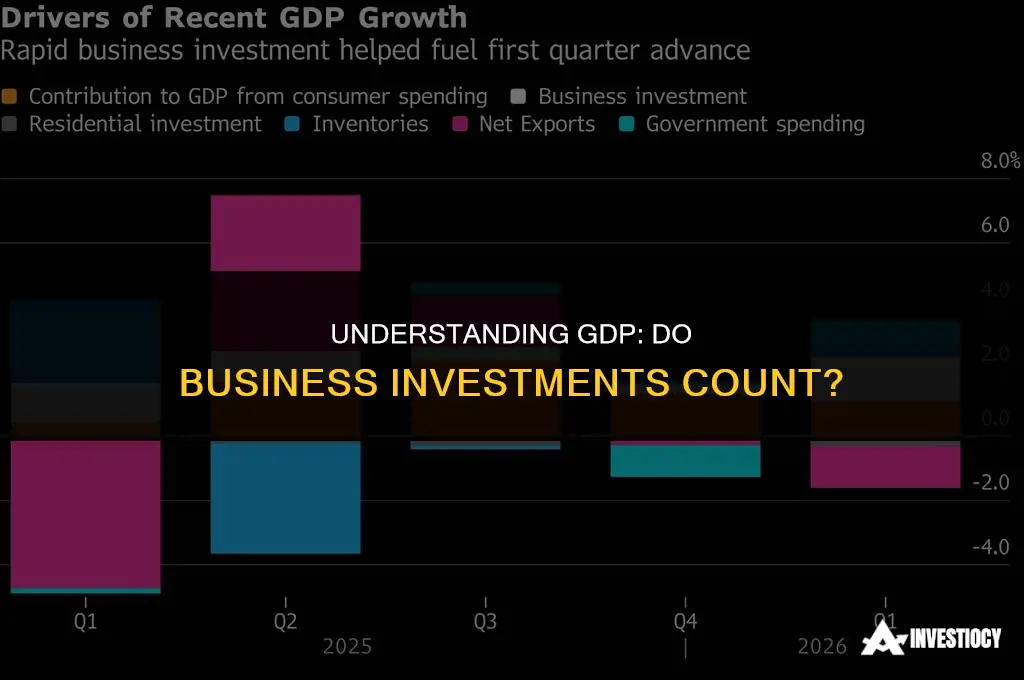
Business investments are a crucial component of a country's Gross Domestic Product (GDP). GDP represents the total value of goods and services produced within a nation's borders over a specific period, typically a year. Business investments, which include expenditures on capital goods such as machinery, equipment, and buildings, contribute significantly to GDP by increasing the productive capacity of the economy. These investments not only enhance the efficiency and output of businesses but also stimulate economic growth by creating jobs and fostering innovation. Understanding the role of business investments in GDP is essential for policymakers, economists, and business leaders as they make decisions that impact national and global economic health.
| Characteristics | Values |
|---|---|
| Definition | Business investments refer to the spending by businesses on capital goods, such as machinery, equipment, and buildings, which are used to produce other goods and services. |
| Inclusion in GDP | Yes, business investments are included in the Gross Domestic Product (GDP) as they represent a significant portion of the economy's productive capacity. |
| Types of Investments | Fixed investments (e.g., machinery, buildings), Inventory investments (e.g., raw materials, finished goods), Intellectual property investments (e.g., patents, copyrights). |
| Importance | Business investments are crucial for economic growth as they increase productivity, create jobs, and stimulate innovation. |
| Measurement | Business investments are typically measured in monetary terms, such as dollars or euros, and are aggregated to calculate their contribution to GDP. |
| Data Sources | National statistical agencies, such as the Bureau of Economic Analysis (BEA) in the United States, collect and report data on business investments. |
| Frequency of Data Collection | Data on business investments is usually collected and reported on a quarterly or annual basis. |
| Impact on GDP Growth | Business investments can have a significant impact on GDP growth, as they contribute to the expansion of the economy's productive capacity. |
| Relationship with Consumption | Business investments are often seen as a complement to consumption, as they help to produce the goods and services that consumers demand. |
| Government Influence | Governments can influence business investments through policies such as tax incentives, subsidies, and regulations. |
| Global Perspective | Business investments are a key component of global economic activity, with countries competing to attract investments to boost their economic growth. |
| Challenges | Measuring the exact impact of business investments on GDP can be challenging due to factors such as depreciation and the complexity of global supply chains. |
Explore related products


$5.82 $16.99




What You'll Learn
- Definition of GDP: Understanding what constitutes Gross Domestic Product and its relevance to business investments
- Types of Investments: Exploring various forms of business investments and their impact on GDP growth
- Economic Indicators: Analyzing how business investments influence key economic indicators within GDP calculations
- Government Policies: Examining the role of government policies in encouraging or discouraging business investments affecting GDP
- Case Studies: Real-world examples illustrating the relationship between business investments and GDP in different countries

Definition of GDP: Understanding what constitutes Gross Domestic Product and its relevance to business investments
Gross Domestic Product (GDP) is a critical economic indicator that measures the total value of goods and services produced within a country's borders over a specific period, typically a year. It is a comprehensive metric that encompasses various aspects of economic activity, including consumption, investment, government spending, and net exports. Understanding the components of GDP is essential for businesses and investors as it provides insights into the overall health and growth potential of an economy.
In the context of business investments, GDP includes expenditures on capital goods such as machinery, equipment, and buildings. These investments are crucial for enhancing productivity and expanding production capacity. By analyzing GDP data, businesses can gauge the level of investment in the economy, which can inform their own investment decisions and strategic planning.
Moreover, GDP serves as a key determinant of economic growth. A rising GDP indicates an expanding economy, which generally translates to increased business opportunities and higher returns on investments. Conversely, a declining GDP may signal economic contraction, prompting businesses to adopt more cautious investment strategies.
To illustrate the relevance of GDP to business investments, consider the following scenario: A company is evaluating the potential of investing in a new manufacturing plant. By examining the GDP growth rate and the investment levels in the manufacturing sector, the company can assess the viability of its proposed investment. If the GDP growth rate is robust and the manufacturing sector is experiencing significant investment, it may indicate a favorable business environment for the new plant.
In conclusion, GDP is a vital metric for understanding the economic landscape and making informed business investment decisions. By closely monitoring GDP trends and components, businesses can align their investment strategies with the prevailing economic conditions, thereby optimizing their growth prospects and minimizing risks.
Is Charles Schwab Going Out of Business? Analyzing the Rumors
You may want to see also
Explore related products


Types of Investments: Exploring various forms of business investments and their impact on GDP growth
Business investments play a crucial role in driving economic growth, and understanding the various forms these investments can take is essential for policymakers and economists alike. One key type of investment is in physical capital, such as machinery, buildings, and infrastructure. These investments increase the productive capacity of an economy, allowing businesses to produce more goods and services, which in turn boosts GDP. For example, a company investing in new manufacturing equipment can increase its output, leading to higher sales and revenue, which contributes directly to GDP growth.
Another important form of investment is in human capital, which involves spending on education, training, and healthcare. By improving the skills and health of the workforce, businesses can enhance productivity and innovation, leading to long-term economic growth. For instance, investing in employee training programs can lead to more efficient work processes and the development of new products or services, both of which can drive GDP growth.
Research and development (R&D) investments are also critical for fostering innovation and economic growth. Companies that invest in R&D are more likely to develop new technologies and products, which can create new markets and industries, contributing significantly to GDP. Governments often provide incentives for R&D investments, recognizing their importance in driving economic progress.
In addition to these forms of investment, financial investments, such as purchasing stocks or bonds, can also impact GDP growth. While these investments do not directly increase productive capacity, they can influence business decisions and market conditions. For example, a surge in stock prices can increase consumer wealth and confidence, leading to higher spending and economic growth.
It is also important to consider the impact of foreign direct investment (FDI) on GDP growth. FDI occurs when a company from one country invests in a business in another country. This type of investment can bring new technologies, management practices, and capital to an economy, leading to increased productivity and economic growth. However, FDI can also have negative effects, such as crowding out domestic businesses or leading to job losses in certain sectors.
In conclusion, business investments are a multifaceted component of GDP growth, encompassing physical capital, human capital, R&D, financial investments, and FDI. Each type of investment has its own unique impact on the economy, and understanding these relationships is crucial for developing effective economic policies and strategies. By fostering a conducive environment for various forms of business investments, policymakers can help drive sustainable economic growth and improve living standards.
Unlocking Tax Benefits: Are Business Investments Deductible?
You may want to see also
Explore related products


Economic Indicators: Analyzing how business investments influence key economic indicators within GDP calculations
Business investments play a crucial role in shaping key economic indicators within GDP calculations. One of the primary indicators influenced by business investments is the gross fixed capital formation, which represents the net increase in physical assets within an economy. This includes investments in buildings, machinery, equipment, and infrastructure. As businesses invest in these assets, they contribute to the overall growth of the economy, which is reflected in the GDP.
Another important indicator affected by business investments is the net change in inventories. When businesses invest in inventory, they are essentially increasing their stock of goods and materials, which can lead to an increase in GDP. However, if inventory levels decrease, it can have a negative impact on GDP. This is because inventory changes are counted as part of the final demand for goods and services, which is a key component of GDP calculations.
Business investments also influence the net exports component of GDP. When businesses invest in export-oriented industries, they can increase the country's export levels, which in turn can boost GDP. Conversely, if businesses invest in import-competing industries, it can lead to a decrease in imports, which can also have a positive impact on GDP. This highlights the importance of business investments in shaping a country's trade balance and overall economic performance.
Furthermore, business investments can have a multiplier effect on the economy, leading to increased economic activity and job creation. When businesses invest in new projects or expand their operations, they create demand for goods and services from other businesses, which can lead to a ripple effect throughout the economy. This increased economic activity can result in higher GDP growth rates and improved living standards for the population.
In conclusion, business investments are a critical component of GDP calculations, influencing key economic indicators such as gross fixed capital formation, net change in inventories, and net exports. By investing in physical assets, inventory, and export-oriented industries, businesses can contribute to the overall growth and development of the economy, leading to increased economic activity and job creation. This underscores the importance of creating a favorable business environment that encourages investment and innovation, ultimately driving economic prosperity.
Smart Investments: Unlocking the Power of Automated Businesses
You may want to see also
Government Policies: Examining the role of government policies in encouraging or discouraging business investments affecting GDP
Government policies play a crucial role in shaping the business investment landscape, which in turn significantly impacts GDP. Policies that encourage business investments can lead to increased economic activity, job creation, and overall growth. Conversely, policies that discourage investments can result in stagnant economic conditions and reduced GDP.
One key policy area is taxation. Governments can incentivize business investments by offering tax breaks, deductions, or credits for investments in certain sectors or technologies. For example, tax incentives for research and development can encourage companies to invest in innovation, leading to long-term economic benefits. On the other hand, high corporate tax rates can deter businesses from investing, as they reduce the after-tax return on investment.
Another important policy area is regulation. Excessive or burdensome regulations can discourage business investments by increasing the cost and complexity of doing business. Streamlining regulatory processes and reducing bureaucratic hurdles can make it easier for businesses to invest and operate, thereby boosting economic activity.
Government spending on infrastructure also plays a vital role in encouraging business investments. Investments in transportation, communication, and energy infrastructure can improve the business environment, making it more attractive for companies to invest. For instance, upgrading transportation networks can reduce logistics costs and improve supply chain efficiency, while investments in broadband infrastructure can enhance digital connectivity and enable businesses to leverage technology more effectively.
Furthermore, policies that promote trade and foreign investment can also have a significant impact on GDP. Trade agreements that reduce tariffs and other trade barriers can encourage businesses to invest in export-oriented industries, while policies that attract foreign direct investment can bring in new capital, technology, and expertise, stimulating economic growth.
In conclusion, government policies have a profound influence on business investments and, by extension, on GDP. By implementing policies that encourage investments, such as tax incentives, regulatory reforms, infrastructure spending, and trade promotion, governments can foster a conducive environment for economic growth and prosperity.
Persuading Investors: A Guide to Securing Funding for Your Business
You may want to see also
Case Studies: Real-world examples illustrating the relationship between business investments and GDP in different countries
#### Analytical Approach: United States
In the United States, business investments are a significant component of GDP. For instance, in 2020, gross private domestic investment accounted for approximately 14.8% of the total GDP. This includes investments in structures, equipment, and inventories. A notable case study is the technology sector, where companies like Apple and Amazon have made substantial investments in research and development, contributing to both innovation and economic growth. These investments not only enhance productivity but also create jobs and stimulate consumer spending, further boosting GDP.
#### Comparative Analysis: China vs. India
China and India are two rapidly growing economies with distinct approaches to business investments. China's GDP has been heavily driven by state-led investments in infrastructure and manufacturing. In contrast, India's growth has been more reliant on private sector investments, particularly in the service and technology industries. For example, China's Belt and Road Initiative, a massive infrastructure project, has significantly contributed to its GDP through increased construction activity and improved connectivity. On the other hand, India's IT sector, led by companies like Infosys and TCS, has been a major driver of its economic growth, attracting foreign investments and creating a skilled workforce.
#### Descriptive Case: Germany
Germany's economy is known for its strong manufacturing base, particularly in the automotive and machinery sectors. Business investments in these industries play a crucial role in the country's GDP. For instance, companies like Volkswagen and Siemens invest heavily in research and development to maintain their competitive edge. These investments lead to the creation of high-quality products, which are then exported globally, contributing to Germany's trade surplus and overall GDP. Additionally, the German government's policies, such as the Industry 4.0 initiative, support digital transformation in manufacturing, further enhancing productivity and economic growth.
#### Tactical Example: Singapore
Singapore is a small but highly developed economy that relies heavily on foreign direct investments (FDI). The government has created a business-friendly environment with attractive tax policies and a skilled workforce, encouraging multinational corporations to set up operations in the country. For example, companies like Intel and Microsoft have invested significantly in Singapore, contributing to its GDP through increased production and employment. The government also invests in infrastructure and education to support these businesses, creating a virtuous cycle of growth and development.
In conclusion, these case studies demonstrate the diverse ways in which business investments contribute to GDP across different countries. Whether through state-led initiatives, private sector growth, or foreign direct investments, these investments are crucial for economic development and prosperity.
Smart Strategies: Investing in Small Businesses for Big Returns
You may want to see also
Frequently asked questions
Yes, business investments are included in GDP. They are a crucial component of the expenditure-based GDP calculation, which totals consumption, investment, government spending, and net exports.
Business investments counted towards GDP include expenditures on capital goods such as machinery, equipment, vehicles, and buildings. These investments are made to increase future production capacity and efficiency.
Business investments positively impact GDP growth by increasing the productive capacity of the economy. This leads to higher output, job creation, and overall economic expansion. Increased investment can also lead to technological advancements and improved efficiency.
Yes, there are specific treatments and exclusions. For instance, investments in financial assets, such as stocks and bonds, are not included in GDP as they do not contribute to physical production. Additionally, the purchase of existing assets, like real estate or used equipment, is not counted as investment in GDP.