Faith Morrow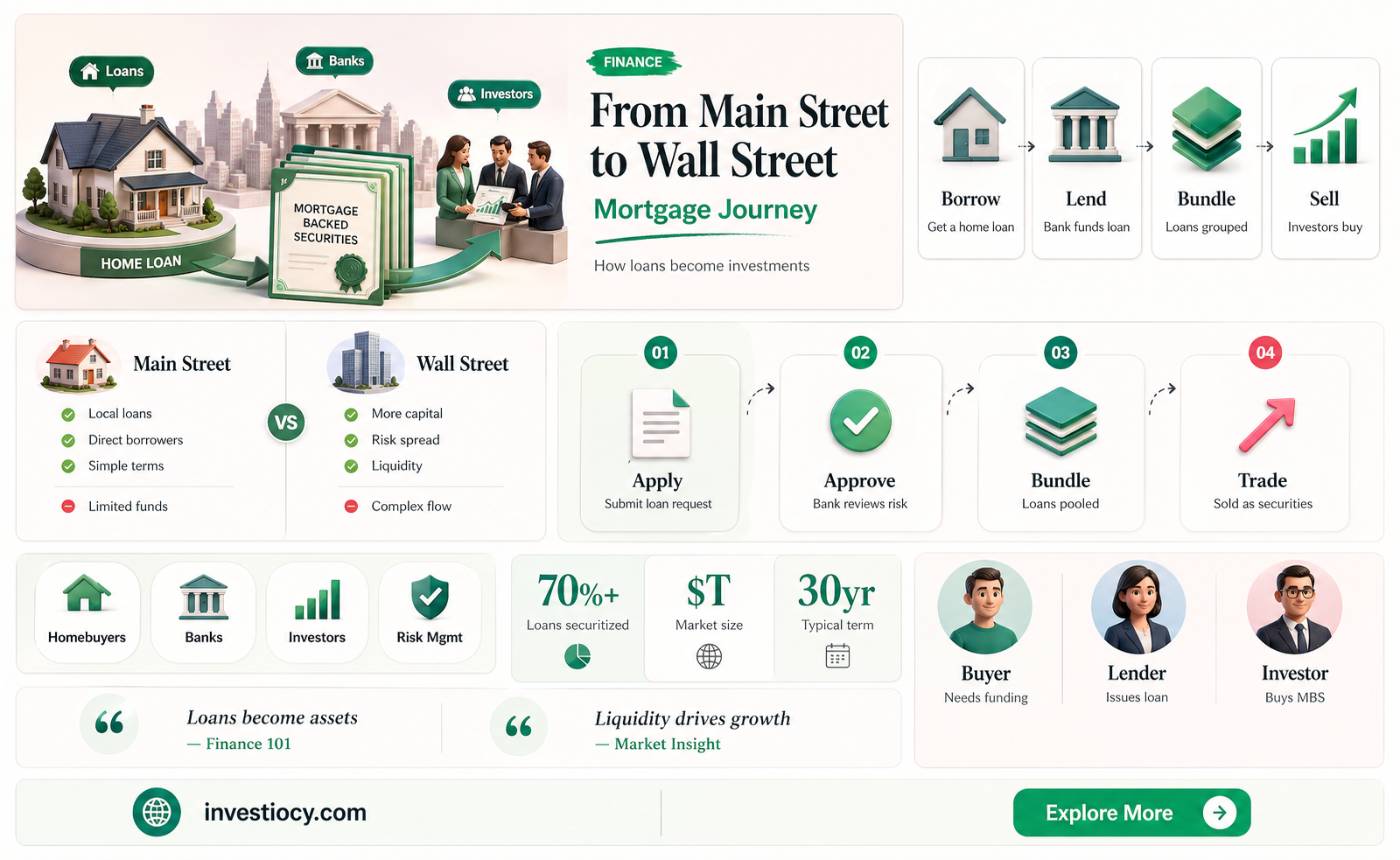
The journey of mortgages to Wall Street is a complex process that involves several key players in the financial industry. It begins with homeowners taking out mortgages from local banks or mortgage lenders. These mortgages are then often sold to larger financial institutions, which bundle them together into mortgage-backed securities (MBS). These MBS are subsequently sold to investors on Wall Street, where they are traded like stocks. This process allows banks to offload risk and free up capital to issue new mortgages, while investors gain exposure to the housing market. However, this system also played a significant role in the 2008 financial crisis, highlighting the risks associated with the securitization of mortgages.
| Characteristics | Values |
|---|---|
| Process | Mortgages end up on Wall Street through a process called securitization, where individual loans are bundled together and sold as securities to investors. |
| Players | Key players include mortgage lenders, investment banks, rating agencies, and investors. |
| Purpose | The primary purpose is to provide liquidity to the mortgage market, allowing lenders to make more loans and investors to gain exposure to the housing market. |
| Types of Mortgages | Various types of mortgages can be securitized, including conventional, FHA, VA, and subprime mortgages. |
| Pooling | Mortgages are pooled based on similar characteristics such as interest rates, loan terms, and credit scores of borrowers. |
| Tranches | The pooled mortgages are then divided into tranches, which are different layers of risk and return. |
| Rating Agencies | Credit rating agencies like Moody's, Standard & Poor's, and Fitch evaluate the tranches and assign credit ratings. |
| Sale to Investors | Investment banks sell these mortgage-backed securities (MBS) to investors, including pension funds, mutual funds, and individual investors. |
| Servicing | The original lender or a third-party servicer continues to service the loans, collecting payments and handling defaults. |
| Risks | Investors face risks such as prepayment risk, credit risk, and interest rate risk. |
| Benefits | Benefits include diversification of investment portfolios, exposure to the housing market, and potentially higher returns compared to other fixed-income investments. |
| Regulation | The process is regulated by various government agencies, including the SEC, HUD, and the Federal Reserve. |
| Market Size | The mortgage-backed securities market is a significant part of the global financial system, with trillions of dollars in outstanding securities. |
| Historical Context | Securitization has been around since the 1970s but grew rapidly in the 1990s and 2000s, contributing to the housing bubble and subsequent financial crisis. |
| Innovations | Recent innovations include the use of blockchain technology to streamline the securitization process and improve transparency. |
Explore related products


What You'll Learn
- Mortgage Origination: Banks and lenders create mortgages for homebuyers, initiating the lending process
- Mortgage-Backed Securities: Mortgages are bundled into securities, which are then sold to investors
- Wall Street Involvement: Investment banks and financial institutions buy and trade mortgage-backed securities
- Securitization Process: The transformation of illiquid assets (mortgages) into liquid assets (securities) tradable on Wall Street
- Impact on Financial Markets: The presence of mortgage-backed securities on Wall Street affects market dynamics and investor portfolios

Mortgage Origination: Banks and lenders create mortgages for homebuyers, initiating the lending process
Banks and lenders play a crucial role in the mortgage origination process, which is the first step in creating mortgages for homebuyers. This process involves several key stages, starting with the initial application and ending with the closing of the loan. During this time, the lender evaluates the borrower's creditworthiness, verifies their income and assets, and assesses the value of the property being purchased.
One of the unique aspects of mortgage origination is the variety of loan options available to borrowers. These can include fixed-rate mortgages, adjustable-rate mortgages, and government-backed loans such as FHA or VA loans. Each type of loan has its own set of criteria and benefits, and lenders must carefully guide borrowers through the selection process to ensure they choose the option that best suits their needs.
Another important aspect of mortgage origination is the underwriting process. This is where the lender's underwriters review the borrower's application and supporting documents to determine whether the loan should be approved. Underwriters consider factors such as the borrower's credit score, debt-to-income ratio, and the loan-to-value ratio of the property. They may also require additional documentation or clarification from the borrower before making a final decision.
Once the loan is approved, the lender and borrower must finalize the terms of the mortgage and prepare for closing. This involves reviewing and signing the loan documents, paying any required closing costs, and transferring the funds to the seller. After the closing, the lender is responsible for servicing the loan, which includes collecting payments, managing escrow accounts, and ensuring compliance with all applicable laws and regulations.
In summary, mortgage origination is a complex process that requires careful attention to detail and a deep understanding of the various loan options and underwriting criteria. Banks and lenders must work closely with borrowers to ensure a smooth and successful transaction, while also managing their own risk and compliance obligations. By doing so, they help to facilitate the dream of homeownership for millions of Americans each year.
Decoding Primary Residence: How Mortgages Influence Your Main Home
You may want to see also
Explore related products



Mortgage-Backed Securities: Mortgages are bundled into securities, which are then sold to investors
Mortgage-backed securities (MBS) are a type of asset-backed security that represents an ownership interest in a pool of mortgages. These securities are created when a financial institution bundles together a large number of mortgages and sells them to investors. The investors then receive payments based on the cash flows from the underlying mortgages, including principal and interest payments.
The process of creating MBS involves several steps. First, a financial institution, such as a bank or mortgage company, originates a large number of mortgages. These mortgages are then pooled together based on certain criteria, such as the type of mortgage, the interest rate, and the credit quality of the borrowers. Once the pool is created, the financial institution sells the mortgages to a special purpose vehicle (SPV), which is a separate legal entity created specifically for this purpose.
The SPV then issues securities to investors, which represent an ownership interest in the pool of mortgages. These securities are typically structured in a way that provides investors with different levels of risk and return, depending on their investment objectives. For example, some securities may be designed to provide a high return but with a higher level of risk, while others may be designed to provide a lower return but with a lower level of risk.
One of the key benefits of MBS is that they allow financial institutions to transfer the risk of mortgage defaults to investors. This can help to free up capital for the financial institution, which can then be used to originate new mortgages or invest in other assets. However, MBS can also be complex and risky investments, and investors need to carefully consider the risks and rewards before investing in them.
In recent years, MBS have become a major part of the global financial system, with trillions of dollars invested in them. They have also played a significant role in the housing market, as they have helped to make mortgage financing more widely available and affordable. However, the complexity and risks associated with MBS have also led to concerns about their potential impact on financial stability, and regulators have been working to address these concerns through various measures, such as increased disclosure and risk management requirements.
Explore related products


$10.1 $19


Wall Street Involvement: Investment banks and financial institutions buy and trade mortgage-backed securities
Investment banks and financial institutions play a pivotal role in the journey of mortgages to Wall Street by purchasing and trading mortgage-backed securities (MBS). These securities are financial instruments that represent an ownership interest in a pool of mortgages. By buying MBS, investment banks essentially acquire a stake in the cash flows generated by the underlying mortgages, which are typically originated by commercial banks or mortgage lenders.
The process begins when investment banks aggregate mortgages from various lenders to create large pools. These pools are then securitized, meaning they are packaged into MBS and sold to investors. This allows the originating lenders to offload the credit risk associated with the mortgages and free up capital to originate new loans. Investment banks, in turn, earn fees for underwriting and structuring these securities.
One of the key benefits of MBS for investment banks is the ability to diversify their portfolios and manage risk. By investing in a pool of mortgages, banks can spread their exposure across multiple borrowers and geographic regions, reducing the impact of any single default. Additionally, MBS can provide a stable source of income through the regular payments of principal and interest.
However, the involvement of investment banks in the mortgage market also raises concerns about potential conflicts of interest and the impact on market stability. Critics argue that the securitization process can lead to a lack of transparency and accountability, as the risks associated with mortgages are dispersed among various investors. Furthermore, the trading of MBS can contribute to market volatility, as changes in interest rates or economic conditions can significantly affect the value of these securities.
In conclusion, investment banks and financial institutions are integral to the process of bringing mortgages to Wall Street through the purchase and trade of mortgage-backed securities. While this involvement offers benefits such as risk diversification and income generation, it also highlights the need for careful regulation and oversight to ensure market stability and protect investor interests.
Explore related products




Securitization Process: The transformation of illiquid assets (mortgages) into liquid assets (securities) tradable on Wall Street
The securitization process is a complex financial mechanism that transforms illiquid assets, such as mortgages, into liquid assets, like securities, which can be traded on Wall Street. This process begins with the aggregation of a large number of mortgages into a single pool. These mortgages are typically issued by banks or other financial institutions and represent a diverse range of borrowers, loan amounts, and property types. Once pooled, the mortgages are sold to a special purpose vehicle (SPV), which is a separate legal entity created specifically for this purpose.
The SPV then issues securities backed by the cash flows from the underlying mortgages. These securities are known as mortgage-backed securities (MBS) and are sold to investors on Wall Street. The cash flows from the mortgages are used to pay interest and principal on the MBS. This process allows investors to gain exposure to the mortgage market without having to directly originate or service mortgages. It also provides liquidity to the mortgage market, as the securities can be easily bought and sold, unlike the underlying mortgages which are typically long-term and illiquid.
One of the key benefits of securitization is that it allows financial institutions to manage their risk more effectively. By selling mortgages to an SPV, banks can remove these assets from their balance sheets, which reduces their exposure to credit risk. This process also enables banks to originate more mortgages, as they are no longer constrained by the need to hold these assets on their balance sheets. However, securitization also introduces new risks, such as the potential for the SPV to default on its obligations or for the value of the MBS to decline due to changes in interest rates or credit conditions.
The securitization process is regulated by various government agencies and industry standards to ensure transparency, fairness, and stability. For example, the Securities and Exchange Commission (SEC) requires that MBS issuers disclose detailed information about the underlying mortgages and the terms of the securities. Additionally, credit rating agencies play a crucial role in evaluating the creditworthiness of MBS and providing investors with information about the potential risks associated with these securities.
In conclusion, the securitization process is a vital component of the financial system that facilitates the flow of capital into the mortgage market. By transforming illiquid mortgages into liquid securities, this process enables investors to participate in the mortgage market and provides financial institutions with a mechanism to manage their risk. However, it also introduces new risks and challenges that must be carefully managed to ensure the stability and integrity of the financial system.
Explore related products


Impact on Financial Markets: The presence of mortgage-backed securities on Wall Street affects market dynamics and investor portfolios
The presence of mortgage-backed securities (MBS) on Wall Street has a profound impact on financial markets, influencing market dynamics and shaping investor portfolios. MBS are financial instruments that represent an ownership interest in a pool of mortgages, and their trading on Wall Street introduces a complex interplay of risk, return, and liquidity.
One significant effect of MBS on market dynamics is their role in interest rate movements. As MBS are sensitive to changes in interest rates, their prices fluctuate accordingly, which can lead to broader market reactions. For instance, when interest rates rise, the value of existing MBS falls, prompting investors to adjust their portfolios and potentially leading to a ripple effect across various asset classes.
Moreover, MBS contribute to the overall liquidity of financial markets. By providing a mechanism for banks and other financial institutions to offload mortgage risk, MBS enable these entities to free up capital for new lending activities. This, in turn, can stimulate economic growth and increase the availability of credit for consumers and businesses.
Investor portfolios are also significantly affected by the presence of MBS on Wall Street. MBS offer investors a way to diversify their holdings and gain exposure to the housing market without directly purchasing real estate. However, the complexity of MBS structures and the associated risks, such as prepayment risk and credit risk, require investors to carefully evaluate their suitability for inclusion in a portfolio.
In conclusion, the presence of mortgage-backed securities on Wall Street has far-reaching implications for financial markets and investor portfolios. Their influence on interest rates, market liquidity, and portfolio diversification underscores the importance of understanding the intricacies of MBS and their role in the broader financial landscape.
Frequently asked questions
Mortgages end up on Wall Street through a process called securitization. This is where banks bundle together a large number of mortgages and sell them to investors as mortgage-backed securities (MBS). These securities are then traded on financial markets, including Wall Street.
The purpose of securitizing mortgages is to provide banks with a way to offload the risk associated with holding a large portfolio of mortgages. By selling these mortgages to investors, banks can free up capital to make new loans and reduce their exposure to potential losses if borrowers default.
Mortgage-backed securities (MBS) are financial instruments that represent an ownership interest in a pool of mortgages. These securities are backed by the cash flows generated by the underlying mortgages, and they pay interest to investors based on those cash flows. MBS are traded on financial markets and can be bought and sold by investors.
Investors make money from mortgage-backed securities by receiving interest payments based on the cash flows generated by the underlying mortgages. As borrowers make their monthly mortgage payments, the principal and interest are distributed to investors in the form of dividends. Additionally, investors can buy and sell MBS on the open market, potentially earning capital gains if the securities increase in value.