 Faith Morrow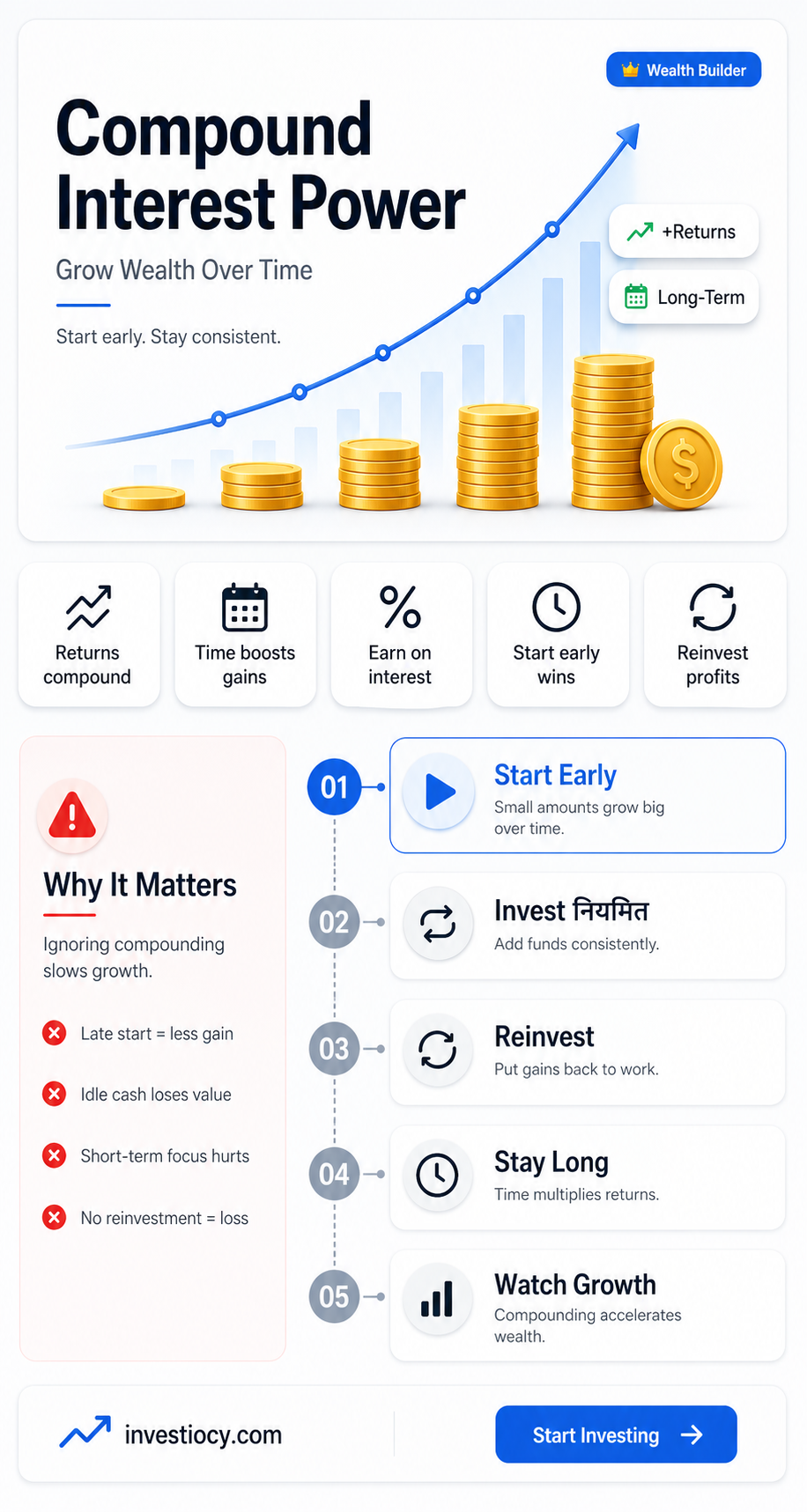
The principle of compound interest is a powerful force in finance that can significantly encourage investment. It refers to the concept where interest is calculated not only on the initial principal amount but also on the accumulated interest from previous periods. This means that as time progresses, the amount of interest earned grows exponentially, leading to a snowball effect that can substantially increase the value of an investment over the long term. For example, if you invest $1,000 at an annual interest rate of 5%, after one year you would have $1,050. In the second year, you would earn 5% interest on $1,050, resulting in $1,102.50, and so on. This exponential growth can be a strong motivator for individuals to invest, as it demonstrates how even small, regular contributions can accumulate into significant wealth over time.
Explore related products


What You'll Learn
- Growth Over Time: Compound interest allows investments to grow exponentially, increasing returns over longer periods
- Reinvestment Benefits: Interest earned is reinvested, generating additional interest and accelerating wealth accumulation
- Risk Mitigation: Regular compounding can help mitigate market volatility by averaging out investment returns
- Encouraging Early Investment: The power of compounding incentivizes starting investments early to maximize long-term gains
- Passive Income Generation: Compound interest can create a steady stream of passive income, enhancing financial security

Growth Over Time: Compound interest allows investments to grow exponentially, increasing returns over longer periods
Imagine you're planting a tree. Initially, it's small and requires careful nurturing. Over time, as it grows, its roots deepen, and its branches expand, eventually providing shade and fruit. This natural process of growth mirrors the financial concept of compound interest, where investments grow exponentially over time, yielding greater returns the longer they're allowed to mature.
In the world of finance, compound interest is a powerful force that encourages investment by promising increased returns on the initial principal as well as on the accumulated interest. This means that the earlier you start investing, the more time your money has to grow, thanks to the compounding effect. For instance, if you invest $1,000 at an annual interest rate of 5%, after one year, you'll have $1,050. The following year, you'll earn interest not just on the original $1,000, but also on the $50 of interest from the first year, resulting in $1,102.50. This snowball effect continues, with each passing year bringing greater returns.
The magic of compound interest lies in its ability to turn small, regular investments into substantial sums over long periods. It's a key reason why financial advisors recommend starting to save for retirement as early as possible. By harnessing the power of compound interest, even modest contributions can grow into a significant nest egg by the time retirement rolls around.
However, it's important to note that compound interest works both ways. Just as it can grow your investments exponentially, it can also increase the cost of debt if not managed properly. Credit card debt, for example, can quickly spiral out of control if the interest is not paid off regularly, leading to a cycle of increasing debt.
To maximize the benefits of compound interest, investors should focus on making consistent contributions over time, rather than trying to time the market or make large, infrequent investments. Additionally, choosing investments with a solid track record of steady growth and reinvesting dividends can further accelerate the compounding effect.
In conclusion, compound interest is a fundamental principle that underpins the growth of investments over time. By understanding and leveraging this concept, investors can set themselves on a path to financial security and long-term wealth accumulation.
Explore related products


Reinvestment Benefits: Interest earned is reinvested, generating additional interest and accelerating wealth accumulation
The reinvestment of interest earned is a fundamental aspect of compound interest that significantly accelerates wealth accumulation. When interest is reinvested, it generates additional interest, creating a snowball effect that can lead to substantial growth in the principal amount over time. This process is a key motivator for investors, as it allows them to maximize their returns and achieve their financial goals more rapidly.
To illustrate the power of reinvestment, consider the following example: Suppose an individual invests $10,000 in a savings account with an annual interest rate of 5%. If the interest earned is reinvested each year, the account balance will grow to $16,288.95 after 10 years, assuming no additional contributions are made. This is in contrast to a simple interest calculation, where the interest earned each year is not reinvested, resulting in a much lower final balance of $15,000.
The benefits of reinvestment are particularly pronounced over longer time horizons. As the interest earned is reinvested and begins to generate its own interest), the growth rate of the investment accelerates. This can lead to a significant increase in wealth over time, making it an attractive option for long-term investors.
In addition to accelerating wealth accumulation, reinvestment also helps to mitigate the effects of inflation. As the cost of living increases over time, the purchasing power of money decreases. By reinvesting interest earned, investors can ensure that their wealth keeps pace with inflation, maintaining their standard of living in retirement or achieving other long-term financial goals.
To maximize the benefits of reinvestment, it is important for investors to choose the right investment vehicles. Accounts that offer compound interest, such as certificates of deposit (CDs), bonds, and mutual funds, are ideal for reinvestment strategies. Additionally, investors should consider automating their reinvestment process to ensure that interest earned is reinvested promptly, maximizing the potential for growth.
In conclusion, the reinvestment of interest earned is a powerful tool for accelerating wealth accumulation and achieving long-term financial goals. By understanding the benefits of reinvestment and choosing the right investment vehicles, investors can harness the power of compound interest to build a secure financial future.
Explore related products


Risk Mitigation: Regular compounding can help mitigate market volatility by averaging out investment returns
Regular compounding plays a crucial role in mitigating market volatility by smoothing out the fluctuations in investment returns. This mechanism works by reinvesting earnings at regular intervals, thereby averaging out the gains and losses over time. For instance, if an investor experiences a 10% gain in one quarter and a 10% loss in the next, regular compounding would blend these outcomes, resulting in a more stable overall return.
One of the key benefits of regular compounding is its ability to reduce the psychological impact of market swings on investors. By consistently reinvesting dividends or interest, investors can focus on the long-term growth of their portfolio rather than being swayed by short-term market movements. This approach fosters a disciplined investment strategy, encouraging investors to stay the course even during periods of high volatility.
Moreover, regular compounding can help investors take advantage of market downturns. When prices fall, the reinvested earnings purchase more shares at lower prices, potentially leading to higher returns when the market recovers. This strategy, known as dollar-cost averaging, is particularly effective in volatile markets, as it allows investors to capitalize on price fluctuations without trying to time the market.
To maximize the benefits of regular compounding, investors should consider setting up automatic reinvestment plans. These plans ensure that earnings are reinvested promptly and consistently, without the need for manual intervention. Additionally, investors should maintain a diversified portfolio to further mitigate risk and enhance the smoothing effect of regular compounding.
In conclusion, regular compounding is a powerful tool for mitigating market volatility and encouraging long-term investment. By averaging out returns and reducing the impact of market swings, this strategy helps investors stay focused on their financial goals and navigate the complexities of the investment landscape.
Explore related products





Encouraging Early Investment: The power of compounding incentivizes starting investments early to maximize long-term gains
The principle of compound interest is a powerful tool in encouraging early investment. By understanding how it works, individuals can be motivated to start investing sooner rather than later. Compound interest is the interest earned on both the principal amount and any accumulated interest over time. This means that the earlier one starts investing, the more time their money has to grow and earn additional interest.
For example, let's consider two individuals, Alex and Ben, who both invest $10,000. Alex starts investing at the age of 25, while Ben starts at the age of 35. Assuming an annual interest rate of 6%, Alex's investment will grow to approximately $42,000 by the time he reaches 65, while Ben's investment will only grow to about $29,000 in the same timeframe. This significant difference in growth is due to the power of compounding, which allows Alex's money to earn interest for a longer period.
Starting early also allows investors to take advantage of the "snowball effect" of compound interest. As the investment grows, the interest earned each year becomes larger, which in turn leads to even more growth in the future. This effect can be particularly powerful for young investors who have many years ahead of them.
Furthermore, early investment can help individuals develop a habit of saving and investing regularly. By starting early, investors can learn to prioritize their financial goals and make saving a part of their lifestyle. This habit can lead to long-term financial stability and success.
In conclusion, the principle of compound interest is a key factor in encouraging early investment. By starting early, individuals can maximize their long-term gains, take advantage of the snowball effect, and develop a habit of saving and investing regularly.
Explore related products





Passive Income Generation: Compound interest can create a steady stream of passive income, enhancing financial security
Compound interest is a powerful force in the world of finance, and it can be harnessed to generate a steady stream of passive income. This concept is particularly appealing to investors looking to enhance their financial security without actively working for every dollar earned. By understanding how compound interest works, individuals can make informed decisions about their investments and potentially create a sustainable income stream that grows over time.
At its core, compound interest is the interest earned on both the principal amount and any accumulated interest. This means that as an investment grows, the interest generated is reinvested, leading to exponential growth. For example, if an investor puts $10,000 into a savings account with a 5% annual interest rate, they would earn $500 in interest after the first year. If they leave that interest in the account, the next year they would earn interest on $10,500, resulting in $525. This process continues, with the interest earned each year contributing to the overall growth of the investment.
One of the key benefits of compound interest is that it allows investors to generate passive income. Passive income is earnings that require little to no effort to maintain, providing a financial cushion that can be used for various purposes, such as retirement, travel, or unexpected expenses. By reinvesting dividends, interest, or capital gains, investors can create a snowball effect that leads to a growing stream of passive income over time.
To maximize the benefits of compound interest, investors should consider a few key strategies. First, it's essential to start investing early, as the longer the investment has to grow, the more significant the impact of compound interest will be. Second, investors should focus on assets with a strong track record of growth and consistent returns, as these will provide the fuel for compound interest to work its magic. Finally, it's crucial to be patient and avoid the temptation to withdraw earnings prematurely, as this can disrupt the compounding process and limit the potential for long-term growth.
In conclusion, compound interest is a powerful tool for generating passive income and enhancing financial security. By understanding how it works and implementing smart investment strategies, individuals can create a sustainable income stream that grows over time, providing them with the financial freedom to pursue their goals and dreams.
Frequently asked questions
Compound interest is the interest earned on both the principal amount and the accumulated interest from previous periods. It can significantly boost investment growth over time by reinvesting earnings, leading to exponential growth.
Compound interest can be calculated daily, monthly, quarterly, semi-annually, or annually. The more frequently it is compounded, the higher the investment returns will be, as the interest earns interest more often.
The formula for compound interest is A = P(1 + r/n)^(nt), where:
- A is the amount of money accumulated after n compounding periods.
- P is the principal amount (the initial amount of money).
- r is the annual interest rate (decimal).
- n is the number of times that interest is compounded per year.
- t is the time the money is invested for in years.
Sure! Suppose you invest $1,000 in a savings account with an annual interest rate of 5%, compounded annually. After one year, you would have $1,050. In the second year, you would earn interest on $1,050, resulting in $1,102.50. This process continues, and over time, the growth becomes substantial.
Compound interest encourages long-term investments because the longer the money is invested, the more significant the growth due to the exponential effect of interest earning interest. This can lead to substantial returns over time, making long-term investments more attractive.


