Faith Morrow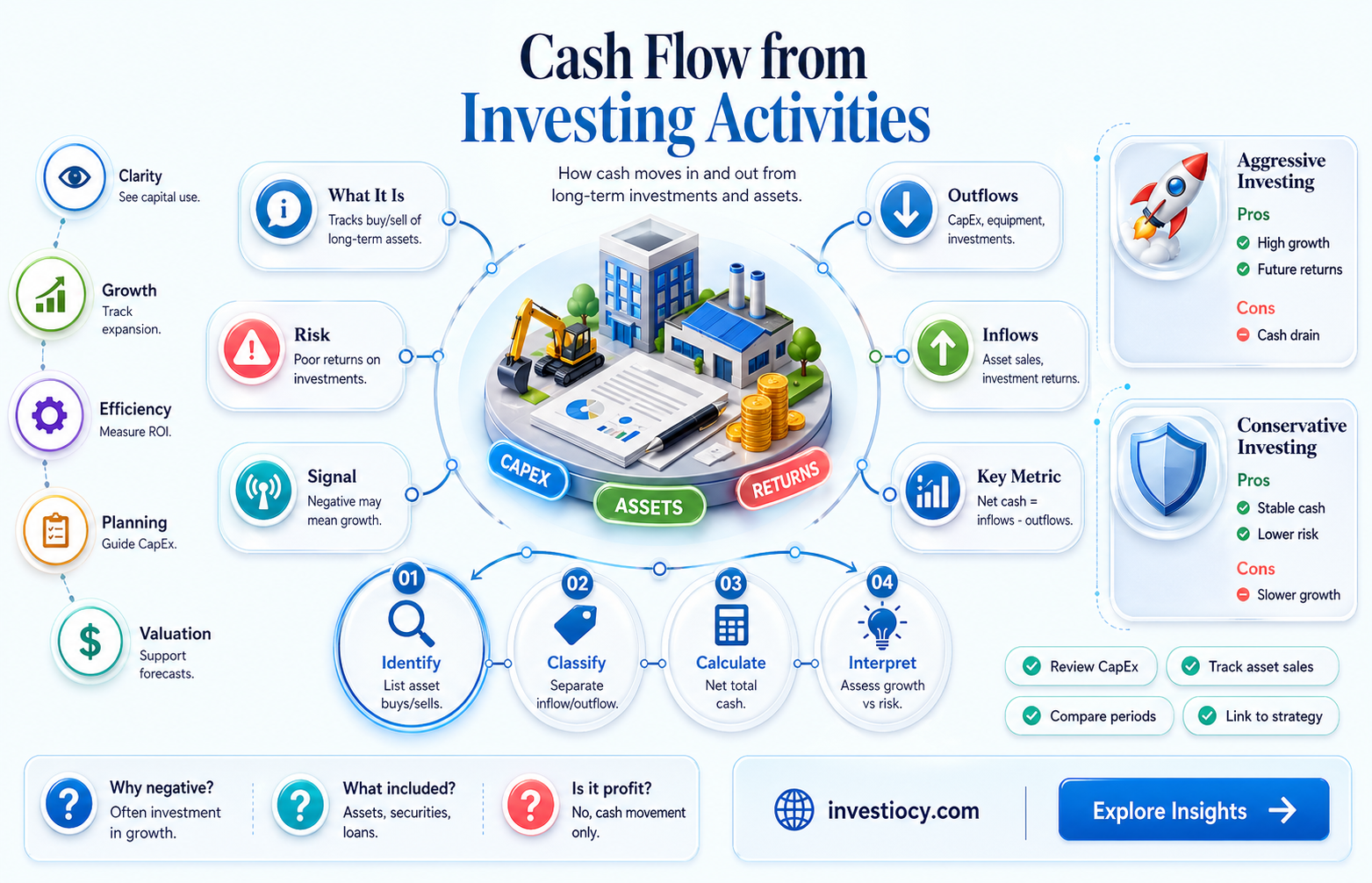
Cash flow from investing activities is a crucial component of a company's financial health, reflecting the money spent on or received from long-term investments. This includes purchases or sales of property, plant, and equipment, investments in subsidiaries or joint ventures, and acquisitions or divestitures of businesses. Understanding this cash flow helps investors and analysts gauge a company's investment strategy and its potential for future growth. Positive cash flow from investing activities can indicate a company is divesting assets or receiving returns on its investments, while negative cash flow might suggest significant investments in assets or businesses, which could be a sign of expansion or growth.
| Characteristics | Values |
|---|---|
| Definition | Cash flow from investing activities refers to the cash inflows and outflows related to the purchase and sale of long-term assets, such as property, plant, and equipment, as well as investments in other companies. |
| Importance | It is crucial for assessing a company's ability to generate cash from its core business operations and its capacity to invest in future growth opportunities. |
| Components | Purchase of property, plant, and equipment, Sale of property, plant, and equipment, Investments in other companies, Proceeds from investments, Dividends received, Interest received |
| Calculation | Net cash flow from investing activities = (Cash inflows from investing activities) - (Cash outflows from investing activities) |
| Positive Indicators | A positive cash flow from investing activities indicates that a company is generating more cash from its investments than it is spending on new investments. |
| Negative Indicators | A negative cash flow from investing activities suggests that a company is spending more on new investments than it is generating from its existing investments. |
| Impact on Financial Health | A consistent positive cash flow can enhance a company's financial health by providing funds for debt repayment, dividends, and reinvestment in the business. |
| Sources | Cash flow from investing activities can be found in a company's statement of cash flows, typically under the "Investing Activities" section. |
| Analysis | Analysts often examine this metric to evaluate a company's investment strategy, its ability to generate returns on investments, and its overall financial performance. |
| Trends | An increasing trend in cash flow from investing activities over time can be a positive sign, indicating successful investments and potentially higher future returns. |
| Industry Comparison | Comparing a company's cash flow from investing activities with industry averages can provide insights into its relative performance and investment efficiency. |
| Limitations | This metric does not account for the timing of cash flows, which can be significant in assessing the true financial health and liquidity of a company. |
| Related Metrics | Return on investment (ROI), Internal rate of return (IRR), Net present value (NPV), Payback period |
| Example | If a company purchases a new factory for $1 million and sells an old factory for $500,000, the cash outflow from investing activities would be $500,000 ($1 million - $500,000). |
Explore related products


What You'll Learn
- Definition: Cash flow from investing activities involves the purchase and sale of long-term assets
- Components: It includes transactions like buying property, equipment, and securities, as well as selling these assets
- Calculation: This cash flow is calculated by subtracting investments from the proceeds of asset sales
- Significance: It's crucial for assessing a company's investment strategy and its impact on liquidity
- Examples: Common examples are purchasing machinery, investing in stocks, or selling real estate

Definition: Cash flow from investing activities involves the purchase and sale of long-term assets
Cash flow from investing activities is a critical component of a company's financial health, reflecting the money spent on acquiring or disposing of long-term assets. These assets can include property, plant, and equipment, as well as investments in other companies or financial instruments. The cash flow statement categorizes these transactions separately from operating and financing activities to provide a clear picture of a company's investment strategy and its impact on liquidity.
The purchase of long-term assets typically results in a negative cash flow, as it requires an outflow of cash. Conversely, the sale of these assets generates a positive cash flow, bringing money into the company. This section of the cash flow statement can reveal a lot about a company's growth strategy, asset management, and potential risks. For instance, a company that is consistently investing in new assets may be expanding its operations, while one that is selling assets might be consolidating or raising capital.
Analyzing cash flow from investing activities involves looking at the types of assets being bought and sold, the frequency of these transactions, and the amounts involved. Investors and analysts often scrutinize this information to assess a company's ability to generate returns on its investments and to gauge its financial stability. A company with a strong cash flow from investing activities is generally seen as more robust and better positioned for long-term growth.
One key aspect to consider is the difference between capital expenditures and investments. Capital expenditures are typically for physical assets that will be used in the company's operations, such as buildings or machinery. Investments, on the other hand, can be in a variety of financial instruments or other companies. Understanding the balance between these two types of outflows can provide insights into a company's strategic priorities and risk tolerance.
Another important factor is the timing of cash flows. Delays in receiving cash from asset sales or accelerated spending on new assets can impact a company's liquidity. Therefore, it's essential to monitor these activities closely to ensure that the company has sufficient cash reserves to meet its short-term obligations while still pursuing its long-term investment goals.
In summary, cash flow from investing activities is a vital indicator of a company's financial strategy and health. By examining the details of these transactions, stakeholders can gain valuable insights into a company's growth prospects, asset management, and overall financial stability.
Explore related products

$31.04 $58


Components: It includes transactions like buying property, equipment, and securities, as well as selling these assets
Cash flow from investing activities is a critical component of a company's financial health, reflecting the money spent on acquiring or disposing of long-term assets. This includes transactions such as purchasing property, equipment, and securities, as well as selling these assets. These activities are essential for a company's growth and strategic positioning but can also significantly impact its liquidity and financial flexibility.
One key aspect of cash flow from investing activities is the acquisition of property, plant, and equipment (PP&E). When a company buys PP&E, it incurs a significant cash outflow, which is recorded as a negative entry in the investing activities section of the cash flow statement. Conversely, when PP&E is sold, the proceeds are recorded as a positive entry, indicating an inflow of cash. The timing and magnitude of these transactions can have a substantial impact on a company's cash flow profile.
Another important component is the purchase and sale of securities, such as stocks and bonds. When a company invests in securities, it provides cash to the issuer, which is reflected as a negative entry in the cash flow statement. Selling securities, on the other hand, results in a positive entry, as the company receives cash from the buyer. The volatility of financial markets can make these transactions particularly impactful on a company's cash flow, as the value of securities can fluctuate significantly over time.
In addition to these primary components, cash flow from investing activities can also include other transactions, such as lending money to other entities, investing in joint ventures, or purchasing intangible assets like patents and trademarks. Each of these transactions involves a transfer of cash and can influence a company's liquidity and financial position.
Understanding the components of cash flow from investing activities is crucial for investors, analysts, and company management. It provides insights into a company's investment strategy, its ability to generate cash, and its overall financial health. By examining the cash flow statement, stakeholders can assess the impact of investing activities on a company's liquidity and make informed decisions about its financial prospects.
Explore related products


Calculation: This cash flow is calculated by subtracting investments from the proceeds of asset sales
To calculate cash flow from investing activities, you need to understand the components involved. This cash flow is calculated by subtracting investments from the proceeds of asset sales. In other words, it's the net change in a company's cash position resulting from its investment activities.
Let's break down the calculation step by step. First, you need to identify the investments made by the company. This could include purchases of property, plant, and equipment, investments in other companies, or purchases of securities. Next, you need to determine the proceeds from asset sales. This could include sales of property, plant, and equipment, sales of investments, or sales of securities.
Once you have identified the investments and proceeds, you can calculate the cash flow from investing activities by subtracting the total investments from the total proceeds. For example, if a company invested $100,000 in new equipment and sold $150,000 worth of old equipment, the cash flow from investing activities would be $50,000 ($150,000 - $100,000).
It's important to note that this calculation only includes investments and proceeds from asset sales. It does not include other sources of cash, such as operating activities or financing activities. Additionally, the calculation is based on the cash method of accounting, which means that cash flows are recognized when cash is actually received or paid.
In conclusion, calculating cash flow from investing activities is a straightforward process that involves identifying investments and proceeds from asset sales, and then subtracting the total investments from the total proceeds. This calculation provides valuable insights into a company's investment activities and can help investors make informed decisions.
Explore related products

$17.97 $19.99



Significance: It's crucial for assessing a company's investment strategy and its impact on liquidity
Cash flow from investing activities is a critical metric for evaluating a company's investment strategy and its implications for liquidity. This financial indicator reveals how much cash a company is allocating to investments in assets such as property, plant, and equipment, as well as securities and other financial instruments. By analyzing this cash flow, stakeholders can gain insights into the company's long-term growth prospects and its ability to generate future revenue streams.
One of the key aspects of cash flow from investing activities is that it provides a snapshot of a company's capital expenditure and investment decisions. This information is crucial for assessing the company's strategic direction and its commitment to innovation and expansion. For instance, a company that is investing heavily in research and development may be positioning itself for future growth, while a company that is divesting assets may be looking to improve its liquidity position.
Moreover, cash flow from investing activities can also shed light on a company's risk management strategies. By examining the types of investments a company is making, investors can gauge its appetite for risk and its ability to manage potential losses. For example, a company that is investing in high-risk, high-reward projects may be more susceptible to market fluctuations, while a company that is investing in more conservative assets may be better positioned to weather economic downturns.
In addition to providing insights into a company's investment strategy, cash flow from investing activities can also help stakeholders assess the company's liquidity position. A company that is generating positive cash flow from investing activities may be able to fund its operations and meet its financial obligations without relying on external financing. Conversely, a company that is experiencing negative cash flow from investing activities may need to seek additional funding sources or adjust its investment strategy to improve its liquidity.
Overall, cash flow from investing activities is a vital metric for understanding a company's investment strategy and its impact on liquidity. By analyzing this financial indicator, stakeholders can gain valuable insights into the company's long-term growth prospects, risk management strategies, and ability to generate future revenue streams.
Explore related products




Examples: Common examples are purchasing machinery, investing in stocks, or selling real estate
Cash flow from investing activities encompasses a wide range of financial transactions that involve the acquisition or disposal of long-term assets. One common example is the purchase of machinery. When a company buys new equipment, it incurs a significant expense that reduces its cash reserves. This outflow of cash is recorded as an investing activity because the machinery is expected to generate future economic benefits through increased production capacity and efficiency.
Investing in stocks is another typical example of cash flow from investing activities. When an individual or institution purchases shares in a company, they provide capital that the company can use to fund its operations, expansion, or other strategic initiatives. In return, the investor receives ownership in the company and the potential for future returns through dividends or capital appreciation. The cash paid for the stocks is classified as an investing activity because it represents a long-term investment in the company's growth and profitability.
Selling real estate is a third example of cash flow from investing activities. When an investor sells a property, they receive a lump sum of cash that can be used to fund other investments or meet financial obligations. The sale of real estate is considered an investing activity because it involves the disposal of a long-term asset that was previously held for investment purposes. The proceeds from the sale can be reinvested in other properties, stocks, bonds, or other investment vehicles, continuing the cycle of cash flow from investing activities.
These examples illustrate the diverse nature of cash flow from investing activities, which can include a wide range of transactions involving the acquisition or disposal of long-term assets. Understanding these activities is crucial for investors and companies alike, as they can have a significant impact on financial performance and long-term growth prospects. By analyzing cash flow from investing activities, stakeholders can gain insights into a company's investment strategy, capital allocation decisions, and overall financial health.
Frequently asked questions
Cash flow from investing activities refers to the cash inflows and outflows related to the purchase and sale of long-term assets, such as property, plant, and equipment, as well as investments in other companies.
Cash flow from investing activities is calculated by subtracting the cash outflows for investments from the cash inflows received from the sale of investments and other long-term assets.
Examples of cash inflows from investing activities include the sale of property, plant, and equipment, the sale of investments in other companies, and the receipt of dividends and interest income.
Examples of cash outflows from investing activities include the purchase of property, plant, and equipment, the purchase of investments in other companies, and the payment of dividends and interest expenses.
Cash flow from investing activities is important because it provides insight into a company's ability to generate cash from its investments and long-term assets, which can be used to fund future growth and operations.