Laila Keith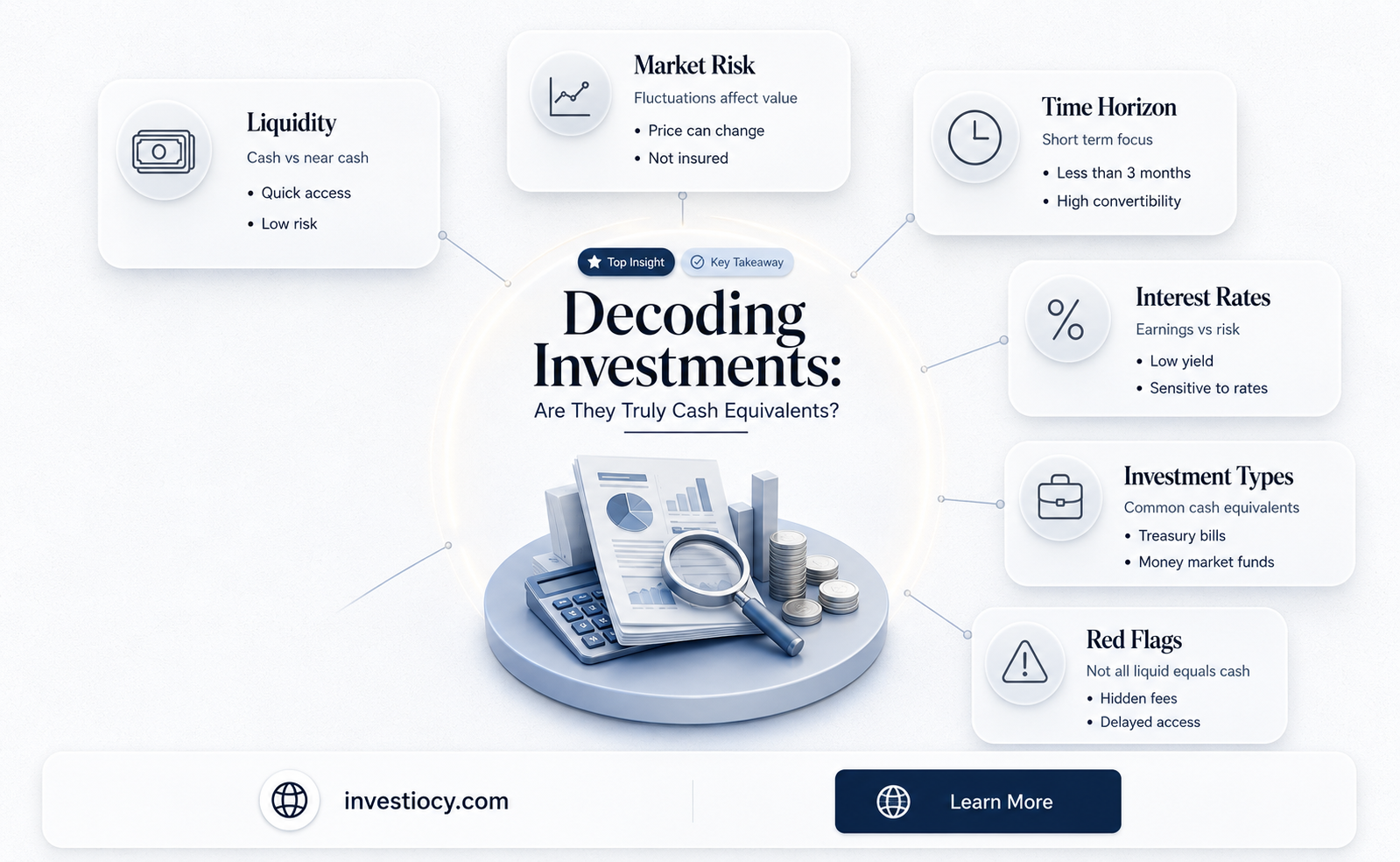
Investments and cash equivalents are fundamental concepts in finance that serve distinct roles in managing liquidity and generating returns. Cash equivalents are highly liquid assets that can be readily converted to cash within a short period, typically three months or less, with minimal risk of loss in value. Examples include savings accounts, money market funds, and short-term government bonds. On the other hand, investments are assets acquired with the expectation of earning a return over a longer period, often involving a higher degree of risk. These can range from stocks and bonds to real estate and mutual funds. While both are essential components of a balanced financial strategy, they differ significantly in terms of liquidity, risk, and return potential. Understanding the distinctions between investments and cash equivalents is crucial for individuals and businesses aiming to optimize their financial portfolios and achieve their economic objectives.
Explore related products


$0.99 $9.99


What You'll Learn

Definition of Cash Equivalents
Cash equivalents are assets that can be readily converted into cash within a short period, typically three months or less. These assets are considered to have a low risk of loss and are highly liquid, meaning they can be easily bought or sold without significantly affecting their market price. Examples of cash equivalents include treasury bills, certificates of deposit, commercial paper, and money market funds.
The definition of cash equivalents is crucial in financial reporting and accounting because it helps to determine which assets can be classified as cash or cash equivalents on a company's balance sheet. This classification is important because cash and cash equivalents are considered the most liquid assets a company has, and they are used to meet short-term obligations and fund daily operations.
In the context of investments, cash equivalents are often used as a benchmark to compare the liquidity and risk of other investments. For example, stocks and bonds are not considered cash equivalents because they are not as easily convertible into cash and they carry a higher risk of loss. However, some investments, such as money market mutual funds, are considered cash equivalents because they invest in a diversified portfolio of short-term, high-quality debt securities that can be easily liquidated.
It's important to note that the definition of cash equivalents can vary depending on the specific accounting standards and regulations that a company follows. For example, the Financial Accounting Standards Board (FASB) in the United States has specific guidelines for classifying assets as cash or cash equivalents, while the International Accounting Standards Board (IASB) has its own set of criteria.
In conclusion, cash equivalents are a critical component of a company's financial health and they play an important role in financial reporting and accounting. Understanding the definition of cash equivalents and how they are classified can help investors and analysts make informed decisions about a company's liquidity and risk profile.
Smart Strategies: Investing Your Extra Cash for Maximum Returns
You may want to see also
Explore related products

$6.37 $6.37


Types of Investments Considered Cash Equivalents
Cash equivalents are a crucial component of any investment portfolio, offering liquidity and stability. These investments are typically low-risk and have a short-term maturity, making them ideal for investors who need quick access to their funds. Common types of cash equivalents include savings accounts, money market funds, treasury bills, and certificates of deposit (CDs). Each of these investments has its own unique characteristics and benefits, catering to different investor needs and preferences.
Savings accounts are the most basic form of cash equivalent, providing a safe place to store money while earning a modest interest rate. They are typically offered by banks and credit unions and are insured by the Federal Deposit Insurance Corporation (FDIC) or the National Credit Union Administration (NCUA), up to certain limits. Money market funds, on the other hand, are mutual funds that invest in a diversified portfolio of short-term debt securities, such as treasury bills, commercial paper, and repurchase agreements. They offer higher interest rates than savings accounts but come with slightly more risk.
Treasury bills, or T-bills, are short-term debt securities issued by the U.S. government. They are considered one of the safest investments available, as they are backed by the full faith and credit of the U.S. government. T-bills have maturities ranging from a few weeks to one year and are sold at a discount to their face value, with the investor earning the difference between the purchase price and the face value at maturity. Certificates of deposit (CDs) are time deposits offered by banks and credit unions, where the investor agrees to leave their money in the account for a specified period, typically ranging from a few months to several years. CDs offer higher interest rates than savings accounts but come with the risk of early withdrawal penalties.
When considering cash equivalents, investors should focus on their individual financial goals and risk tolerance. For those who prioritize liquidity and stability, savings accounts and money market funds may be the best options. For investors looking for slightly higher returns and willing to take on a bit more risk, treasury bills and CDs could be more suitable. It's essential to diversify within the cash equivalent category to minimize risk and maximize returns.
In conclusion, cash equivalents play a vital role in investment portfolios, providing a safe and liquid asset class. By understanding the different types of cash equivalents and their unique characteristics, investors can make informed decisions that align with their financial objectives and risk preferences.
Smart Strategies for Growing Your Wealth: A Cash Investment Guide
You may want to see also
Explore related products


$8.73 $19.99


Criteria for Cash Equivalence
Cash equivalence in investments hinges on several critical criteria that ensure the asset can be readily converted to cash without significant loss of value. The first criterion is liquidity, which refers to the ease with which an asset can be bought or sold in the market. Highly liquid investments, such as government bonds and money market funds, typically meet this criterion as they can be quickly converted to cash with minimal impact on their market price.
Another key criterion is maturity. Investments with short maturities, usually less than three months, are generally considered cash equivalents because they can be easily liquidated upon maturity. This short-term nature minimizes the risk of price fluctuations and ensures that the funds are available when needed.
The third criterion is credit quality. Cash equivalent investments should have high credit ratings to minimize the risk of default. For instance, treasury bills and certificates of deposit (CDs) issued by reputable banks are often considered cash equivalents due to their low default risk.
Lastly, the investment should not be subject to significant market risk. This means that the value of the investment should not fluctuate widely with market conditions. Stable investments, such as savings accounts and short-term government securities, are ideal examples of cash equivalents as they provide a stable store of value.
In summary, for an investment to be classified as a cash equivalent, it must meet the criteria of liquidity, short maturity, high credit quality, and low market risk. These criteria ensure that the investment can be quickly and easily converted to cash without significant loss of value, making it a reliable option for investors seeking to maintain a portion of their portfolio in a highly accessible form.
Understanding Cash Calls in E-Trade: A Beginner's Guide
You may want to see also
Explore related products


Benefits of Cash Equivalent Investments
Cash equivalent investments offer a myriad of benefits that make them an attractive option for investors seeking liquidity and stability. One of the primary advantages is their high liquidity, allowing investors to quickly convert these assets into cash without significant loss in value. This makes them ideal for emergency funds or short-term financial goals where immediate access to capital is crucial.
Another key benefit is the lower risk profile associated with cash equivalents. Unlike stocks or bonds, which can be subject to market volatility, cash equivalents are typically backed by governments or large financial institutions, providing a higher degree of security. This reduced risk makes them a suitable choice for conservative investors or those looking to diversify their portfolios and mitigate overall risk exposure.
Cash equivalent investments also offer competitive interest rates, particularly when compared to traditional savings accounts. This allows investors to earn a higher return on their idle cash without sacrificing liquidity. Additionally, many cash equivalents, such as money market funds, provide check-writing privileges and debit card access, offering convenience and flexibility in managing funds.
Furthermore, cash equivalents can play a strategic role in an investor's portfolio by serving as a buffer during market downturns. By maintaining a portion of their portfolio in cash equivalents, investors can avoid selling other assets at a loss during periods of market volatility, thereby preserving their long-term investment strategy.
In summary, the benefits of cash equivalent investments include high liquidity, lower risk, competitive interest rates, convenience, and strategic portfolio management. These advantages make cash equivalents a valuable component of a well-diversified investment portfolio, particularly for those seeking to balance risk and return while maintaining easy access to their funds.
Smart Strategies for Safeguarding Your Savings: A Beginner's Guide
You may want to see also
Risks Associated with Cash Equivalent Investments
Cash equivalent investments, while generally considered low-risk, are not without their pitfalls. One significant risk is inflation, which can erode the purchasing power of the invested funds over time. For instance, if an investor places $10,000 in a cash equivalent investment with a 2% annual return, but inflation runs at 3%, the real return is actually -1%. This means the investor's money is losing value in real terms.
Another risk associated with cash equivalent investments is liquidity risk. While these investments are typically easy to convert to cash, there may be instances where the market becomes illiquid, making it difficult to sell the investment quickly. This can be particularly problematic if the investor needs immediate access to their funds.
Interest rate risk is also a concern. When interest rates rise, the value of existing cash equivalent investments falls. For example, if an investor purchases a 6-month CD at a 1% interest rate and then interest rates rise to 2%, the CD's value will decrease, resulting in a loss if the investor needs to sell it before maturity.
Credit risk is another factor to consider. While cash equivalent investments are generally backed by governments or large financial institutions, there is still a risk that the issuer may default on their obligations. This risk can be mitigated by diversifying the portfolio across different issuers and types of cash equivalent investments.
Finally, reinvestment risk can impact the overall return on cash equivalent investments. When the investment matures, the investor may not be able to find another investment with the same or higher return, potentially leading to a decrease in the portfolio's overall performance.
To mitigate these risks, investors should carefully consider their investment goals, time horizon, and risk tolerance. Diversification across different types of cash equivalent investments and regular monitoring of the portfolio can help to minimize the impact of these risks and ensure that the investor's funds remain safe and liquid.
Maximize Your Returns: Cashing Out Investments on Cash App
You may want to see also
Frequently asked questions
Investments are not typically considered cash equivalents. Cash equivalents are assets that can be readily converted to cash within three months or less, such as savings accounts, money market funds, and short-term government bonds. Investments, on the other hand, are assets held for longer periods to generate returns and may not be as easily liquidated.
Examples of cash equivalents include checking and savings accounts, money market funds, treasury bills, certificates of deposit (CDs) with maturities of three months or less, and commercial paper. These assets are highly liquid and can be quickly converted to cash with minimal loss of value.
Cash equivalents are crucial for businesses because they provide liquidity to meet short-term obligations, such as paying bills, salaries, and taxes. Having a sufficient amount of cash equivalents ensures that a business can operate smoothly and avoid financial distress, even during periods of low cash flow or unexpected expenses.
Investments generally carry higher risks than cash equivalents but also offer the potential for higher returns. Cash equivalents are low-risk assets that provide stability and easy access to funds, but they typically yield lower interest rates. Investments, such as stocks, bonds, and mutual funds, involve more risk due to market fluctuations, but they can generate higher returns over the long term, making them suitable for long-term financial goals.