 Laila Keith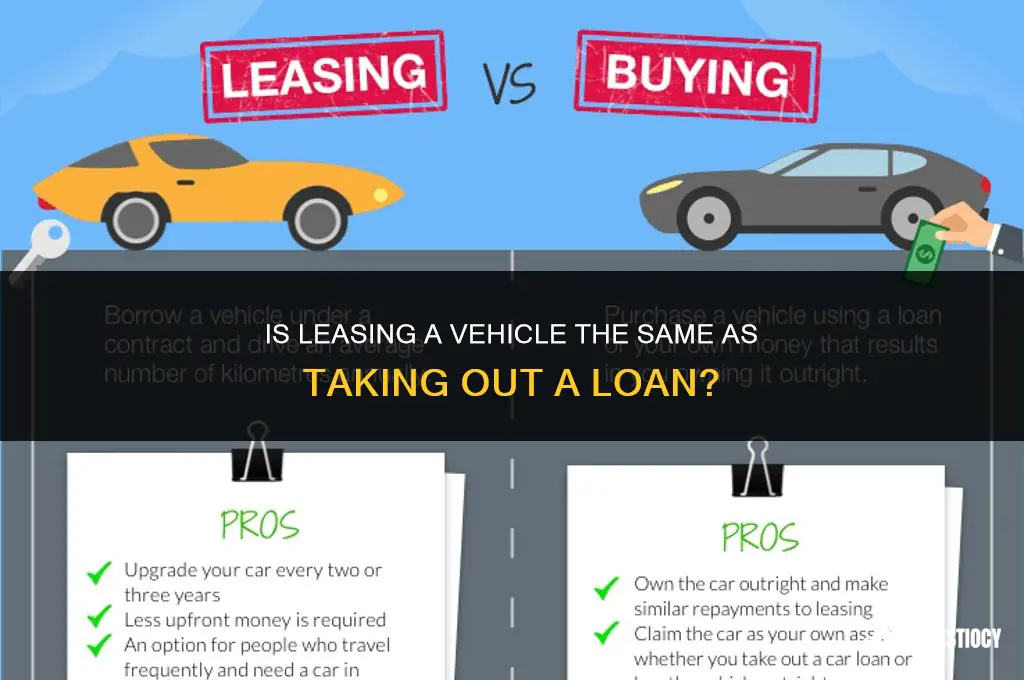
Leasing a vehicle is often compared to taking out a loan, but it's important to understand the key differences between the two. While both options involve making regular payments to use a vehicle, leasing is essentially a long-term rental agreement where the lessee pays for the right to use the vehicle for a specified period. On the other hand, taking out a loan to purchase a vehicle means the borrower is financing the full purchase price of the car and will own it outright once the loan is paid off. Leasing typically involves lower monthly payments but may come with mileage restrictions and additional fees, whereas loan payments are generally higher but offer the benefit of eventual ownership and equity in the vehicle.
Explore related products


What You'll Learn
- Definition of Leasing: A contractual agreement where a lessor provides a vehicle to a lessee for a specified period
- Types of Leases: Common types include closed-end leases, open-end leases, and lease-to-own agreements
- Financial Implications: Leasing often involves monthly payments, down payments, and potential fees for excess mileage or wear
- Ownership and Equity: Lessee does not own the vehicle; the lessor retains ownership throughout the lease term
- End-of-Lease Options: Choices include returning the vehicle, purchasing it at a predetermined price, or extending the lease

Definition of Leasing: A contractual agreement where a lessor provides a vehicle to a lessee for a specified period
Leasing a vehicle is often misunderstood as a form of loan, but it is, in fact, a distinct financial arrangement. At its core, leasing is a contractual agreement where one party, the lessor, provides a vehicle to another party, the lessee, for a predetermined period. This arrangement comes with specific terms and conditions that govern the use and maintenance of the vehicle, as well as the financial obligations of both parties.
One key aspect of leasing is that the lessee does not own the vehicle outright. Instead, they have the right to use it for the duration of the lease term. This means that at the end of the lease, the vehicle must be returned to the lessor, who retains ownership. This is a significant difference from a loan, where the borrower typically takes ownership of the asset once the loan is repaid.
Another important feature of leasing is the financial structure. Lease payments are usually calculated based on the vehicle's purchase price, the lease term, and the expected residual value of the vehicle at the end of the lease. These payments are often lower than loan payments for the same vehicle, as they do not include interest charges. However, lessees may also be required to pay additional fees, such as a security deposit, acquisition fee, and disposition fee.
Leasing can offer several advantages over buying a vehicle outright or taking out a loan. For one, it allows lessees to drive a new vehicle without the significant upfront costs associated with purchasing. Additionally, lease terms are typically shorter than loan terms, which means lessees can upgrade to a new vehicle more frequently. Leasing can also provide tax benefits, as lease payments are often deductible as a business expense.
However, leasing also has its drawbacks. Lessees may face mileage restrictions and wear-and-tear charges if the vehicle is not returned in good condition. Additionally, leasing can be more expensive in the long run, as lessees may end up paying more in lease payments and fees than they would in loan payments and interest.
In conclusion, while leasing a vehicle may share some similarities with taking out a loan, it is a unique financial arrangement with its own set of terms, benefits, and drawbacks. Understanding the specifics of leasing can help individuals make informed decisions about whether it is the right option for their needs.
Exploring Interlibrary Loan Capabilities in Koha: A Comprehensive Guide
You may want to see also
Explore related products


Types of Leases: Common types include closed-end leases, open-end leases, and lease-to-own agreements
Leasing a vehicle involves various types of agreements, each with its own set of terms and conditions. Understanding these types is crucial to determining whether leasing is akin to taking out a loan. A closed-end lease, for instance, is a straightforward agreement where the lessee pays a fixed amount over a predetermined period and returns the vehicle at the end of the lease. This type of lease typically includes mileage limits and wear-and-tear clauses that can affect the final payment.
In contrast, an open-end lease, also known as a finance lease, allows the lessee to purchase the vehicle at the end of the lease period. The monthly payments are generally lower than those of a closed-end lease because they do not include the full depreciation of the vehicle. However, the lessee is responsible for the residual value of the car, which can be a significant amount if the vehicle depreciates more than anticipated.
Lease-to-own agreements, another common type of lease, combine elements of both closed-end and open-end leases. These agreements allow the lessee to rent the vehicle with the option to purchase it at the end of the lease term. The payments are typically higher than those of a standard lease because they include both the rental cost and the option to buy. However, a portion of the rental payments may be applied towards the purchase price, making it easier for the lessee to own the vehicle outright.
When considering whether leasing a vehicle is similar to taking out a loan, it's essential to examine the financial implications of each type of lease. While leases may offer lower monthly payments and the flexibility to return or purchase the vehicle, they can also include hidden costs such as down payments, acquisition fees, and disposition fees. Additionally, leases often require the lessee to maintain the vehicle in good condition and adhere to strict mileage limits, which can be costly if not followed.
In conclusion, leasing a vehicle involves various types of agreements, each with its own financial structure and obligations. While leases may provide an alternative to traditional car loans, they come with their own set of considerations and potential drawbacks. Understanding the different types of leases and their implications is key to making an informed decision about whether leasing is the right option for you.
Understanding Land Loans: The NOI Factor Explained
You may want to see also
Explore related products


$124.99 $180.99


Financial Implications: Leasing often involves monthly payments, down payments, and potential fees for excess mileage or wear
Leasing a vehicle comes with a unique set of financial obligations that differ significantly from traditional car loans. One of the primary financial implications is the structure of payments. Unlike a loan, where the borrower pays off the principal amount plus interest over time, leasing involves paying for the use of the vehicle over a specified period. This typically includes a monthly lease payment, which covers the cost of using the car, and a down payment, often referred to as a "capitalized cost reduction." This down payment reduces the overall lease cost but does not contribute to equity in the vehicle, as it would with a loan.
Another critical financial aspect of leasing is the potential for additional fees. Lease agreements often include charges for excess mileage or wear and tear on the vehicle beyond what is considered normal use. These fees can add up quickly if the lessee drives more than the allotted miles or if the car is not well-maintained. Furthermore, lease agreements may include other costs such as acquisition fees, disposition fees, and taxes, which can increase the overall expense of leasing.
When comparing leasing to taking out a loan, it's essential to consider the long-term financial impact. With a loan, the borrower eventually owns the vehicle outright, which can be an asset if the car retains its value well. In contrast, leasing never results in ownership, and the lessee must either return the vehicle at the end of the lease term or purchase it at a predetermined price, which may be higher than its market value. This lack of equity can be a significant disadvantage for those who plan to keep their vehicle for an extended period.
Moreover, leasing can be more expensive in the long run, especially for those who drive frequently or do not maintain their vehicles well. The combination of monthly payments, down payments, and potential fees can result in higher overall costs compared to financing a vehicle through a loan. However, for some individuals, leasing may offer benefits such as lower upfront costs, the ability to drive a newer vehicle more frequently, and the convenience of not having to worry about selling or trading in the car when it's time for a new one.
In conclusion, while leasing a vehicle may seem like an attractive option due to lower monthly payments and the opportunity to drive a new car, it's crucial to understand the financial implications fully. Leasing involves a different payment structure, potential additional fees, and a lack of equity in the vehicle, which can make it more expensive in the long term compared to taking out a loan. Prospective lessees should carefully consider their driving habits, financial situation, and long-term goals before deciding whether leasing is the right choice for them.
Exploring Equity Loan Options with Lake Trust: A Comprehensive Guide
You may want to see also
Ownership and Equity: Lessee does not own the vehicle; the lessor retains ownership throughout the lease term
In the context of vehicle leasing, one of the fundamental aspects to understand is the concept of ownership and equity. Unlike purchasing a vehicle outright, where the buyer gains full ownership and equity over time, leasing a vehicle operates under a different model. Throughout the lease term, the lessee—the individual leasing the vehicle—does not own the vehicle. Instead, ownership is retained by the lessor, which is typically a financial institution or a leasing company.
This arrangement has several implications for the lessee. Firstly, since the lessee does not own the vehicle, they do not build equity in it. Equity is the value of the vehicle that the owner can claim after paying off any outstanding loans or liens. In a leasing scenario, any payments made by the lessee are essentially rental fees for the use of the vehicle, rather than installments towards ownership.
Moreover, the lessee is usually responsible for maintaining the vehicle in good condition, as per the terms of the lease agreement. This includes regular servicing, repairs, and ensuring that the vehicle is returned at the end of the lease term in a condition that meets the lessor’s standards. Failure to do so may result in additional charges or penalties.
Another significant aspect is that the lessee typically has the option to purchase the vehicle at the end of the lease term. This is known as a lease buyout. If the lessee decides to exercise this option, they would need to pay the lessor the predetermined buyout price, which is usually based on the vehicle’s residual value at the end of the lease.
In summary, when leasing a vehicle, it is crucial to understand that the lessee does not own the vehicle and does not build equity in it. The lessor retains ownership throughout the lease term, and the lessee’s payments are essentially rental fees. The lessee is responsible for maintaining the vehicle and has the option to purchase it at the end of the lease term through a buyout.
Legal Review of Loan Documents: What You Need to Know
You may want to see also
End-of-Lease Options: Choices include returning the vehicle, purchasing it at a predetermined price, or extending the lease
At the end of a vehicle lease, you have several options to consider. One choice is to return the vehicle to the leasing company. This is often the simplest option, as it allows you to walk away without any further financial obligations. However, you should be aware that there may be fees associated with returning the vehicle, such as a disposition fee or charges for any damage or excessive mileage.
Another option is to purchase the vehicle at a predetermined price. This price is typically set at the beginning of the lease and is based on the vehicle's expected value at the end of the lease term. Purchasing the vehicle can be a good option if you have grown attached to it or if you believe it will appreciate in value over time. However, you should carefully consider the purchase price and compare it to the current market value of the vehicle to ensure you are getting a fair deal.
A third option is to extend the lease. This can be a good choice if you are not ready to commit to purchasing the vehicle but still want to continue driving it. Extending the lease will allow you to keep the vehicle for a longer period, but you should be aware that you will continue to make lease payments and may be subject to additional fees.
When considering your end-of-lease options, it is important to carefully evaluate your financial situation and your needs. You should also take into account the current market conditions and the potential future value of the vehicle. By weighing all of these factors, you can make an informed decision about which option is best for you.
Exploring Residency Relocation Loans: A Look at Laurel Road's Options
You may want to see also
Frequently asked questions
No, leasing a vehicle is not the same as taking out a loan. When you lease a vehicle, you are essentially renting it for a specific period, typically 2-5 years, with the option to purchase it at the end of the lease term. You make monthly payments based on the vehicle's depreciation and interest, but you do not own the vehicle outright until you decide to purchase it.
Leasing a vehicle offers several benefits compared to buying one. First, leasing allows you to drive a new vehicle without having to pay the full purchase price upfront. This can be especially helpful if you don't have a large down payment saved up. Second, leasing often comes with lower monthly payments than buying, as you are only paying for the vehicle's depreciation and interest during the lease term. Third, leasing can provide more flexibility, as you can choose to return the vehicle at the end of the lease term and lease a new one, or purchase the vehicle if you decide you want to keep it.
Leasing a vehicle also has some drawbacks compared to buying one. First, when you lease a vehicle, you do not own it outright, which means you cannot sell it or trade it in for a new vehicle. Second, leasing often comes with mileage restrictions, which can be a problem if you drive a lot. Third, leasing can be more expensive in the long run, as you are paying for the vehicle's depreciation and interest, as well as any additional fees and taxes.
Leasing a vehicle can affect your credit score in several ways. First, when you apply for a lease, the leasing company will check your credit score to determine your eligibility and interest rate. This can result in a temporary drop in your credit score. Second, making timely lease payments can help improve your credit score, as it demonstrates your ability to manage debt responsibly. However, if you miss payments or default on your lease, it can negatively impact your credit score.
