Inaya Mclaughlin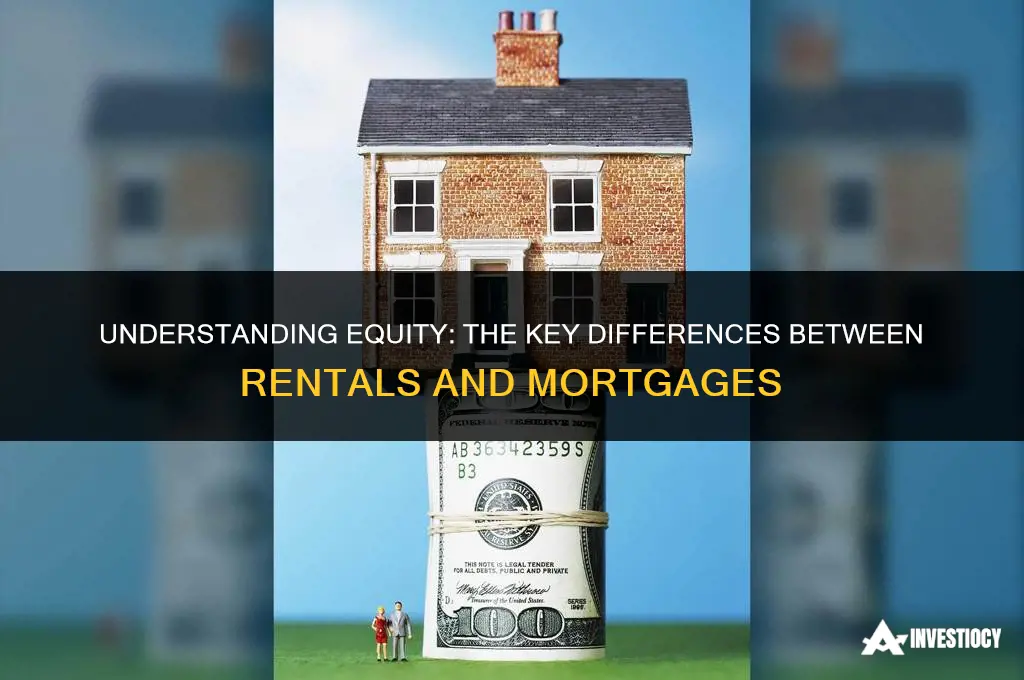
Rentals and mortgages represent two distinct paths to homeownership, each with its own set of financial implications and equity considerations. When renting, individuals pay a monthly fee to occupy a property owned by someone else, typically without building any equity over time. In contrast, mortgages allow individuals to purchase a home by borrowing money from a lender, with the property serving as collateral. As mortgage payments are made, the borrower gradually builds equity in the home, which can be a valuable asset over time. Understanding the differences in equity between rentals and mortgages is crucial for making informed decisions about one's housing situation and long-term financial goals.
Explore related products


What You'll Learn
- Ownership: Rentals don't build equity; mortgages do as you pay down the loan
- Monthly Payments: Rent payments are typically lower but don't contribute to equity
- Tax Benefits: Mortgage interest is tax-deductible, while rent payments are not
- Forced Savings: Mortgages force you to save through equity buildup; rentals don't
- Long-term Wealth: Mortgages can lead to long-term wealth through equity appreciation; rentals don't

Ownership: Rentals don't build equity; mortgages do as you pay down the loan
Rentals and mortgages differ significantly in terms of equity, with rentals typically not building equity for the tenant, while mortgages allow homeowners to build equity as they pay down the loan. This distinction is crucial for individuals considering their housing options and long-term financial goals.
In a rental scenario, tenants pay a monthly fee to the landlord for the use of the property. This payment does not contribute to the tenant's equity in the home, as the landlord retains full ownership. Over time, the tenant may pay tens of thousands of dollars in rent, but they will not have any ownership stake in the property. This can be a disadvantage for those looking to build wealth through real estate.
On the other hand, when a person takes out a mortgage to purchase a home, they are essentially borrowing money from a lender to buy the property. As they make monthly mortgage payments, a portion of the payment goes towards the principal balance of the loan, effectively increasing the homeowner's equity in the property. This means that over time, the homeowner's net worth can increase as they pay down the mortgage and the property appreciates in value.
For example, consider a scenario where a person rents a home for $1,500 per month for five years. In this case, they would pay a total of $90,000 in rent, but they would not have any equity in the property. In contrast, if the same person took out a mortgage to purchase a home for $200,000 with a 20% down payment and a 30-year fixed-rate mortgage at 4% interest, they would pay a total of $1,037 per month. Over the course of five years, they would pay $62,220 in mortgage payments, but they would also build equity in the property. Assuming the property appreciates at a rate of 3% per year, the homeowner's equity would increase by $31,680 over the five-year period, in addition to the $62,220 paid towards the principal balance of the loan.
In conclusion, while rentals may be a more flexible and short-term option for some individuals, mortgages offer the advantage of building equity over time. This can be a significant factor for those looking to invest in their future and build wealth through real estate.
Navigating High Mortgage Costs in Texas: A Comprehensive Guide
You may want to see also
Explore related products


Monthly Payments: Rent payments are typically lower but don't contribute to equity
Rent payments are typically lower than mortgage payments, which can be a significant advantage for renters. This is because renters do not have to pay for property taxes, insurance, or maintenance, which are all costs that homeowners must cover. Additionally, renters can often negotiate their rent, which can lead to even lower monthly payments. However, it is important to note that rent payments do not contribute to equity, which means that renters are not building any ownership in the property they are living in.
One of the main differences between renting and owning a home is the concept of equity. When you own a home, you are building equity with each mortgage payment you make. This equity can be used to secure loans, invest in other properties, or even retire. However, when you rent, you are not building any equity, which means that you are not investing in your future. This can be a significant disadvantage for renters, especially those who plan to own a home in the future.
Another important consideration is the long-term cost of renting versus owning. While rent payments may be lower in the short term, they can add up over time. For example, if you rent a property for $1,000 per month for 10 years, you will have paid $120,000 in rent. However, if you had purchased a home with a mortgage payment of $1,200 per month for 10 years, you would have built up equity in the property, which could be worth significantly more than the $120,000 you paid in rent.
In conclusion, while rent payments may be lower than mortgage payments, they do not contribute to equity, which can be a significant disadvantage for renters. It is important for renters to consider the long-term cost of renting versus owning and to make informed decisions about their housing situation.
Navigating the High Costs of Homeownership in Hawaii
You may want to see also
Explore related products


Tax Benefits: Mortgage interest is tax-deductible, while rent payments are not
One significant difference between renting and owning a mortgage lies in the tax implications. Mortgage interest is tax-deductible, which means that homeowners can reduce their taxable income by the amount of interest they pay on their mortgage each year. This deduction can result in substantial savings, especially in the early years of a mortgage when the interest portion of payments is higher. In contrast, rent payments are not tax-deductible, providing no direct financial benefit to renters in terms of reducing their tax liability.
To illustrate this difference, consider a homeowner who pays $12,000 in mortgage interest annually. Assuming they are in a 25% tax bracket, they would save $3,000 on their taxes each year by deducting this interest. Over the course of a 30-year mortgage, this could amount to nearly $90,000 in tax savings. Renters, on the other hand, would not receive any tax benefits for their payments, regardless of the amount paid or the duration of their tenancy.
It's important to note that while mortgage interest is deductible, the principal portion of mortgage payments is not. Additionally, the Tax Cuts and Jobs Act of 2017 placed a cap on the amount of mortgage interest that can be deducted, limiting it to interest on the first $750,000 of mortgage debt for new mortgages taken out after December 14, 2017. For those with existing mortgages, the cap remains at $1 million.
In summary, the tax deductibility of mortgage interest provides a significant financial advantage to homeowners over renters. This benefit can contribute to the overall cost-effectiveness of owning a home, especially when combined with other factors such as building equity and potential appreciation in property value. Renters, however, do not have access to this tax benefit and must consider other factors when deciding whether to rent or buy.
Unlocking Profits: The Lucrative World of Mortgage Pool Investments
You may want to see also
Explore related products


Forced Savings: Mortgages force you to save through equity buildup; rentals don't
One of the most significant differences between mortgages and rentals lies in the concept of forced savings. When you take out a mortgage, a portion of your monthly payment goes towards the principal, which gradually reduces the amount you owe on the property. This process, known as equity buildup, forces you to save money over time as you pay down the mortgage. In contrast, when you rent a property, your monthly payment goes entirely to the landlord, and you do not build any equity.
Forced savings through equity buildup can be a powerful tool for wealth accumulation. As you pay down your mortgage, the value of your property typically appreciates, further increasing your equity. This can lead to a substantial nest egg that you can tap into later in life or use to fund other financial goals. Additionally, the discipline of making regular mortgage payments can help instill good financial habits and encourage you to prioritize saving.
On the other hand, rentals do not offer the same forced savings mechanism. While renters may be able to save money by paying less in monthly rent than they would in mortgage payments, they do not benefit from equity buildup. This means that renters must rely on other methods of saving, such as setting aside a portion of their income in a savings account or investing in stocks or mutual funds. Without the forced savings aspect of a mortgage, renters may find it more challenging to accumulate wealth over time.
However, it is essential to note that mortgages also come with significant risks and responsibilities. Homeowners are responsible for maintaining the property, paying property taxes, and covering any unexpected repairs or maintenance costs. Additionally, if property values decline, homeowners may find themselves owing more on their mortgage than the property is worth, a situation known as being underwater on a mortgage. Renters, on the other hand, do not bear these risks and can often move more easily if their financial situation changes.
In conclusion, while mortgages offer the benefit of forced savings through equity buildup, rentals do not provide the same opportunity. This difference can have a significant impact on an individual's long-term financial stability and wealth accumulation. When deciding between renting and buying, it is crucial to consider your financial goals, risk tolerance, and lifestyle preferences to determine which option is best for you.
Unlocking Profits: A Guide to Real Estate Mortgage Success
You may want to see also
Explore related products


Long-term Wealth: Mortgages can lead to long-term wealth through equity appreciation; rentals don't
Mortgages can lead to long-term wealth through equity appreciation; rentals don't. This fundamental difference is rooted in the nature of each arrangement. When you take out a mortgage to purchase a property, you are investing in an asset that has the potential to increase in value over time. As you pay down the mortgage, you build equity in the property, which can be leveraged for future financial gains.
In contrast, renting does not offer the same opportunity for equity appreciation. Rent payments are typically made to a landlord or property management company and do not contribute to building equity in the property. Instead, renters are often required to pay a security deposit and monthly rent, which can add up over time but do not provide the same long-term financial benefits as mortgage payments.
One of the key advantages of mortgages is the ability to tap into the equity built up in the property through refinancing or selling. This can provide a significant financial boost, which can be used for a variety of purposes, such as investing in other assets, paying off debt, or funding major life expenses. Rentals, on the other hand, do not offer this same level of financial flexibility.
Furthermore, mortgages can also provide tax benefits, as the interest paid on a mortgage is often tax-deductible. This can help to reduce the overall cost of homeownership and further enhance the long-term wealth-building potential of mortgages. Rentals do not offer the same tax advantages, as rent payments are not typically tax-deductible.
In summary, mortgages can lead to long-term wealth through equity appreciation, while rentals do not offer the same opportunity. This difference is due to the nature of each arrangement, with mortgages allowing for investment in an asset that can increase in value over time, and rentals simply requiring payments to a landlord without building equity. As a result, mortgages can provide significant financial benefits in the long run, while rentals are more focused on short-term housing needs.
Exploring Navy Federal Mortgages: A Comprehensive Comparison Guide
You may want to see also
Frequently asked questions
The primary difference is that with a mortgage, you build equity in the property as you pay down the loan, whereas with a rental, you do not build any equity as you are simply paying for the right to live in the property.
With a rental, you typically pay a fixed amount of rent each month, which does not contribute to building equity. In contrast, with a mortgage, your monthly payments include both principal and interest, with the principal portion contributing to building equity in the property.
When you have a mortgage, the equity in the property increases as you pay down the loan. This equity can be accessed through refinancing or selling the property. When you rent, there is no equity built up, so you do not have any ownership stake in the property.