 Faith Morrow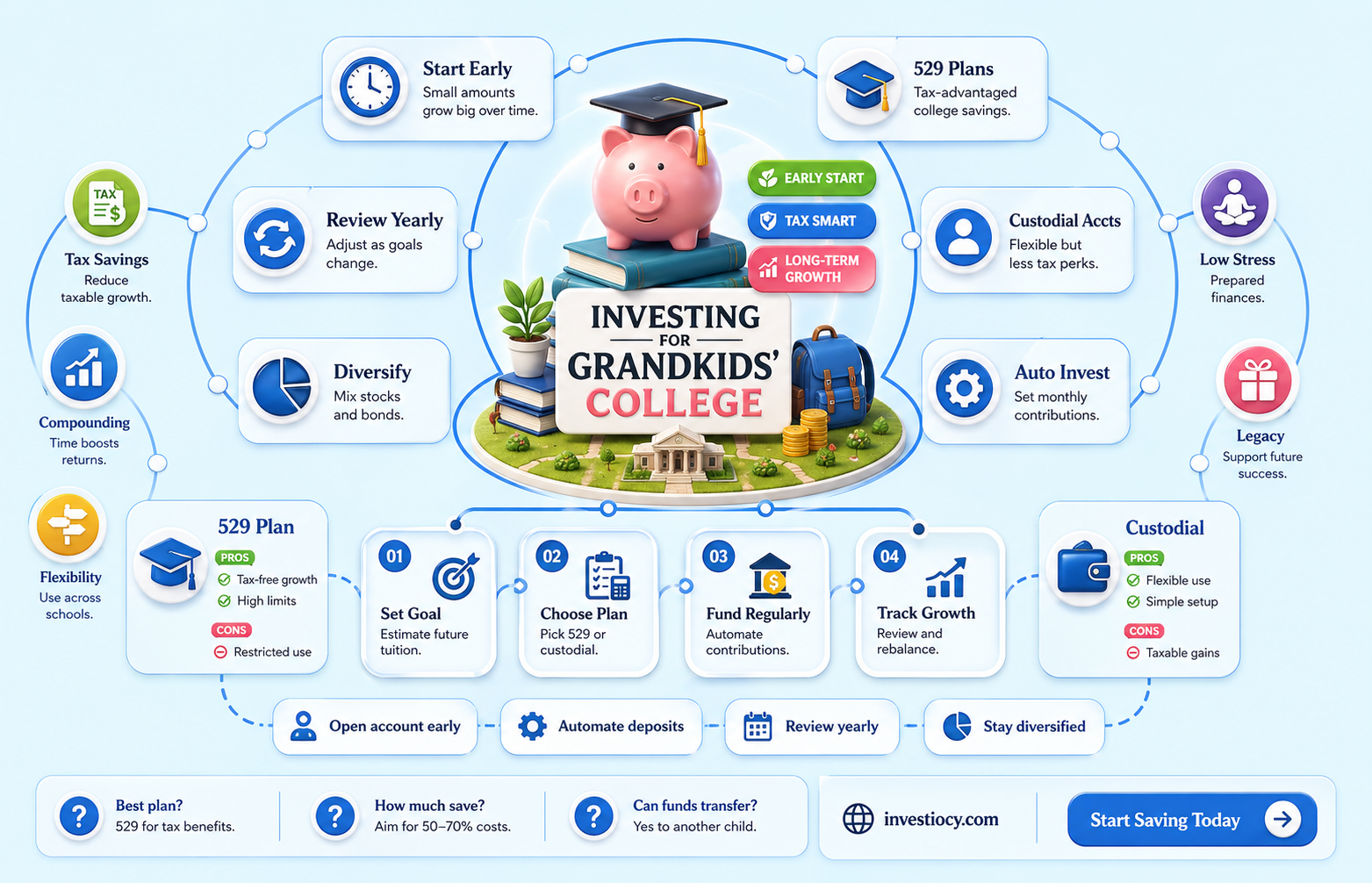
Investing for college savings for your grandkids is a thoughtful and forward-thinking approach to securing their future educational opportunities. With the rising cost of higher education, starting early can make a significant difference in the long run. There are several options to consider, such as 529 plans, which offer tax advantages and flexibility in terms of how the funds can be used. Additionally, exploring other investment vehicles like mutual funds or exchange-traded funds (ETFs) can help diversify the portfolio and potentially increase returns. It's important to research and understand the different investment options available, as well as to consider factors such as risk tolerance, time horizon, and financial goals. By taking the time to plan and invest wisely, you can help set your grandkids on a path towards achieving their college dreams.
Explore related products


What You'll Learn
- College Savings Plans: Tax-advantaged plans designed to encourage saving for future higher education expenses
- Coverdell Education Savings Accounts: Flexible savings accounts allowing contributions to grow tax-free for education purposes
- UTMA/UGMA Accounts: Uniform Transfer/Gift to Minors Accounts, enabling minors to manage gifted assets, including savings for college
- College Savings Bonds: Government-backed bonds offering tax benefits and a guaranteed return, ideal for long-term education savings
- Scholarship and Grant Research: Exploring various scholarships and grants available to help fund college education for grandchildren

529 College Savings Plans: Tax-advantaged plans designed to encourage saving for future higher education expenses
A 529 college savings plan is a tax-advantaged investment plan designed to encourage saving for the future higher education expenses of a designated beneficiary, typically a child or grandchild. These plans are sponsored by state governments and come in two major types: prepaid tuition plans and college savings plans. Prepaid tuition plans allow contributors to prepay tuition at current rates, while college savings plans allow contributors to invest money in mutual funds or other investments, with the earnings growing tax-deferred.
One of the primary benefits of 529 plans is the tax advantage. Contributions to a 529 plan are made with after-tax dollars, but the earnings grow tax-deferred. When the funds are withdrawn for qualified higher education expenses, the withdrawals are generally tax-free. This can provide significant savings over time, especially for those in higher tax brackets. Additionally, 529 plans offer flexibility in terms of how the funds can be used. The money can be used for tuition, fees, books, room and board, and other qualified expenses at accredited colleges and universities, as well as vocational and trade schools.
Another advantage of 529 plans is the ability to transfer the account to a different beneficiary if the original beneficiary does not need the funds. This can be useful in situations where one child or grandchild decides not to pursue higher education or has received scholarships that cover their expenses. The account holder can also change the investment options within the plan as the beneficiary gets closer to college age, allowing for more conservative investments to protect the principal.
When considering a 529 plan, it's important to research the specific plan offered by your state, as each plan has its own unique features, fees, and investment options. Some plans may have minimum contribution requirements or maximum contribution limits, and the fees associated with the plan can vary widely. It's also important to consider the impact of 529 plan contributions on financial aid eligibility. While contributions to a 529 plan are not considered income for financial aid purposes, the funds in the account may affect the Expected Family Contribution (EFC) calculation, which determines eligibility for need-based financial aid.
In conclusion, 529 college savings plans offer a tax-advantaged way to save for future higher education expenses. They provide flexibility in terms of how the funds can be used and allow for transfers to different beneficiaries if needed. However, it's important to carefully research the specific plan offered by your state and consider the impact of contributions on financial aid eligibility. By doing so, you can make the most of this valuable college savings tool.
Explore related products




Coverdell Education Savings Accounts: Flexible savings accounts allowing contributions to grow tax-free for education purposes
Coverdell Education Savings Accounts (ESAs) offer a flexible and tax-advantaged way to save for your grandchildren's future education expenses. Unlike traditional savings accounts, Coverdell ESAs allow contributions to grow tax-free, and qualified withdrawals are also free from federal taxes. This makes them an attractive option for grandparents looking to invest in their grandchildren's educational future.
One of the key benefits of Coverdell ESAs is their flexibility. You can use the funds in the account to pay for a wide range of education-related expenses, including tuition, fees, books, and even room and board. Additionally, the account can be used for both higher education and K-12 education expenses, giving you the freedom to support your grandchildren's education at any stage.
Another advantage of Coverdell ESAs is that they do not have income limits or age restrictions. This means that grandparents of any income level can contribute to the account, and the funds can be used for grandchildren of any age. However, it's important to note that the total contributions to all Coverdell ESAs for a single beneficiary cannot exceed $2,000 per year.
When it comes to investing the funds in a Coverdell ESA, you have a variety of options. You can choose from a range of investment vehicles, including stocks, bonds, mutual funds, and exchange-traded funds (ETFs). This allows you to tailor the investment strategy to your risk tolerance and financial goals. It's also important to consider the time horizon for the investments, as you'll want to ensure that the funds are liquid and easily accessible when your grandchildren need them.
One potential drawback of Coverdell ESAs is that the funds must be used for education expenses by the time the beneficiary reaches age 30. If the funds are not used by this deadline, they will be subject to federal taxes and a 10% penalty. However, this can be mitigated by carefully planning and monitoring the account's growth and withdrawals.
In conclusion, Coverdell Education Savings Accounts offer a flexible and tax-advantaged way to save for your grandchildren's future education expenses. By understanding the benefits and limitations of these accounts, you can make informed decisions about how to invest for your grandchildren's educational future.
Explore related products


UTMA/UGMA Accounts: Uniform Transfer/Gift to Minors Accounts, enabling minors to manage gifted assets, including savings for college
UTMA/UGMA accounts, or Uniform Transfer/Gift to Minors Accounts, provide a structured way for minors to manage assets gifted to them, including funds earmarked for college savings. These accounts are governed by specific state laws and offer a practical solution for grandparents looking to invest in their grandchildren's future education.
One of the key benefits of UTMA/UGMA accounts is that they allow minors to gain experience managing financial assets under adult supervision. This hands-on approach can help instill financial literacy and responsibility from a young age. Additionally, these accounts offer tax advantages, as the earnings are typically taxed at the minor's lower tax rate, which can help maximize the growth of the investment over time.
To set up a UTMA/UGMA account, grandparents need to follow specific steps. First, they must choose the state whose laws will govern the account, as each state has its own regulations and age limits for these types of accounts. Next, they need to select a custodian who will oversee the account and make investment decisions on behalf of the minor. This custodian can be a parent, guardian, or another trusted adult. Once the custodian is chosen, the account can be opened with a financial institution, and funds can be transferred or gifted into the account.
It's important to note that while UTMA/UGMA accounts offer many benefits, they also come with some drawbacks. One potential downside is that the minor gains control of the account at a certain age, which can vary by state. This means that the funds could potentially be used for purposes other than college savings if the minor chooses to do so. Additionally, the account's assets are considered part of the minor's estate, which could impact their eligibility for financial aid.
Despite these considerations, UTMA/UGMA accounts remain a popular choice for grandparents looking to invest in their grandchildren's future education. By understanding the ins and outs of these accounts, grandparents can make informed decisions about how to best support their grandchildren's college savings goals.
Explore related products


College Savings Bonds: Government-backed bonds offering tax benefits and a guaranteed return, ideal for long-term education savings
College savings bonds are a type of government-backed bond specifically designed to help families save for higher education expenses. These bonds offer several unique benefits that make them an attractive option for long-term education savings. One of the primary advantages of college savings bonds is the tax benefits they provide. The interest earned on these bonds is typically exempt from federal taxes, and in many cases, state taxes as well. This can result in significant savings over time, especially for those in higher tax brackets.
Another key benefit of college savings bonds is the guaranteed return they offer. Unlike other types of investments, such as stocks or mutual funds, college savings bonds provide a fixed rate of return that is backed by the government. This means that you can be confident that your investment will grow at a steady pace, without the risk of losing principal due to market fluctuations.
College savings bonds are also relatively easy to purchase and manage. They can be bought directly from the government or through a financial advisor, and they typically have low minimum investment requirements. Once purchased, the bonds can be held until they mature, at which point the funds can be used for qualified education expenses.
One important consideration when investing in college savings bonds is the impact of inflation. While the guaranteed return can provide peace of mind, it is important to ensure that the return is keeping pace with inflation. If the return is too low, the purchasing power of the savings may be eroded over time.
Overall, college savings bonds can be an excellent option for families looking to save for higher education expenses. They offer tax benefits, a guaranteed return, and are relatively easy to purchase and manage. However, it is important to carefully consider the impact of inflation and to ensure that the bonds are part of a well-diversified investment portfolio.
Explore related products


Scholarship and Grant Research: Exploring various scholarships and grants available to help fund college education for grandchildren
Navigating the landscape of college funding for grandchildren can be a daunting task, but scholarships and grants offer a valuable avenue to explore. These financial aids can significantly reduce the burden of tuition fees and other educational expenses. To begin the search, it's essential to understand the different types of scholarships and grants available. Merit-based scholarships reward academic excellence, while need-based grants consider the family's financial situation. There are also scholarships tailored to specific fields of study, hobbies, or community service.
One effective strategy is to start the search early, as some scholarships have deadlines well before the college application process begins. Grandparents can assist by researching and compiling a list of potential scholarships and grants that align with their grandchild's interests, achievements, and future goals. Online resources such as the Free Application for Federal Student Aid (FAFSA) and scholarship search engines like Fastweb or Scholarships.com can be invaluable tools in this process.
When applying for scholarships, it's crucial to pay attention to the eligibility criteria and application requirements. Some scholarships may require essays, letters of recommendation, or standardized test scores. Grandparents can offer guidance and support by helping their grandchild craft compelling essays and securing strong recommendations from teachers or mentors. Additionally, they can assist in proofreading applications to ensure they are free of errors and present a polished image.
Another important aspect to consider is the potential impact of scholarships and grants on other forms of financial aid. Some scholarships may affect the amount of aid received from the college or government programs. It's essential to understand how different types of aid interact and to prioritize scholarships that offer the most significant benefits without negatively impacting other aid sources.
Finally, it's important to remember that the scholarship search is an ongoing process. New opportunities may arise, and circumstances can change. Grandparents should encourage their grandchild to continue exploring and applying for scholarships throughout their high school career and even into college. By staying proactive and informed, they can maximize their chances of securing the financial support needed to achieve their educational goals.
Frequently asked questions
The best investment options for college savings for your grandkids depend on several factors, including your risk tolerance, investment horizon, and financial goals. Popular options include 529 plans, which offer tax advantages and flexibility, as well as mutual funds and exchange-traded funds (ETFs) that focus on growth and income.
Choosing the right 529 plan involves considering factors such as fees, investment options, and state tax benefits. Research different plans, compare their performance and costs, and consult with a financial advisor to determine the best fit for your grandkids' future educational needs.
Yes, you can contribute to your grandkids' college savings without significantly impacting your own retirement savings by creating a balanced financial plan. Consider setting aside a specific amount each month for college savings while ensuring you're also adequately funding your retirement accounts.
Investing for your grandkids' college education can have various tax implications. Contributions to 529 plans are generally tax-deductible at the state level, and earnings grow tax-free as long as the funds are used for qualified education expenses. However, it's essential to understand the specific tax laws and regulations in your state and consult with a tax professional for personalized advice.
Involving your grandkids in the college savings process can help them understand the value of education and the importance of financial planning. Consider opening a joint 529 plan account with them, discussing investment strategies, and encouraging them to contribute a portion of their earnings or gifts to the account. This collaborative approach can foster a sense of responsibility and ownership in their future educational goals.
