Faith Morrow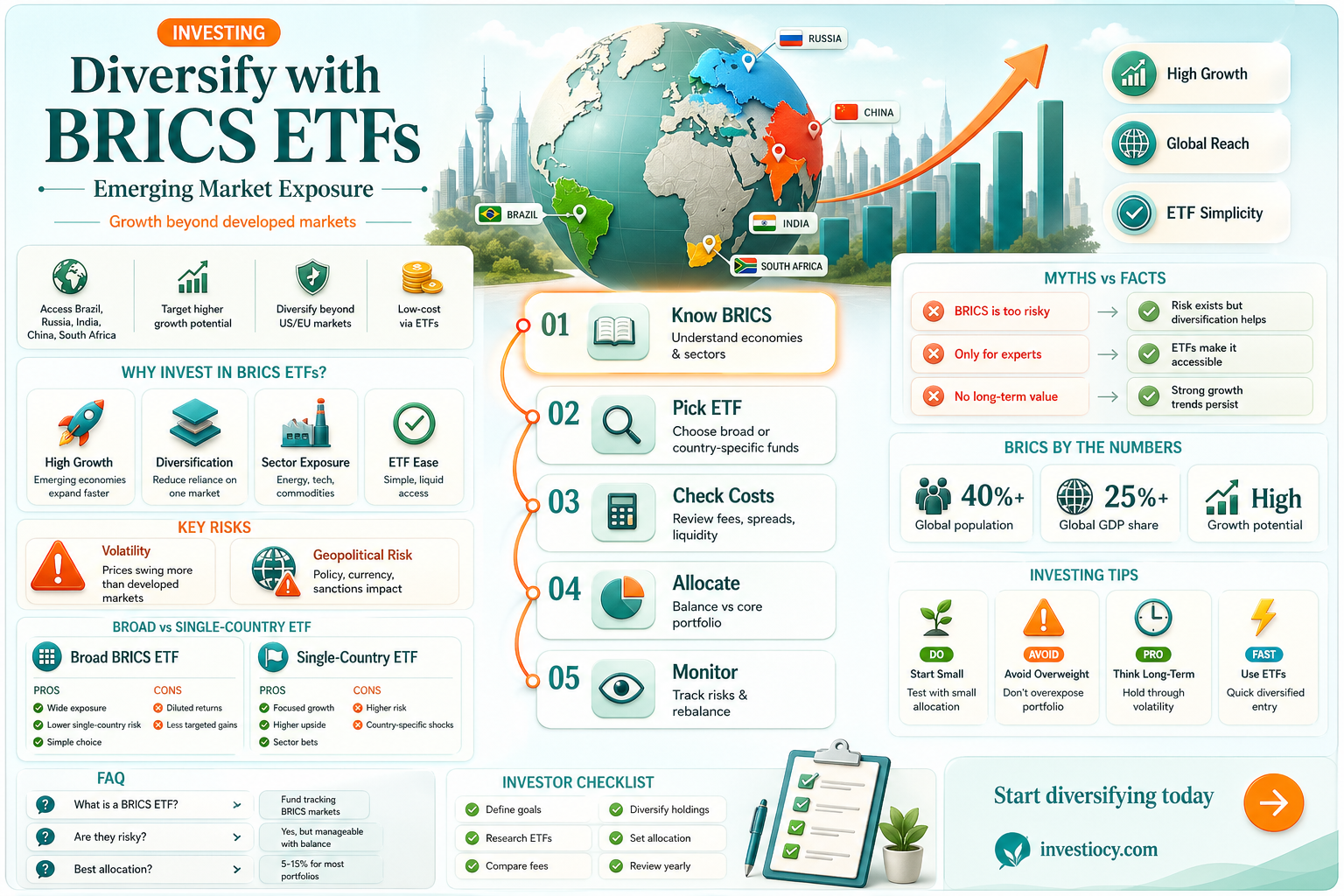
Investing in BRICS Exchange-Traded Funds (ETFs) offers a diversified exposure to the emerging markets of Brazil, Russia, India, China, and South Africa. These economies are known for their rapid growth potential and increasing global influence. To invest in BRICS ETFs, one should first research the various funds available, considering factors such as expense ratios, fund size, and historical performance. It's also crucial to understand the risks associated with emerging markets, including political instability, currency fluctuations, and economic volatility. Investors can purchase BRICS ETFs through a brokerage account, and it's advisable to consult with a financial advisor to ensure that such investments align with one's overall financial goals and risk tolerance.
Explore related products


What You'll Learn
- Understanding BRICS ETFs: Learn about the BRICS economies and how ETFs track their performance
- Benefits of BRICS Investment: Explore the potential advantages of investing in BRICS ETFs, such as diversification and growth
- Risks Associated with BRICS ETFs: Understand the risks involved, including political instability, currency fluctuations, and market volatility
- Choosing the Right BRICS ETF: Research and compare different BRICS ETFs based on their composition, fees, and historical performance
- Investment Strategies for BRICS ETFs: Develop a strategy for investing in BRICS ETFs, considering factors like risk tolerance, investment horizon, and market conditions

Understanding BRICS ETFs: Learn about the BRICS economies and how ETFs track their performance
The BRICS economies—Brazil, Russia, India, China, and South Africa—are a group of emerging market countries that have garnered significant attention from investors due to their rapid economic growth and increasing global influence. Exchange-traded funds (ETFs) that track the performance of these economies offer a convenient way for investors to gain exposure to these markets. Understanding how these ETFs work and the factors that influence their performance is crucial for making informed investment decisions.
BRICS ETFs typically hold a basket of securities that represent the respective countries, such as stocks, bonds, or a combination of both. These funds aim to replicate the performance of a specific benchmark index that tracks the BRICS markets. For example, the MSCI BRICS Index is a widely used benchmark that measures the market performance of large- and mid-cap companies in the BRICS countries. ETFs that track this index will hold securities that are similar in composition to the index, allowing investors to gain broad exposure to the BRICS economies with a single investment.
One of the key factors that influence the performance of BRICS ETFs is the economic conditions of the underlying countries. Events such as changes in government policies, economic reforms, and shifts in global commodity prices can have a significant impact on the performance of these funds. For instance, a decline in oil prices could negatively affect the performance of Russian and Brazilian ETFs, as these countries are major oil exporters. Conversely, a rise in global demand for technology products could benefit Indian and Chinese ETFs, as these countries have strong technology sectors.
Investors should also consider the risks associated with investing in BRICS ETFs. These funds are subject to various risks, including political risk, currency risk, and market risk. Political instability or changes in government policies can lead to significant fluctuations in the value of BRICS ETFs. Currency risk is another important consideration, as changes in exchange rates can impact the fund's performance. Additionally, market risk is inherent in any investment, and BRICS ETFs are no exception. It is essential for investors to understand these risks and to have a diversified investment portfolio to mitigate them.
When selecting a BRICS ETF, investors should consider factors such as the fund's expense ratio, liquidity, and tracking error. The expense ratio is the annual fee charged by the fund manager, and it can vary significantly among different ETFs. Liquidity is another important factor, as it refers to the ease with which an investor can buy or sell shares of the ETF. A highly liquid ETF will have a tight bid-ask spread and a high trading volume, making it easier for investors to enter or exit the fund. Tracking error is the difference between the fund's performance and the performance of its benchmark index. A low tracking error indicates that the fund is closely tracking its benchmark, while a high tracking error suggests that the fund may not be performing as expected.
In conclusion, BRICS ETFs offer investors a convenient way to gain exposure to the rapidly growing BRICS economies. However, it is essential to understand the factors that influence the performance of these funds and to consider the associated risks. By carefully selecting a BRICS ETF and maintaining a diversified investment portfolio, investors can potentially benefit from the growth of these emerging markets while managing their risk exposure.
Explore related products


Benefits of BRICS Investment: Explore the potential advantages of investing in BRICS ETFs, such as diversification and growth
Investing in BRICS ETFs offers several potential advantages, primarily centered around diversification and growth. By allocating funds to these emerging markets, investors can spread their risk across different economies and asset classes, reducing their exposure to the volatility of any single market. This diversification can lead to a more stable portfolio, as the performance of BRICS countries may not be highly correlated with that of developed markets.
One of the key benefits of investing in BRICS ETFs is the potential for higher returns. These emerging markets are often characterized by rapid economic growth, driven by factors such as industrialization, urbanization, and a growing middle class. As a result, companies operating in these countries may experience higher revenue growth and profitability, which can translate into attractive returns for investors. Additionally, BRICS countries are increasingly becoming major players in the global economy, with significant contributions to sectors such as technology, energy, and commodities.
Another advantage of BRICS ETFs is their ability to provide exposure to a wide range of industries and sectors. These funds typically hold a diversified portfolio of stocks across various sectors, allowing investors to benefit from the growth potential of multiple industries. This can be particularly appealing for investors looking to capitalize on the economic development and industrial expansion occurring in these emerging markets.
Furthermore, investing in BRICS ETFs can offer a hedge against currency fluctuations. As these funds are denominated in local currencies, they can provide a natural hedge against changes in exchange rates. This can be beneficial for investors looking to mitigate the impact of currency volatility on their portfolios.
However, it is important to note that investing in BRICS ETFs also comes with certain risks. These emerging markets can be subject to political instability, regulatory changes, and economic challenges, which can impact the performance of the funds. Additionally, the liquidity of these ETFs may be lower compared to those tracking developed markets, potentially making it more difficult to buy or sell shares quickly.
In conclusion, investing in BRICS ETFs can offer a range of benefits, including diversification, growth potential, exposure to various industries, and a hedge against currency fluctuations. However, investors should also be aware of the associated risks and carefully consider their investment objectives and risk tolerance before allocating funds to these emerging markets.
Explore related products

$23 $23
$25.16 $54.98

$67.5 $97


Risks Associated with BRICS ETFs: Understand the risks involved, including political instability, currency fluctuations, and market volatility
Investing in BRICS ETFs comes with a unique set of risks that investors must carefully consider. Political instability is a significant concern, as the BRICS countries—Brazil, Russia, India, China, and South Africa—are known for their volatile political environments. Changes in government policies, corruption scandals, and geopolitical tensions can all impact the performance of these ETFs. For instance, the Russian invasion of Ukraine led to significant economic sanctions against Russia, causing its stock market to plummet and affecting the overall performance of BRICS ETFs.
Currency fluctuations are another major risk factor. The currencies of BRICS countries are often subject to high volatility due to factors such as inflation, interest rates, and trade balances. This can lead to significant changes in the value of ETF holdings, even if the underlying stocks perform well. For example, the Brazilian real has experienced substantial depreciation against the US dollar in recent years, which has negatively impacted the returns of Brazil-focused ETFs.
Market volatility is also a concern, as BRICS countries tend to have less mature and more illiquid financial markets compared to developed economies. This can result in large price swings and difficulty in buying or selling ETF shares at favorable prices. The Chinese stock market, for instance, has been known for its extreme volatility, with sharp rises and falls often occurring in response to government policies and economic indicators.
To mitigate these risks, investors should conduct thorough research on the specific BRICS countries they are interested in and consider diversifying their portfolios across multiple regions. It is also important to monitor geopolitical developments and economic indicators that could impact the performance of BRICS ETFs. Additionally, investors may want to consider hedging strategies to protect against currency fluctuations and market volatility.
In conclusion, while BRICS ETFs offer the potential for high returns, they also come with significant risks that must be carefully managed. By understanding the political, economic, and market factors that can impact these investments, investors can make more informed decisions and develop strategies to mitigate potential losses.
Explore related products
![Retail Market Environment [BRIC, India & CMA]: Retailing](https://m.media-amazon.com/images/I/61lct95mpyS._AC_UY218_.jpg)


Choosing the Right BRICS ETF: Research and compare different BRICS ETFs based on their composition, fees, and historical performance
To choose the right BRICS ETF, it's essential to delve into the specifics of each fund's composition. BRICS ETFs typically invest in a mix of equities from Brazil, Russia, India, China, and South Africa. However, the exact allocation can vary significantly between funds. Some ETFs may have a higher weighting in certain countries due to market size, economic growth prospects, or other factors. For instance, China often has a larger allocation due to its substantial market capitalization and growth potential. Investors should review the fund's prospectus or fact sheet to understand the specific country allocations and the criteria used for stock selection.
Fees are another critical factor to consider when selecting a BRICS ETF. The expense ratio, which includes management fees, administrative costs, and other expenses, can eat into investment returns over time. It's advisable to compare the expense ratios of different BRICS ETFs to find one that offers a competitive fee structure. Additionally, investors should be aware of any additional costs, such as transaction fees or foreign currency conversion fees, that may apply when buying or selling ETF shares.
Historical performance is also a key consideration, but it should be evaluated with caution. Past performance is not always indicative of future results, especially in volatile markets like those of the BRICS countries. Investors should look at both short-term and long-term performance metrics, as well as how the fund has performed during different market conditions. It's also useful to compare the fund's performance to relevant benchmarks, such as the MSCI BRICS Index, to get a sense of how well the fund is managed relative to the broader market.
In addition to these factors, investors may want to consider the fund's size and liquidity. Larger ETFs with higher trading volumes tend to have narrower bid-ask spreads, making it easier and less costly to buy and sell shares. Furthermore, the fund's management team and their experience in navigating the complexities of emerging markets can also be an important consideration.
Ultimately, choosing the right BRICS ETF requires careful research and a clear understanding of one's investment goals and risk tolerance. By comparing different funds based on their composition, fees, and historical performance, investors can make an informed decision that aligns with their overall investment strategy.
Explore related products


Investment Strategies for BRICS ETFs: Develop a strategy for investing in BRICS ETFs, considering factors like risk tolerance, investment horizon, and market conditions
To develop an effective investment strategy for BRICS ETFs, it's crucial to first assess your risk tolerance. BRICS markets can be volatile, so understanding how much risk you're willing to take on is essential. If you have a high risk tolerance, you may consider allocating a larger portion of your portfolio to BRICS ETFs. Conversely, if you're risk-averse, you might opt for a smaller allocation or look for ETFs that track more stable indices within the BRICS countries.
Next, consider your investment horizon. BRICS ETFs can be suitable for both short-term and long-term investors. If you're investing for the long term, you may want to focus on ETFs that track broad indices, as these can provide more stable returns over time. For short-term investments, you might look for ETFs that track specific sectors or industries that are expected to perform well in the near future.
Market conditions also play a significant role in your investment strategy. It's important to monitor the economic and political climate in the BRICS countries, as these can impact the performance of your investments. For example, if there's political instability in one of the countries, you may want to reduce your exposure to that particular market. Conversely, if there's a positive economic outlook, you might consider increasing your allocation.
Diversification is another key factor to consider. While BRICS ETFs can provide exposure to emerging markets, it's important to ensure that your portfolio is diversified across different asset classes and regions. This can help mitigate risk and provide more stable returns over time.
Finally, it's essential to regularly review and rebalance your portfolio. The performance of BRICS ETFs can change over time, so it's important to monitor your investments and make adjustments as needed. This can help ensure that your portfolio remains aligned with your investment goals and risk tolerance.
Frequently asked questions
A BRICS ETF is an exchange-traded fund that invests in companies based in the BRICS countries: Brazil, Russia, India, China, and South Africa. These funds aim to provide investors with exposure to the emerging markets and economies of these nations.
To invest in a BRICS ETF, you'll need to open a brokerage account if you don't already have one. Once your account is set up, you can search for BRICS ETFs using their ticker symbols or fund names. Place a buy order for the desired number of shares, and the ETF will be added to your portfolio.
Investing in a BRICS ETF can offer several benefits, including diversification of your portfolio, exposure to emerging markets with high growth potential, and the convenience of investing in multiple countries through a single fund. Additionally, ETFs typically have lower fees compared to actively managed mutual funds.
Like any investment, there are risks associated with BRICS ETFs. These can include market volatility, political instability in the BRICS countries, currency exchange risks, and the potential for lower returns if the emerging markets underperform. It's essential to research the fund and understand its risk profile before investing.