Laila Keith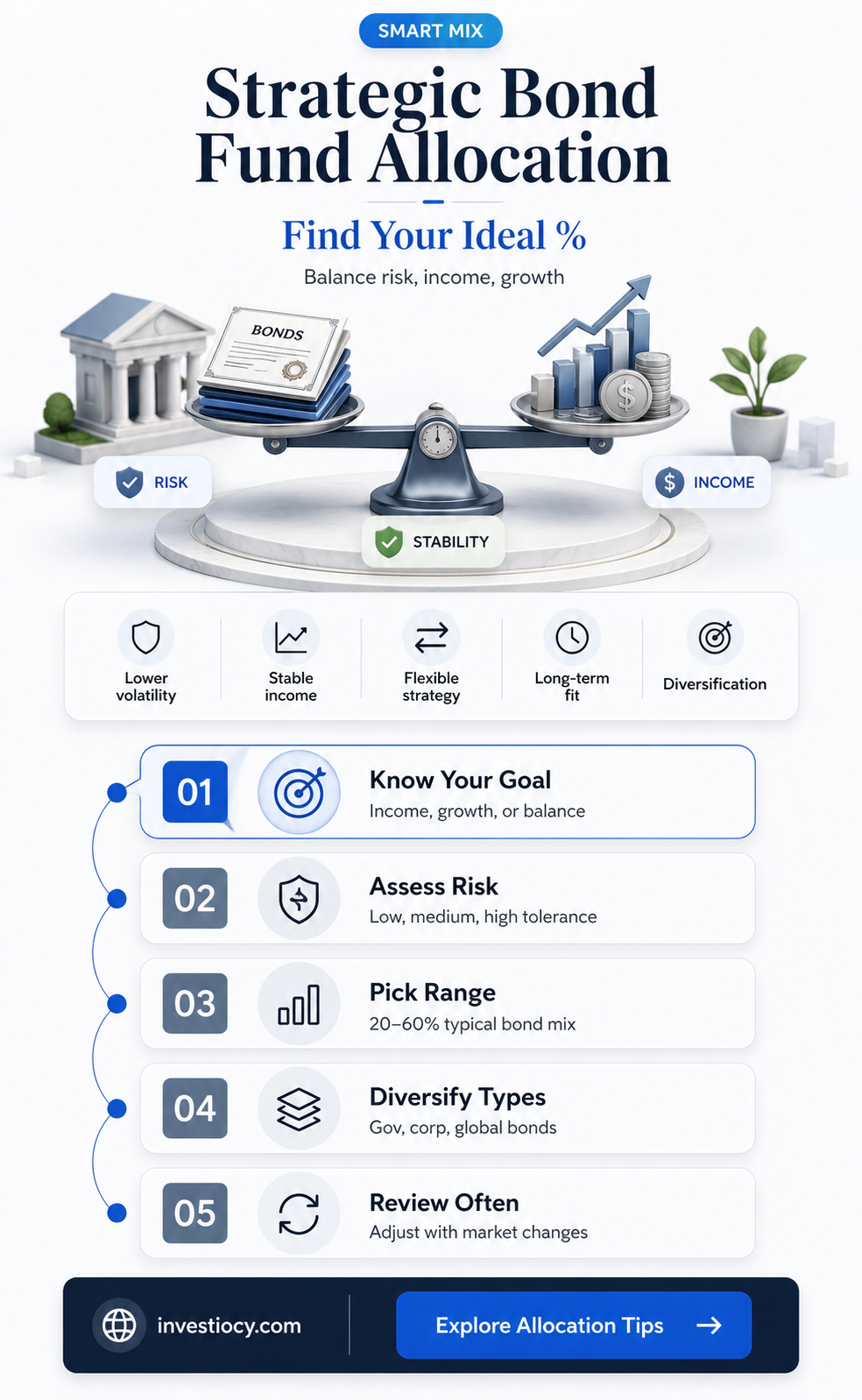
When considering the appropriate percentage of your portfolio to allocate to a bond fund, several factors come into play. Bonds are generally considered a lower-risk investment compared to stocks, making them a crucial component of a diversified portfolio. The percentage you should invest in a bond fund depends on your risk tolerance, investment goals, and time horizon. For instance, if you're nearing retirement and seeking to preserve capital, you might allocate a higher percentage to bonds. Conversely, if you're younger and can tolerate more risk, you might opt for a smaller allocation. Financial advisors often recommend a balanced approach, adjusting the bond allocation based on your individual circumstances and market conditions.
Explore related products


What You'll Learn
- Risk Tolerance: Assess your comfort with market fluctuations and potential losses
- Investment Goals: Determine if you're investing for growth, income, or capital preservation
- Time Horizon: Consider how long you can keep your money invested without needing it
- Diversification: Evaluate how bonds fit into your overall portfolio mix
- Economic Conditions: Analyze current interest rates and economic indicators that impact bond performance

Risk Tolerance: Assess your comfort with market fluctuations and potential losses
Assessing your risk tolerance is a critical step in determining the appropriate percentage of your portfolio to allocate to a bond fund. Risk tolerance refers to your ability and willingness to withstand market fluctuations and potential losses. It's a personal measure that can vary greatly from one individual to another, influenced by factors such as age, financial goals, income level, and investment experience.
To evaluate your risk tolerance, consider how you would react to a significant drop in the value of your investments. Would you be able to sleep at night knowing that your portfolio has decreased in value, or would you be inclined to sell your investments to cut your losses? If you're more comfortable with the idea of potential losses and can afford to wait out market downturns, you may have a higher risk tolerance. Conversely, if the thought of losing money keeps you up at night, you may have a lower risk tolerance.
One way to assess your risk tolerance is by using a risk tolerance questionnaire. These questionnaires typically ask a series of questions about your financial situation, investment goals, and how you feel about risk. Based on your responses, the questionnaire will provide a score that indicates your risk tolerance level, which can range from conservative to aggressive. This can be a helpful tool in determining the percentage of your portfolio to allocate to a bond fund, as bond funds are generally considered to be lower-risk investments compared to stocks.
Another approach is to consider your investment horizon. If you have a longer time frame until you need to access your funds, you may be able to tolerate more risk and allocate a smaller percentage to bonds. However, if you're nearing retirement or have a shorter investment horizon, you may want to allocate a larger percentage to bonds to reduce the risk of losses.
Ultimately, the key is to find a balance that aligns with your personal risk tolerance and investment goals. By carefully assessing your comfort with market fluctuations and potential losses, you can make an informed decision about the percentage of your portfolio to invest in a bond fund.
Smart Investing: Mutual Funds and Your Savings Allocation
You may want to see also
Explore related products

$14.2 $14.95


Investment Goals: Determine if you're investing for growth, income, or capital preservation
Before determining the appropriate percentage to invest in a bond fund, it's crucial to align your investment strategy with your overarching financial goals. Are you investing for growth, seeking to maximize returns over the long term? Are you focused on generating income, perhaps to supplement your retirement or cover regular expenses? Or are you prioritizing capital preservation, aiming to protect your principal while still earning some returns? Each of these goals will influence your asset allocation and, consequently, the proportion of your portfolio dedicated to bond funds.
For growth-oriented investors, bond funds may play a supporting role in a portfolio dominated by equities. In this case, you might allocate a smaller percentage, such as 20-30%, to bond funds to provide stability and diversification. Income-focused investors, on the other hand, may allocate a larger portion of their portfolio to bond funds, potentially 50-70%, to capitalize on the regular interest payments. Those prioritizing capital preservation might opt for an even higher allocation, possibly 70-90%, to minimize risk and ensure the safety of their principal.
Consider your risk tolerance and investment horizon when determining your bond fund allocation. If you're risk-averse or have a shorter time frame, a higher allocation to bond funds may be appropriate. Conversely, if you're comfortable with volatility and have a longer investment horizon, you might favor a lower bond fund allocation. Additionally, factor in your tax situation, as bond fund returns may be subject to different tax treatments depending on whether they're held in a taxable or tax-advantaged account.
Ultimately, the key to successful investing is to create a diversified portfolio that aligns with your specific goals and risk profile. By carefully considering your investment objectives and the role bond funds play within your overall strategy, you can determine an appropriate allocation that helps you achieve your financial aspirations.
Explore related products


Time Horizon: Consider how long you can keep your money invested without needing it
The time horizon is a critical factor in determining the appropriate percentage to invest in a bond fund. It refers to the length of time you can keep your money invested without needing it. The longer your time horizon, the more time your investments have to grow and recover from any market fluctuations. Conversely, a shorter time horizon means you may need to access your funds sooner, which could impact your investment strategy.
For investors with a long time horizon, typically 10 years or more, a higher percentage allocation to bond funds may be suitable. This is because bonds tend to offer more stable returns over the long term, which can help to smooth out the overall performance of your portfolio. Additionally, the longer time horizon allows for the potential compounding of returns, which can significantly enhance the growth of your investment.
On the other hand, investors with a shorter time horizon, such as those planning to retire in the next few years, may need to adopt a more conservative approach. In this case, a lower percentage allocation to bond funds might be more appropriate, as it reduces the risk of capital loss in the event of market downturns. Instead, these investors may want to consider allocating a larger portion of their portfolio to more liquid assets, such as cash or short-term investments, to ensure they have access to funds when needed.
It's also important to consider the role of inflation when determining your time horizon and bond fund allocation. Over time, inflation can erode the purchasing power of your investments, so it's essential to factor this into your calculations. For example, if you're planning to retire in 20 years and expect an average annual inflation rate of 2%, you'll need to ensure your investments grow at a rate that outpaces inflation to maintain your standard of living.
In conclusion, the time horizon is a crucial consideration when deciding on the percentage to invest in a bond fund. By carefully evaluating your investment goals, risk tolerance, and time frame, you can develop a strategy that aligns with your financial objectives and helps you achieve long-term financial security.
Explore related products


$14.95


Diversification: Evaluate how bonds fit into your overall portfolio mix
Evaluating how bonds fit into your overall portfolio mix is a critical step in achieving a balanced investment strategy. Bonds, as fixed-income securities, play a unique role in diversification by providing a steady income stream and reducing the overall risk of a portfolio dominated by equities. To effectively incorporate bonds into your portfolio, consider the following steps:
- Assess Your Risk Tolerance: Determine your comfort level with market fluctuations and potential losses. Bonds are generally considered less risky than stocks, but they also offer lower returns. If you have a low risk tolerance, a higher allocation to bonds may be appropriate.
- Evaluate Your Investment Goals: Consider whether your primary objective is capital growth, income generation, or a combination of both. Bonds are excellent for generating regular income, making them suitable for investors nearing retirement or those who need to cover living expenses.
- Analyze Your Current Portfolio: Review the existing asset allocation in your portfolio. If you currently hold a significant amount of equities, adding bonds can help balance the risk and return profile. Conversely, if your portfolio already contains a large bond component, you may need to rebalance to ensure you're not overly conservative.
- Choose the Right Bond Fund: Select a bond fund that aligns with your investment goals and risk tolerance. Options include government bonds, corporate bonds, high-yield bonds, and municipal bonds. Each type has its own risk and return characteristics, so it's essential to choose wisely.
- Determine the Appropriate Allocation: Based on your risk tolerance, investment goals, and current portfolio composition, decide on the percentage of your portfolio to allocate to bonds. A common rule of thumb is the "100 minus your age" rule, where the percentage of bonds in your portfolio equals 100 minus your age. However, this is a general guideline and may not be suitable for all investors.
- Monitor and Rebalance: Regularly review your portfolio to ensure it remains aligned with your investment objectives. Market conditions can change, affecting the performance of both bonds and equities. Periodic rebalancing can help maintain the desired risk and return profile.
In conclusion, incorporating bonds into your portfolio mix is a strategic decision that requires careful consideration of your individual circumstances. By assessing your risk tolerance, evaluating your investment goals, analyzing your current portfolio, choosing the right bond fund, determining the appropriate allocation, and monitoring and rebalancing, you can effectively diversify your investments and achieve a more balanced financial future.
Explore related products


Economic Conditions: Analyze current interest rates and economic indicators that impact bond performance
The current economic landscape is characterized by fluctuating interest rates and a myriad of economic indicators that can significantly impact bond performance. As an investor, it's crucial to understand these factors to make informed decisions about your bond fund investments.
Interest rates are a primary driver of bond prices. When interest rates rise, bond prices typically fall, and vice versa. This inverse relationship is due to the fact that bonds with higher yields become more attractive to investors when interest rates increase, leading to a decrease in demand for existing bonds with lower yields. Conversely, when interest rates decrease, bonds with lower yields become more desirable, causing their prices to rise.
In addition to interest rates, other economic indicators such as inflation, GDP growth, and unemployment rates also play a role in bond performance. Inflation can erode the purchasing power of bond returns, making them less attractive to investors. GDP growth, on the other hand, can lead to increased corporate profits and higher bond yields. Unemployment rates can impact consumer spending and business investment, which in turn can affect bond prices.
To analyze these economic conditions, investors can look at various data sources such as the Federal Reserve's statements, economic reports, and market indices. By understanding the current state of the economy and how it may evolve, investors can make more informed decisions about the percentage of their portfolio to allocate to bond funds.
For example, if interest rates are expected to rise, an investor may choose to reduce their bond fund allocation to avoid potential losses. Alternatively, if the economy is expected to slow down, an investor may increase their bond fund allocation to take advantage of potentially higher yields.
In conclusion, analyzing current interest rates and economic indicators is essential for investors looking to optimize their bond fund investments. By understanding these factors and their potential impact on bond performance, investors can make more informed decisions about the percentage of their portfolio to allocate to bond funds.