Laila Keith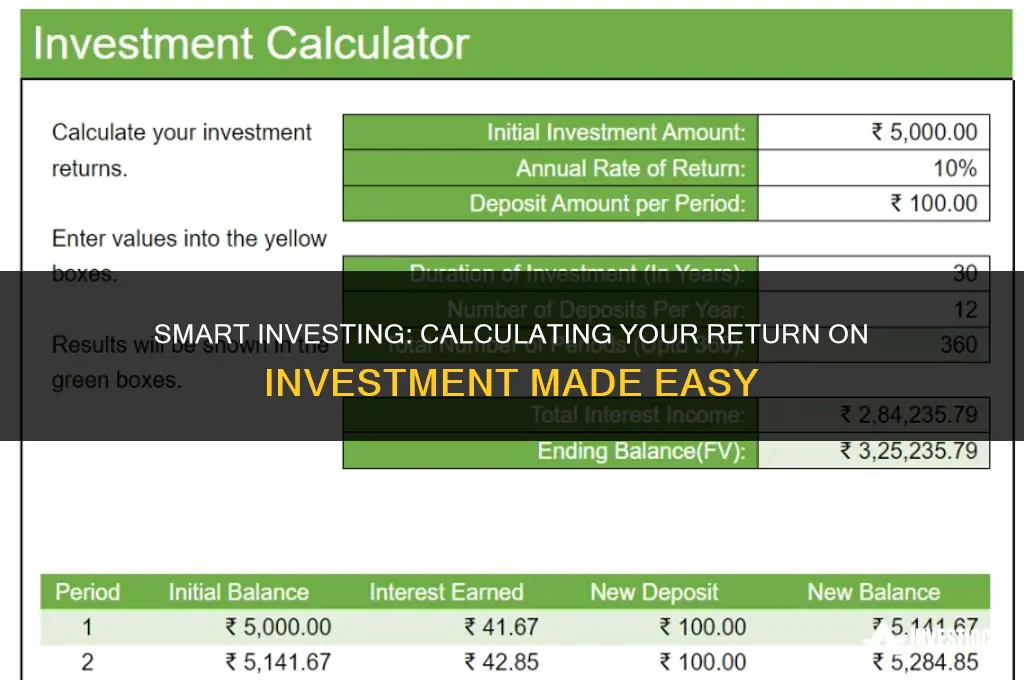
Calculating the rate of return on investment (ROI) is a crucial step for any investor looking to evaluate the performance of their investments. ROI is a financial metric that measures the profitability of an investment relative to its cost. It's expressed as a percentage and helps investors understand how much they've earned or lost on their investment over a specific period. To calculate ROI, you'll need to know the initial investment amount, the final value of the investment, and the time period over which the investment was held. The formula for ROI is: ROI = (Final Value - Initial Investment) / Initial Investment x 100. This simple yet powerful tool allows investors to compare different investment opportunities and make informed decisions about where to allocate their funds.
Explore related products


What You'll Learn
- Determine Initial Investment: Calculate the total amount initially invested, including any fees or expenses
- Calculate Final Value: Assess the final value of the investment, considering any returns, dividends, or capital gains
- Compute Time Period: Define the time frame over which the investment was held, typically in years
- Apply Rate of Return Formula: Use the formula: (Final Value - Initial Investment) / Initial Investment * 100
- Interpret Results: Analyze the calculated rate of return to evaluate the investment's performance and make informed decisions

Determine Initial Investment: Calculate the total amount initially invested, including any fees or expenses
To determine the initial investment, you need to consider all the costs involved at the outset of your investment journey. This includes not only the principal amount you invest but also any associated fees or expenses. These could encompass brokerage fees, transaction costs, or any other charges levied by the investment platform or financial advisor.
For instance, if you're investing in stocks, you might incur a brokerage fee for each transaction. If you're investing in mutual funds, there might be a front-end or back-end load, which is a percentage of your investment that goes to the fund company. Real estate investments might involve closing costs, legal fees, and property inspection fees. It's crucial to account for all these costs to get an accurate picture of your initial investment.
Let's say you're investing $10,000 in a mutual fund with a 5% front-end load. Your initial investment would not be $10,000, but rather $10,500, because you would be paying $500 in fees upfront. This distinction is important because it affects your rate of return calculation. If you don't account for these fees, you might overestimate your returns.
To avoid this, make sure to read the fine print and understand all the fees associated with your investment. Ask your financial advisor or the investment company to provide a detailed breakdown of all costs. Once you have this information, you can calculate your total initial investment by adding up the principal amount and all the fees and expenses.
Remember, the goal here is to get a clear and accurate understanding of how much you're actually investing. This will help you make more informed decisions and set realistic expectations for your returns. By taking the time to determine your initial investment accurately, you're setting yourself up for success in your investment journey.
Unlocking Economic Growth: A Guide to Calculating Investment
You may want to see also
Explore related products


Calculate Final Value: Assess the final value of the investment, considering any returns, dividends, or capital gains
To calculate the final value of an investment, you need to consider all the components that contribute to its growth over time. This includes not only the initial principal but also any returns, dividends, or capital gains that have been reinvested or distributed. The final value is a critical metric for assessing the performance of your investment and making informed decisions about your financial future.
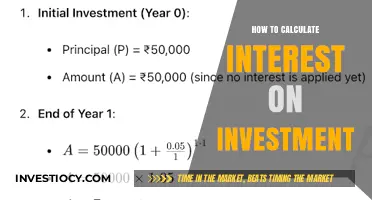
One approach to calculating the final value is to use the compound interest formula, which takes into account the principal amount, the annual interest rate, the number of compounding periods, and the time the money is invested. The formula is:
\[ A = P \left(1 + \frac{r}{n}\right)^{nt} \]
Where:
- \( A \) is the amount of money accumulated after n compounding periods.
- \( P \) is the principal amount (the initial amount of money).
- \( r \) is the annual interest rate (decimal).
- \( n \) is the number of times that interest is compounded per year.
- \( t \) is the time the money is invested for in years.
For example, if you invest $1,000 at an annual interest rate of 5%, compounded quarterly, for 10 years, the final value would be:
\[ A = 1000 \left(1 + \frac{0.05}{4}\right)^{4 \times 10} \approx 1628.89 \]
This calculation assumes that all dividends and capital gains are reinvested, which is a common strategy for maximizing returns over the long term. However, if you choose to receive dividends or sell some of your investment, you would need to adjust the calculation accordingly.
Another important consideration when assessing the final value of an investment is the impact of taxes. Depending on your tax situation and the type of investment, you may be subject to capital gains taxes or other levies that could reduce your overall returns. It's essential to factor these costs into your calculations to get an accurate picture of your investment's performance.
In summary, calculating the final value of an investment involves using the compound interest formula to account for the principal, interest rate, compounding periods, and time invested. Additionally, you need to consider the impact of dividends, capital gains, and taxes on your overall returns. By taking these factors into account, you can make more informed decisions about your investments and financial future.
Mortgage Payoff vs. Investment: Calculating Your Best Financial Move
You may want to see also
Explore related products


Compute Time Period: Define the time frame over which the investment was held, typically in years
To compute the time period for an investment, you need to define the exact start and end dates. This is crucial because the duration of the investment directly impacts the rate of return calculation. For instance, if you invested $1,000 on January 1, 2018, and withdrew $1,200 on December 31, 2020, the time period would be three years.
The time frame is typically expressed in years, but it's essential to consider the compounding effect of returns. If the investment generates returns that are reinvested, the time period affects how significantly the initial investment grows. For example, an investment with a 10% annual return will grow more substantially over five years compared to one year due to the compounding effect.
When defining the time period, also consider the frequency of return calculation. Returns can be calculated annually, semi-annually, quarterly, or monthly. The chosen frequency must align with the investment's characteristics and the investor's goals. For instance, a long-term investment might be reviewed annually, while a short-term, high-liquidity investment might require more frequent monitoring.
In some cases, the time period might not be straightforward. For example, if an investment is made in stages or if there are partial withdrawals, the time period for each segment of the investment might differ. In such scenarios, it's necessary to calculate the weighted average time period, taking into account the proportion of the investment held during each distinct period.
Understanding the time period is fundamental to accurately calculating the rate of return. It allows investors to assess the performance of their investments and make informed decisions about future allocations. By defining the time frame correctly, investors can ensure that their return calculations are precise and reflective of the investment's true performance.
Calculating Gross Investment: A Step-by-Step Guide for Financial Success
You may want to see also
Explore related products

![H&R Block Tax Software Deluxe + State 2025 Win/Mac [PC/Mac Online Code]](https://m.media-amazon.com/images/I/611uM-FzipL._AC_UY218_.jpg)
![TurboTax Deluxe Desktop Edition 2025, Federal & State Tax Return [Win11/Mac14 Download]](https://m.media-amazon.com/images/I/71OcM906MLL._AC_UY218_.jpg)


![3-in-1 Personal Finance 3.0 for Mac [Download]](https://m.media-amazon.com/images/I/61I1dsH16-L._AC_UY218_.jpg)
Apply Rate of Return Formula: Use the formula: (Final Value - Initial Investment) / Initial Investment * 100
To calculate the rate of return on an investment using the provided formula, begin by identifying the final value of the investment. This is the amount you would receive if you were to sell the investment today. Next, determine the initial investment, which is the original amount you invested. The formula to apply is:
\[ \text{Rate of Return} = \left( \frac{\text{Final Value} - \text{Initial Investment}}{\text{Initial Investment}} \right) \times 100 \]
Using this formula, you can calculate the percentage return on your investment. For example, if you initially invested $1,000 and the current value of your investment is $1,200, the calculation would be:
\[ \text{Rate of Return} = \left( \frac{1200 - 1000}{1000} \right) \times 100 = 20\% \]
This means your investment has returned 20% of its initial value.
It's important to note that this formula calculates the simple rate of return, which does not take into account the time period over which the investment was held. For a more accurate assessment of the investment's performance, especially over longer periods, you may want to consider using the compound annual growth rate (CAGR) formula.
When applying this formula, ensure that you have accurate values for both the final value and the initial investment. This will help you obtain a precise rate of return. Additionally, be mindful of any fees or taxes associated with the investment, as these can impact the final value and, consequently, the rate of return.
In summary, the rate of return formula is a useful tool for evaluating the performance of an investment. By understanding how to apply this formula correctly, you can make more informed decisions about your investment portfolio and assess the effectiveness of your investment strategies.
Maximizing Profits: A Guide to Calculating Return on Invested Capital
You may want to see also
Explore related products

![[OLD VERSION] H&R Block Tax Software Deluxe + State 2019 [Amazon Exclusive] [PC Download]](https://m.media-amazon.com/images/I/71ddlh9VacL._AC_UY218_.jpg)
![[Old Version] TurboTax Deluxe 2023, Federal & State Tax Return [PC/Mac Disc]](https://m.media-amazon.com/images/I/71Eulvi6neL._AC_UY218_.jpg)

![TurboTax Premier Desktop Edition 2025, Federal & State Tax Return [Win11/Mac14 Download]](https://m.media-amazon.com/images/I/71ofxs16-9L._AC_UY218_.jpg)
![[OLD VERSION] TurboTax Deluxe 2024 Tax Software, Federal & State Tax Return [PC/MAC Download]](https://m.media-amazon.com/images/I/71UbHaUeeUL._AC_UY218_.jpg)
Interpret Results: Analyze the calculated rate of return to evaluate the investment's performance and make informed decisions
Analyzing the calculated rate of return is a critical step in evaluating the performance of an investment. This process involves examining the percentage change in the value of the investment over a specific period, taking into account any dividends, interest, or capital gains. By interpreting these results, investors can make informed decisions about whether to hold, buy more, or sell the investment.
To effectively interpret the rate of return, it's essential to consider the investment's risk profile, the investor's financial goals, and the overall market conditions. For instance, a high rate of return may indicate a successful investment, but it could also suggest a higher level of risk. Conversely, a low rate of return might imply a more stable investment but could also mean that the investor is not maximizing their potential earnings.
Investors should also compare the rate of return to relevant benchmarks, such as the performance of similar investments or the overall market average. This comparison can help determine whether the investment is outperforming or underperforming relative to its peers. Additionally, it's crucial to consider the time horizon of the investment, as short-term fluctuations may not accurately reflect the investment's long-term potential.
Interpreting the rate of return requires a nuanced understanding of financial concepts and market dynamics. By carefully analyzing the calculated rate of return and considering various factors, investors can make more informed decisions about their investment portfolios and work towards achieving their financial objectives.
Smart Start: Calculating Your Initial Investment for Success
You may want to see also
Frequently asked questions
The formula to calculate ROI is: ROI = (Net Profit / Cost of Investment) x 100. This formula helps you determine the percentage return you've earned on your investment.
To determine the net profit, subtract the total costs (including any fees or taxes) from the total revenue generated by the investment. This gives you the profit attributable to the investment.
For ROI calculations, you should use the initial investment cost, not the current market value. This is because ROI measures the return on the original amount invested.
Yes, ROI can be used to compare different investment opportunities. However, it's important to consider other factors such as risk, time horizon, and liquidity when making investment decisions.
Some limitations of using ROI include: it doesn't account for the time value of money, it can be misleading if the investment has a short holding period, and it doesn't consider the risk associated with the investment. Additionally, ROI can be manipulated by altering the net profit or cost of investment figures.