 Josephine Norton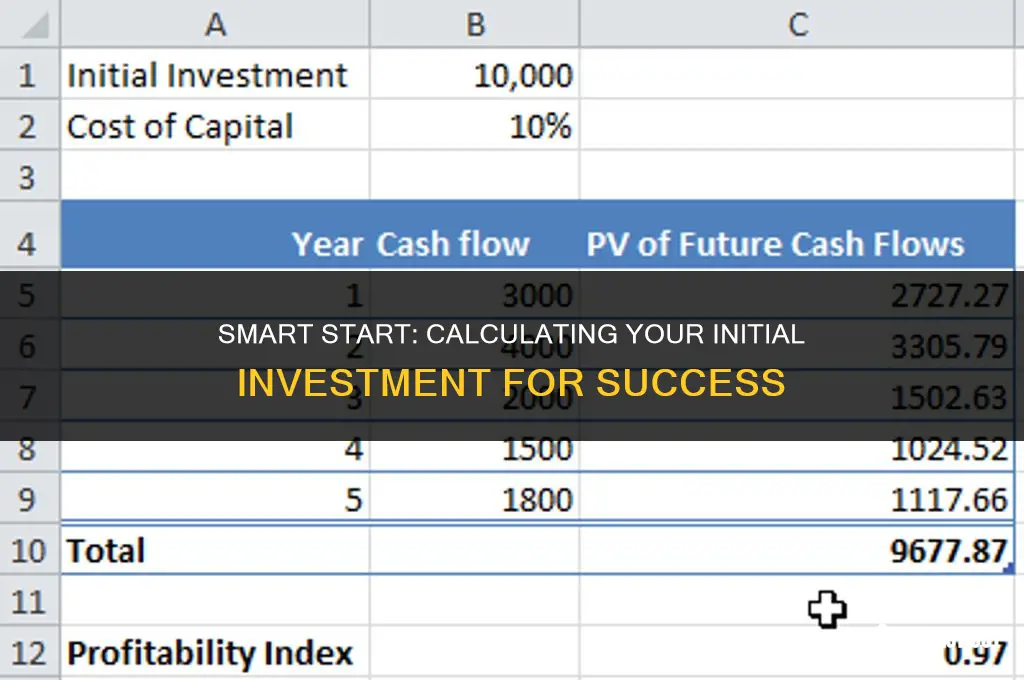
Calculating the initial investment is a crucial step for any financial venture, whether it's starting a business, investing in real estate, or entering the stock market. The initial investment refers to the total amount of money required to begin an investment or business activity. It includes all the upfront costs such as equipment, inventory, property, and any other necessary expenses. Understanding how to calculate this figure accurately is essential for creating a realistic budget, securing adequate funding, and setting financial goals. This calculation involves identifying all the relevant costs, estimating their amounts, and summing them up to get a comprehensive picture of the financial commitment required at the outset.
Explore related products


What You'll Learn
- Determine the total project cost: Calculate the sum of all expenses required to start and complete the project
- Identify the source of funds: Decide whether the investment will come from personal savings, loans, or other financial sources
- Assess the risk: Evaluate the potential risks associated with the investment and determine if they are acceptable
- Estimate the return on investment: Calculate the expected profit or benefit that the investment will generate over time
- Create a budget: Allocate the necessary funds to different aspects of the project based on their importance and urgency

Determine the total project cost: Calculate the sum of all expenses required to start and complete the project
To determine the total project cost, you must meticulously calculate the sum of all expenses required to start and complete the project. This involves a detailed breakdown of costs into various categories such as materials, labor, equipment, and overhead. Begin by listing all the items you will need to purchase or rent, including any necessary tools or machinery. Next, estimate the cost of labor by considering the number of workers required and their hourly rates. Don't forget to include overhead costs, which can encompass utilities, insurance, and administrative expenses.
Once you have identified all the cost components, assign a monetary value to each item. This may require researching current market prices or consulting with suppliers and contractors. It's crucial to be as accurate as possible in your estimations to avoid unexpected expenses down the line. Consider using project management software or spreadsheets to help organize and calculate your costs efficiently.
After you have calculated the individual costs, sum them up to get the total project cost. This figure will serve as a benchmark for your budget and help you determine if the project is financially feasible. It's also important to build in a contingency fund to account for any unforeseen expenses that may arise during the project.
In addition to direct costs, consider the opportunity costs associated with the project. These are the costs of not pursuing other opportunities while you are tied up with this project. For example, if you are using funds from your savings account to finance the project, you may miss out on potential investment returns.
Finally, analyze your cost structure to identify areas where you can potentially save money. This could involve negotiating better rates with suppliers, finding more cost-effective materials, or optimizing your labor usage. By carefully managing your costs, you can increase the likelihood of your project being successful and profitable.
Maximizing Profits: A Guide to Calculating Return on Invested Capital
You may want to see also
Explore related products


Identify the source of funds: Decide whether the investment will come from personal savings, loans, or other financial sources
Identifying the source of funds is a critical step in determining the initial investment for any financial venture. This process involves a thorough evaluation of one's financial resources and the selection of the most appropriate funding method. Here are some key considerations to keep in mind:
First, assess your personal savings. This includes any liquid assets such as checking and savings accounts, as well as investments that can be easily converted to cash, like stocks or bonds. It's important to have a clear understanding of your financial situation before committing to any investment.
Next, consider the option of taking out a loan. This could be a personal loan from a bank or credit union, or a business loan if you're starting a company. Be sure to research the interest rates and repayment terms carefully, as taking on debt can be risky if not managed properly.
Another potential source of funds is through partnerships or investors. If you have a solid business plan and a promising idea, you may be able to attract outside investment. This could come in the form of venture capital, angel investors, or crowdfunding.
Finally, don't overlook the possibility of using other financial sources, such as inheritance, gifts, or even winnings from contests or lotteries. While these sources may not be as common, they can still provide a viable means of funding your investment.
In conclusion, identifying the source of funds is a crucial step in the investment process. By carefully evaluating your financial resources and exploring all available options, you can make an informed decision about how to best fund your investment.
Smart Investing: Calculating Your Average Return on Investment
You may want to see also
Explore related products


Assess the risk: Evaluate the potential risks associated with the investment and determine if they are acceptable
Evaluating the potential risks associated with an investment is a critical step in the decision-making process. This involves identifying and assessing various factors that could impact the investment's performance and determining whether these risks are within an acceptable range for the investor.
One approach to assessing risk is to conduct a thorough analysis of the investment's historical performance, if available. This can involve reviewing financial statements, market trends, and industry reports to gain insight into the investment's volatility and potential for growth. Additionally, investors may want to consider the investment's correlation with other assets in their portfolio, as this can impact the overall risk profile.
Another important aspect of risk assessment is understanding the investor's own risk tolerance and investment goals. This involves considering factors such as the investor's age, financial situation, and investment horizon. For example, a younger investor with a longer investment horizon may be more willing to take on higher risks in pursuit of greater returns, while an older investor nearing retirement may prioritize capital preservation and opt for lower-risk investments.
Investors should also consider the specific risks associated with the type of investment they are considering. For example, stocks are subject to market risk, which is the risk that the overall market will decline, while bonds are subject to interest rate risk, which is the risk that interest rates will rise and the bond's value will decline. Real estate investments may be subject to risks such as property damage or changes in local zoning laws.
To mitigate these risks, investors may want to consider diversifying their portfolio across different asset classes and investment types. This can help to spread out the risk and reduce the impact of any single investment on the overall portfolio. Additionally, investors may want to consider using risk management strategies such as stop-loss orders or hedging to protect against potential losses.
Ultimately, the goal of risk assessment is to ensure that the investor is comfortable with the level of risk associated with the investment and that the investment aligns with their overall financial goals and objectives. By carefully evaluating the potential risks and taking steps to mitigate them, investors can make more informed decisions and increase their chances of achieving their investment goals.
Debt or Invest? Crunching the Numbers for Your Financial Future
You may want to see also
Explore related products


![LLC Beginner's Guide [All-in-1]: Everything on How to Start, Run, and Grow Your First Company Without Prior Experience. Includes Essential Tax Hacks, Critical Legal Strategies, and Expert Insights](https://m.media-amazon.com/images/I/61eAQwSUEcL._AC_UY218_.jpg)

Estimate the return on investment: Calculate the expected profit or benefit that the investment will generate over time
To estimate the return on investment (ROI), it's crucial to calculate the expected profit or benefit that the investment will generate over time. This involves forecasting future cash flows and determining the time value of money. One common method is to use the net present value (NPV) formula, which discounts future cash flows back to their present value using a specified discount rate. The NPV provides a clear picture of the investment's profitability, considering the time value of money.
Another approach is to use the internal rate of return (IRR) formula, which calculates the discount rate at which the NPV of the investment equals zero. The IRR represents the rate of return that an investment is expected to generate, and it's a useful metric for comparing different investment opportunities. When calculating the IRR, it's important to consider the reinvestment rate, which is the rate at which intermediate cash flows are reinvested.
In addition to these financial metrics, it's essential to consider qualitative factors that may impact the investment's performance. For example, market trends, industry outlook, and competitive landscape can all influence the investment's potential returns. Conducting thorough research and due diligence can help investors make informed decisions and mitigate potential risks.
When estimating the ROI, it's also important to consider the investment's risk profile. Higher-risk investments typically offer higher potential returns, but they also come with a greater chance of loss. Investors should carefully assess their risk tolerance and investment goals before making any decisions. Diversifying the investment portfolio can help spread risk and improve overall returns.
Finally, it's crucial to monitor and review the investment's performance over time. Regularly assessing the investment's progress and making adjustments as needed can help maximize returns and minimize losses. This may involve rebalancing the portfolio, adjusting the investment strategy, or even exiting the investment if it's not performing as expected.
In conclusion, estimating the ROI requires a combination of financial analysis, qualitative assessment, and ongoing monitoring. By carefully considering these factors, investors can make informed decisions and improve their chances of achieving their investment goals.
Maximizing Returns: A Guide to Calculating Investment Turnover
You may want to see also
Explore related products


Create a budget: Allocate the necessary funds to different aspects of the project based on their importance and urgency
To create a budget for your project, begin by identifying all the key components that require funding. This could include materials, labor, equipment, marketing, and any other expenses specific to your project. Once you have a comprehensive list, assess the importance and urgency of each item. For instance, if your project is time-sensitive, you may need to prioritize funding for labor and equipment to ensure timely completion.
Next, assign a monetary value to each component based on its importance and urgency. This may involve researching market prices, obtaining quotes from suppliers, or estimating costs based on similar projects. Be sure to include a contingency fund for unexpected expenses, typically around 10-20% of your total budget.
After allocating funds, create a detailed budget breakdown that outlines each expense category, the amount allocated, and the rationale behind the allocation. This document will serve as a financial roadmap for your project, helping you track expenses and make informed decisions as you progress.
Regularly review and adjust your budget as needed. As your project unfolds, you may encounter unforeseen challenges or opportunities that require reallocation of funds. By maintaining a flexible and dynamic budget, you can adapt to changing circumstances and ensure the financial health of your project.
In summary, creating a budget involves identifying project components, assessing their importance and urgency, assigning monetary values, including a contingency fund, documenting the budget breakdown, and regularly reviewing and adjusting the budget as necessary. This process is crucial for effective financial management and project success.
Maximizing Profits: A Step-by-Step Guide to Calculating Project ROI
You may want to see also
Frequently asked questions
The formula to calculate the initial investment is: Initial Investment = Total Project Cost - Present Value of Future Cash Flows.
To determine the present value of future cash flows, you use the formula: Present Value = Future Cash Flow / (1 + Discount Rate)^Number of Periods.
The discount rate is the rate at which future cash flows are discounted to their present value. It is used in the calculation to reflect the time value of money, which states that a dollar today is worth more than a dollar in the future.
Sure, let's say you have a project that costs $100,000 and is expected to generate $20,000 in cash flows each year for 5 years. Using a discount rate of 10%, the present value of the future cash flows would be: $20,000 / (1 + 0.10)^1 + $20,000 / (1 + 0.10)^2 + $20,000 / (1 + 0.10)^3 + $20,000 / (1 + 0.10)^4 + $20,000 / (1 + 0.10)^5 = $83,962. The initial investment would then be: $100,000 - $83,962 = $16,038.
Some common mistakes to avoid when calculating the initial investment include: forgetting to discount future cash flows, using an incorrect discount rate, and not considering all relevant costs and cash flows. It's important to carefully consider all factors and use accurate calculations to ensure a successful project.


