Josephine Norton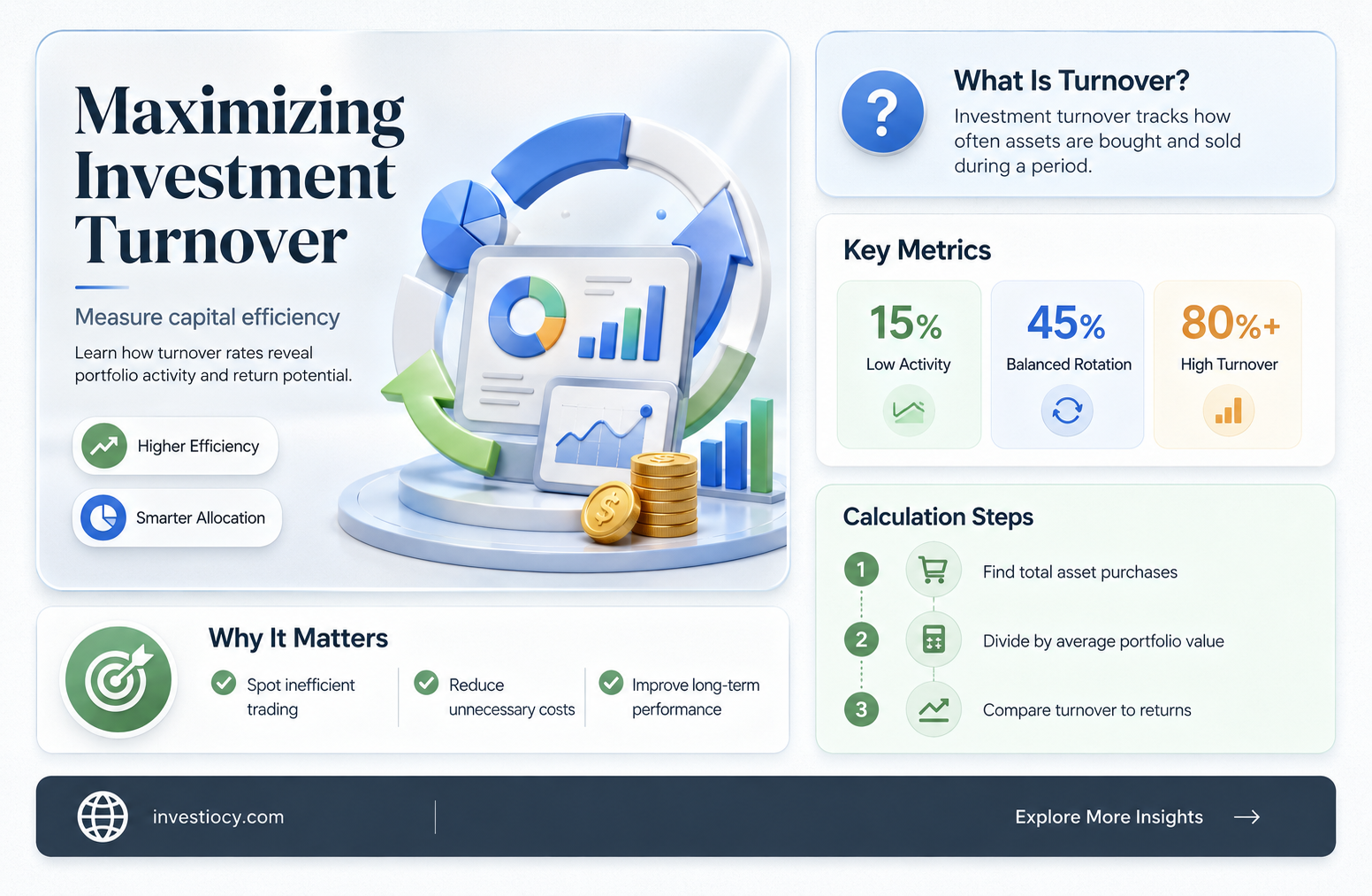
Investment turnover is a crucial metric for evaluating the efficiency of an investment portfolio. It measures the frequency with which investments are bought and sold within a given period, indicating the portfolio's liquidity and the investor's strategy. To calculate investment turnover, you need to determine the total value of securities sold and divide it by the average value of the portfolio over the period in question. This ratio helps investors understand how actively their investments are being managed and whether the strategy aligns with their financial goals. A high turnover rate may suggest a more aggressive investment approach, potentially leading to higher transaction costs but also the possibility of capturing short-term gains. Conversely, a low turnover rate might indicate a more passive, long-term investment strategy, which could result in lower transaction costs but may also mean missing out on short-term opportunities. Understanding how to calculate and interpret investment turnover is essential for investors looking to optimize their portfolio performance and align it with their risk tolerance and financial objectives.
| Characteristics | Values |
|---|---|
| Definition | Investment turnover is a financial ratio that measures the frequency with which an investment is replaced within a given period. |
| Formula | Investment Turnover = Total Sales / Average Investment |
| Purpose | It helps investors and analysts understand how efficiently investments are being used to generate sales. |
| Ideal Value | A higher investment turnover ratio is generally preferred as it indicates better use of investments. |
| Industry Variation | The ideal turnover ratio varies by industry; for example, retail typically has a higher turnover than manufacturing. |
| Time Period | Usually calculated over a year, but can be done for shorter periods like quarters or months. |
| Example | If a company has total sales of $10 million and an average investment of $2 million, the investment turnover is 5. |
| Interpretation | An investment turnover of 5 means the investment is replaced 5 times within the year. |
| Factors Influencing | Sales volume, investment amount, industry type, market conditions, and company strategy. |
| Limitations | Does not account for the profitability of sales or the quality of investments. |
| Comparison | Can be compared across companies within the same industry to assess operational efficiency. |
| Trend Analysis | Useful for tracking changes in a company's investment efficiency over time. |
| Benchmarking | Industry benchmarks can be used to evaluate a company's performance relative to its peers. |
| Calculation Tools | Can be calculated using financial software, spreadsheets, or manually with financial statements. |
| Reporting | Often included in annual reports, financial analyses, and investor presentations. |
Explore related products


What You'll Learn
- Definition of Investment Turnover: Understanding the concept and its importance in financial analysis
- Formula for Calculation: Detailed breakdown of the formula used to calculate investment turnover
- Types of Investments: Overview of different types of investments that can be analyzed using turnover
- Steps to Calculate: Step-by-step guide on how to calculate investment turnover using real-world examples
- Interpretation of Results: How to interpret the results of investment turnover calculations to make informed decisions

Definition of Investment Turnover: Understanding the concept and its importance in financial analysis
Investment turnover is a critical metric in financial analysis that measures the frequency with which an investment is bought and sold within a given period. It is calculated by dividing the total value of sales by the average value of investments over a specific timeframe. This ratio helps investors and analysts understand the liquidity and efficiency of an investment portfolio. A high turnover rate may indicate that the investments are highly liquid and can be easily converted into cash, while a low turnover rate might suggest that the investments are more long-term and less frequently traded.
Understanding investment turnover is essential for several reasons. Firstly, it can help investors assess the performance of their portfolios. A higher turnover rate can lead to increased transaction costs, which can eat into the overall returns of the investment. On the other hand, a lower turnover rate may indicate that the investments are not being actively managed, potentially leading to missed opportunities for profit. Secondly, investment turnover can provide insights into the investment strategy being employed. For instance, a high turnover rate may be indicative of a short-term trading strategy, while a low turnover rate may suggest a buy-and-hold approach.
Moreover, investment turnover can be used to compare the performance of different investment managers or funds. By analyzing the turnover rates of various portfolios, investors can identify managers who are able to achieve high returns with low turnover, indicating efficient management and potentially lower transaction costs. Conversely, a high turnover rate with low returns may signal poor management and excessive trading.
In addition to its analytical uses, investment turnover can also be an important consideration for tax planning. In many jurisdictions, frequent buying and selling of investments can lead to higher capital gains taxes. Therefore, understanding and managing investment turnover can help investors minimize their tax liabilities and maximize their after-tax returns.
In conclusion, investment turnover is a vital concept in financial analysis that provides valuable insights into the liquidity, efficiency, and performance of an investment portfolio. By understanding and monitoring investment turnover, investors can make more informed decisions about their investment strategies, compare the performance of different managers or funds, and optimize their tax planning.
Smart Investing: How to Calculate Additional Investment for Maximum Returns
You may want to see also
Explore related products


Formula for Calculation: Detailed breakdown of the formula used to calculate investment turnover
The formula for calculating investment turnover is a critical component in understanding the efficiency of an investment portfolio. It is calculated by dividing the total value of securities sold or matured during a given period by the average value of the portfolio during that same period. This ratio helps investors and analysts determine how quickly investments are being turned over and reinvested, which can impact overall portfolio performance.
Breaking down the formula, we have two main components: the numerator and the denominator. The numerator represents the total value of securities sold or matured, which includes any capital gains or losses realized from the sale of investments. This figure is straightforward and can be obtained from the portfolio's transaction history.
The denominator, on the other hand, is the average value of the portfolio during the period in question. This is calculated by taking the beginning value of the portfolio, adding any contributions or withdrawals, and then dividing by the number of days in the period. It's important to note that the average portfolio value should be calculated using the market value of the securities, not their cost basis.
Once the numerator and denominator are determined, the investment turnover ratio can be calculated by dividing the numerator by the denominator. For example, if the total value of securities sold or matured is $100,000 and the average portfolio value is $50,000, the investment turnover ratio would be 2. This means that the portfolio's investments are being turned over twice during the given period.
Interpreting the investment turnover ratio requires some context. A high turnover ratio may indicate that the portfolio is actively managed, with frequent buying and selling of securities. This can be beneficial in certain market conditions but may also lead to higher transaction costs and potential tax implications. Conversely, a low turnover ratio may suggest a more passive investment strategy, which can be advantageous for long-term investors who prefer to minimize transaction costs and taxes.
In conclusion, the formula for calculating investment turnover provides valuable insights into the management and efficiency of an investment portfolio. By understanding this formula and its components, investors can make more informed decisions about their investment strategies and optimize their portfolio performance.
Smart Investing: Calculate the Lifespan of Your Investments Today!
You may want to see also
Explore related products


Types of Investments: Overview of different types of investments that can be analyzed using turnover
Analyzing investment turnover is crucial for understanding the performance and liquidity of various investment types. Turnover rate, which measures the frequency of buying and selling securities within a given period, can significantly impact investment returns and risk profiles. Here's an overview of different investment types that can be evaluated using turnover analysis:
- Stocks: Stock turnover is a key metric for assessing the trading activity and market sentiment surrounding a particular company's shares. A high turnover rate in stocks may indicate increased volatility and liquidity, potentially offering more opportunities for short-term traders. Conversely, low turnover stocks might be more suitable for long-term investors seeking stable growth.
- Bonds: Bond turnover is essential for gauging the creditworthiness and market demand for a specific bond issue. High turnover in bonds can signal a higher risk of default or interest rate fluctuations, making them more appealing to risk-tolerant investors. Low turnover bonds, on the other hand, may offer more predictable returns and lower risk, attracting conservative investors.
- Mutual Funds: Turnover in mutual funds helps investors understand the fund manager's trading strategy and the fund's overall performance. High turnover mutual funds often incur higher transaction costs and may be more susceptible to market fluctuations, but they can also provide greater opportunities for capital appreciation. Low turnover funds tend to have lower costs and offer more stable returns, making them suitable for long-term investors.
- Real Estate: Real estate turnover is a valuable indicator of market conditions and property liquidity. High turnover in real estate can suggest a booming market with ample buying and selling opportunities, but it may also lead to increased transaction costs and potential market bubbles. Low turnover real estate markets might be more stable and predictable, offering steady rental income and long-term appreciation potential.
- Commodities: Commodity turnover is crucial for assessing market demand and supply dynamics. High turnover commodities, such as oil or gold, can be highly volatile and offer significant profit potential for short-term traders. However, they also carry higher risks due to geopolitical and economic factors. Low turnover commodities, like agricultural products, may provide more stable returns and lower risk, making them attractive for long-term investors seeking diversification.
By analyzing turnover rates across these investment types, investors can gain valuable insights into market trends, risk profiles, and potential returns. This information can help them make informed decisions about their investment portfolios and strategies.
Mastering ROI Calculations: A Step-by-Step Excel Guide
You may want to see also
Explore related products


Steps to Calculate: Step-by-step guide on how to calculate investment turnover using real-world examples
To calculate investment turnover, begin by identifying the total value of investments at the start of the period in question. This could include stocks, bonds, mutual funds, or any other investment vehicles. For example, if an investor had $100,000 in investments at the beginning of the year, this would be their starting point.
Next, determine the total value of investments at the end of the period. This may involve calculating the current market value of stocks and bonds, or the redemption value of mutual funds. Continuing with the previous example, if the investor's portfolio was worth $120,000 at the end of the year, this would be the ending value.
The turnover rate can then be calculated by dividing the total value of investments at the end of the period by the total value at the start of the period. In the example given, the turnover rate would be $120,000 divided by $100,000, resulting in a turnover rate of 1.2, or 120%.
It's important to note that this calculation only provides a snapshot of investment turnover for a specific period. To get a more comprehensive understanding of an investor's turnover rate, it may be necessary to calculate the turnover rate over multiple periods and take an average.
Additionally, investors should be aware of the potential tax implications of high turnover rates. Frequent buying and selling of investments can result in capital gains taxes, which can eat into overall investment returns. Therefore, it's important to consider the tax consequences of investment decisions when calculating turnover rates.
In conclusion, calculating investment turnover involves identifying the starting and ending values of investments, dividing the ending value by the starting value, and considering the tax implications of high turnover rates. By following these steps, investors can gain a better understanding of their investment performance and make more informed decisions about their portfolios.
Calculating Gross Investment: A Step-by-Step Guide for Financial Success
You may want to see also
Explore related products






Interpretation of Results: How to interpret the results of investment turnover calculations to make informed decisions
Interpreting the results of investment turnover calculations is crucial for making informed decisions about your portfolio. Once you've calculated the turnover ratio, you'll need to analyze what it means in the context of your investment goals and the broader market. A high turnover ratio may indicate that your investments are generating significant returns, but it could also suggest that you're taking on more risk than necessary. Conversely, a low turnover ratio might imply stability, but it could also mean that your investments are underperforming.
To interpret your results effectively, consider the following steps:
- Compare to Benchmarks: Compare your turnover ratio to industry benchmarks or the performance of similar portfolios. This will help you understand whether your turnover is above or below average and identify areas for improvement.
- Assess Risk and Return: Evaluate the risk-return tradeoff of your portfolio. If your turnover ratio is high, ensure that the returns justify the increased risk. If your turnover is low, consider whether you're sacrificing potential returns for the sake of stability.
- Review Investment Goals: Align your turnover ratio with your investment goals. If you're investing for the long term, a lower turnover ratio may be more appropriate. If you're looking for short-term gains, a higher turnover ratio might be acceptable.
- Monitor Market Conditions: Keep an eye on market conditions and adjust your turnover ratio accordingly. In volatile markets, a lower turnover ratio can help minimize losses, while in bull markets, a higher turnover ratio might be advantageous.
- Seek Professional Advice: If you're unsure how to interpret your turnover ratio, consider consulting with a financial advisor. They can provide personalized guidance based on your unique financial situation and investment objectives.
By following these steps, you can gain a deeper understanding of your investment turnover and make more informed decisions about your portfolio. Remember, the key to successful investing is not just about generating returns, but also about managing risk and aligning your investments with your long-term goals.
Debt or Invest? Crunching the Numbers for Your Financial Future
You may want to see also
Frequently asked questions
Investment turnover is a financial metric that measures the number of times an investment is sold and replaced within a given period. It's important because it helps investors understand the liquidity and performance of their investments. A higher turnover rate can indicate more active trading, which might lead to higher costs but also the potential for greater returns. Conversely, a lower turnover rate suggests a more passive investment strategy, which could result in lower costs but might also mean slower growth.
To calculate the investment turnover ratio, you divide the total value of investments sold during a period by the average value of investments held during that same period. The formula is:
\[ \text{Investment Turnover Ratio} = \frac{\text{Total Value of Investments Sold}}{\text{Average Value of Investments Held}} \]
For example, if you sold investments worth $100,000 in a year and the average value of your investments during that year was $50,000, your investment turnover ratio would be 2.
Several factors can influence the investment turnover ratio, including market conditions, investment strategy, and investor behavior. For instance, a bull market might lead to higher turnover as investors take advantage of rising prices to sell and buy more investments. Conversely, a bear market might result in lower turnover as investors hold onto their investments, hoping for a recovery.
Investors can use the investment turnover ratio to evaluate the performance of their portfolios and make informed decisions about their investment strategies. A high turnover ratio might indicate that an investor is overtrading, which could lead to higher transaction costs and potentially lower returns. On the other hand, a low turnover ratio might suggest that an investor is not taking advantage of market opportunities or is holding onto underperforming investments. By monitoring their turnover ratio, investors can adjust their strategies to optimize their portfolio performance.