Laila Keith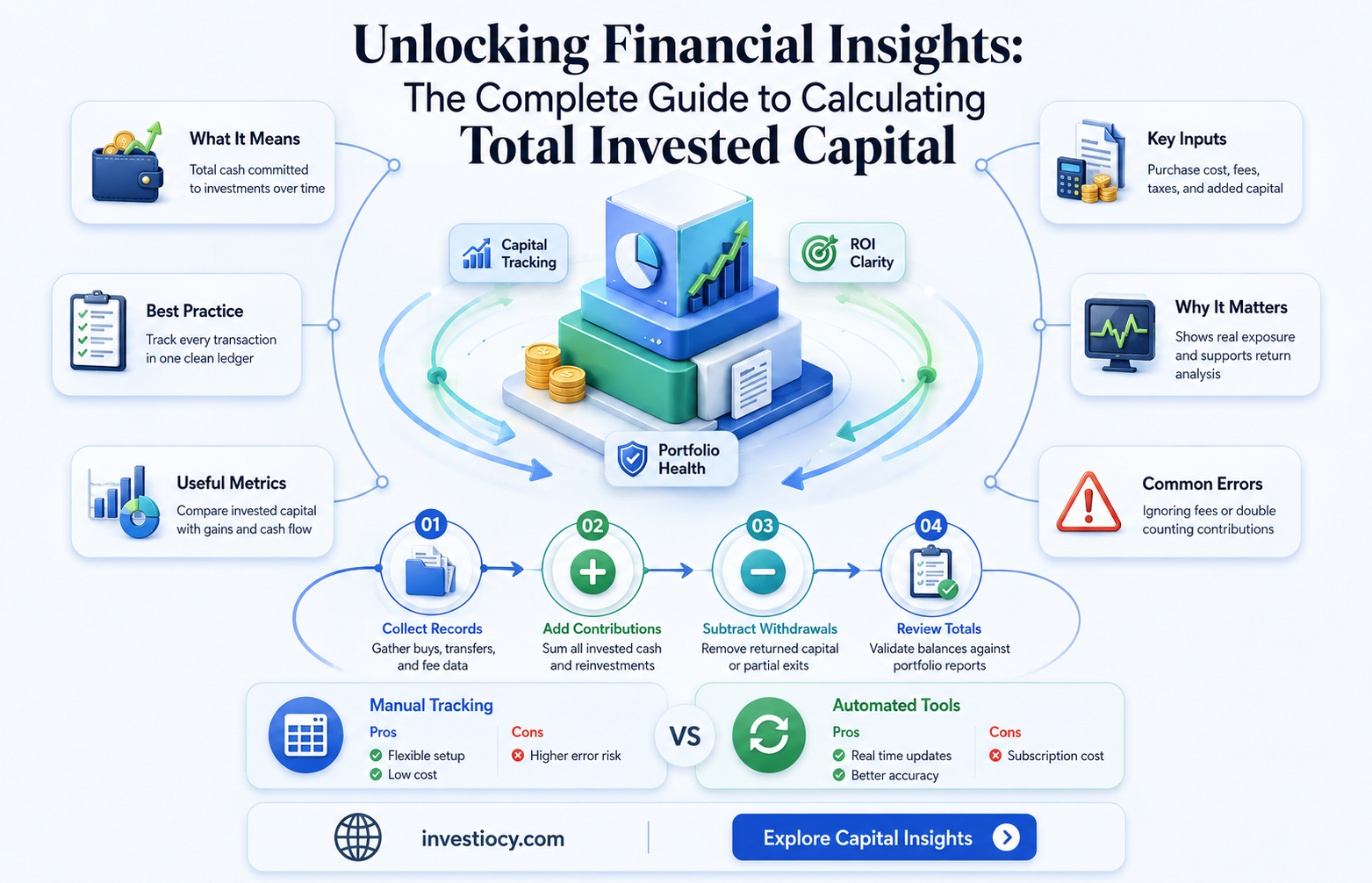
Calculating total invested capital is a crucial step for businesses looking to understand their financial health and make informed decisions. This metric represents the total amount of money invested in a company, including both equity and debt. To determine the total invested capital, you'll need to add together the company's total debt, including long-term and short-term obligations, and its total equity, which includes common stock, preferred stock, and retained earnings. This figure provides a comprehensive view of the company's financial structure and can be used to assess its ability to generate returns for investors. Understanding how to calculate total invested capital is essential for business owners, investors, and financial analysts alike, as it helps in evaluating the company's performance and potential for growth.
| Characteristics | Values |
|---|---|
| Definition | Total Invested Capital (TIC) is the total amount of money invested in a business or project, including both equity and debt financing. |
| Formula | TIC = Total Equity + Total Debt |
| Components | Total Equity, Total Debt |
| Purpose | To assess the financial health and leverage of a company, and to calculate return on invested capital (ROIC). |
| Equity Sources | Shareholder investments, retained earnings, additional paid-in capital |
| Debt Sources | Bank loans, bonds, notes payable, lease obligations |
| Calculation Frequency | Typically calculated annually or quarterly. |
| Industry Relevance | Relevant across all industries, especially in finance, investment, and corporate strategy. |
| Example | If a company has $500,000 in total equity and $300,000 in total debt, its TIC would be $800,000. |
| Importance | Helps in evaluating the efficiency of capital usage and the potential for future growth. |
| Limitations | Does not account for the market value of assets or the potential risks associated with the investments. |
| Related Metrics | Return on Invested Capital (ROIC), Debt-to-Equity Ratio, Capital Structure |
| Tools for Calculation | Financial statements, accounting software, spreadsheet models |
| Expertise Required | Basic understanding of financial accounting and corporate finance concepts. |
| Time Complexity | Moderate, depending on the availability of financial data. |
| Accuracy | High, when based on accurate and complete financial data. |
| Applications | Investment analysis, corporate valuation, financial planning, and strategy formulation. |
Explore related products





What You'll Learn
- Determine Initial Investments: Sum up all initial contributions made by investors and the company
- Add Subsequent Investments: Include any additional investments made after the initial funding round
- Account for Debt: Calculate total debt taken on by the company and add it to the investment sum
- Subtract Withdrawals: Deduct any funds withdrawn by investors or used for other purposes
- Adjust for Valuation Changes: Modify the total based on changes in the company's valuation over time

Determine Initial Investments: Sum up all initial contributions made by investors and the company
To determine initial investments, you must first identify all the sources of capital that have been injected into the company from its inception. This includes contributions from founders, angel investors, venture capitalists, and any other external or internal sources. Each of these contributions represents a piece of the total invested capital puzzle.
Next, you need to sum up these contributions. This involves adding together the monetary values of each investment. Be sure to consider the valuation of any non-monetary contributions, such as property or services, and convert them into a monetary equivalent for accurate calculation.
It's crucial to differentiate between initial investments and subsequent funding rounds. Initial investments are those made during the early stages of the company, often before it has a fully developed product or service. These are typically smaller amounts compared to later-stage investments.
When calculating initial investments, pay attention to the timing of each contribution. The cutoff point for what constitutes an 'initial' investment can vary, but it's generally considered to be within the first year or two of the company's operation.
Finally, ensure that you have a clear understanding of the terms associated with each investment. This includes knowing whether the investment is in the form of equity, debt, or a convertible note, as these terms will impact how the investment is valued and how it affects the company's financial structure.
By accurately determining and summing up initial investments, you can gain a clear picture of the total invested capital in the company, which is essential for making informed financial decisions and assessing the company's growth trajectory.
Debt or Invest? Crunching the Numbers for Your Financial Future
You may want to see also
Explore related products


Add Subsequent Investments: Include any additional investments made after the initial funding round
To accurately calculate total invested capital, it's crucial to account for all subsequent investments made after the initial funding round. These additional investments can significantly impact the overall valuation and financial health of a company. Here's a step-by-step guide on how to add subsequent investments to your total invested capital calculation:
- Identify Subsequent Investments: Begin by identifying all additional investments made after the initial funding round. This includes follow-on equity rounds, debt financing, convertible notes, and any other forms of capital infusion.
- Determine Investment Amounts: For each subsequent investment, determine the exact amount invested. This information should be readily available in the company's financial records or investment agreements.
- Calculate Cumulative Investment: Add up the amounts of all subsequent investments to calculate the cumulative investment. This figure represents the total additional capital injected into the company after the initial funding round.
- Adjust for Valuation Changes: If the company's valuation has changed between investment rounds, adjust the cumulative investment accordingly. This ensures that the total invested capital reflects the current market value of the company.
- Include Initial Funding Round: Finally, add the cumulative investment to the initial funding round to calculate the total invested capital. This comprehensive figure provides a clear picture of the company's overall financial backing.
By following these steps, you can accurately calculate total invested capital and gain valuable insights into the company's financial structure and growth potential.
Smart Investing: How to Calculate Additional Investment for Maximum Returns
You may want to see also
Explore related products


Account for Debt: Calculate total debt taken on by the company and add it to the investment sum
To accurately calculate total invested capital, it's crucial to account for the debt a company has taken on. This involves more than just tallying up outstanding loans; it requires a comprehensive approach that considers various forms of debt and their implications on the company's financial structure. Start by identifying all sources of debt, including long-term loans, short-term borrowings, bonds, and any other financial obligations the company has committed to.
Once you've compiled a list of debt sources, the next step is to determine the total amount owed. This isn't always straightforward, as some debts may have variable interest rates or be subject to change based on market conditions. For fixed-rate debts, you can simply add up the principal amounts. For variable-rate debts, you'll need to estimate the current value based on the latest interest rates and payment schedules.
In addition to the raw debt figures, it's important to consider the cost of servicing that debt. This includes interest payments, fees, and any other expenses associated with maintaining the debt. These costs can significantly impact the company's cash flow and overall financial health, so they should be factored into your calculation of total invested capital.
When adding debt to the investment sum, be sure to distinguish between productive and non-productive debt. Productive debt is typically used to finance investments that generate revenue, such as purchasing new equipment or expanding operations. Non-productive debt, on the other hand, is often used for purposes that don't directly contribute to revenue growth, like paying off existing debts or financing acquisitions. Understanding the nature of the debt can help you assess its impact on the company's long-term profitability.
Finally, consider the company's debt-to-equity ratio, which compares the total debt to the total equity invested in the company. This ratio can provide valuable insights into the company's financial leverage and risk profile. A high debt-to-equity ratio may indicate that the company is heavily reliant on debt financing, which can increase its vulnerability to economic downturns or changes in interest rates. Conversely, a low debt-to-equity ratio may suggest that the company has a more conservative financing strategy, which can provide greater stability but may also limit its growth potential.
By carefully accounting for debt and its associated costs, you can gain a more accurate picture of a company's total invested capital and its overall financial health. This information is essential for investors, lenders, and other stakeholders who need to make informed decisions about their involvement with the company.
Mastering ROI Calculations: A Step-by-Step Excel Guide
You may want to see also
Explore related products


Subtract Withdrawals: Deduct any funds withdrawn by investors or used for other purposes
To accurately calculate the total invested capital, it's crucial to account for any funds that have been withdrawn from the investment pool. This includes not only the principal amounts invested but also any returns or profits that have been distributed to investors. The process of subtracting these withdrawals ensures that the total invested capital reflects the current value of the funds committed to the investment.
The first step in this process is to identify all the withdrawals that have been made. This could include regular distributions, special payouts, or any other form of fund removal. It's important to have a comprehensive record of these transactions to ensure accuracy in the calculation.
Once the withdrawals have been identified, the next step is to categorize them. This is necessary because different types of withdrawals may have different implications for the total invested capital. For example, a return of principal would reduce the total invested capital, while a distribution of profits would not.
After categorizing the withdrawals, the relevant amounts can be deducted from the total invested capital. This should be done carefully to avoid any errors that could misrepresent the true value of the investment. It's also important to consider the timing of the withdrawals, as this can affect the calculation of the total invested capital.
Finally, it's essential to review and verify the calculations regularly. This will help to ensure that the total invested capital is accurately represented and that any discrepancies are identified and addressed promptly. Regular reviews can also help to identify trends or patterns in withdrawals, which can be useful for making informed investment decisions.
In conclusion, subtracting withdrawals is a critical step in calculating the total invested capital. By carefully identifying, categorizing, and deducting withdrawals, investors can ensure that they have an accurate representation of their investment's value. This information can then be used to make informed decisions about future investments and to track the performance of the investment over time.
Calculating Gross Investment: A Step-by-Step Guide for Financial Success
You may want to see also
Explore related products


$92.13 $123


Adjust for Valuation Changes: Modify the total based on changes in the company's valuation over time
To accurately calculate total invested capital, it's crucial to adjust for valuation changes over time. This involves modifying the total based on fluctuations in the company's valuation, which can be influenced by various factors such as market conditions, company performance, and investor sentiment.
One approach to adjusting for valuation changes is to use a discounted cash flow (DCF) analysis. This method involves estimating the company's future cash flows and discounting them back to their present value using a cost of capital. The resulting present value can then be used to adjust the total invested capital figure.
Another approach is to use a multiples-based valuation method. This involves comparing the company's valuation to that of similar companies in the same industry. By analyzing the valuation multiples of comparable companies, you can determine whether the company in question is overvalued or undervalued, and adjust the total invested capital accordingly.
It's important to note that adjusting for valuation changes can be a complex process, and it's essential to have a thorough understanding of the company's financials and the broader market context. Additionally, it's crucial to consider the potential risks and uncertainties associated with valuation changes, and to factor these into your calculations.
In conclusion, adjusting for valuation changes is a critical step in calculating total invested capital. By using methods such as DCF analysis or multiples-based valuation, you can ensure that your calculations are accurate and reflective of the company's true value.
Smart Investing: Calculate the Lifespan of Your Investments Today!
You may want to see also
Frequently asked questions
The formula to calculate Total Invested Capital (TIC) is: TIC = Total Debt + Total Equity + Non-Current Assets - Current Liabilities.
To determine Total Debt for TIC calculation, you sum up all the long-term debt obligations of the company, including bonds, loans, and other borrowings.
Current Liabilities are subtracted from the TIC formula because they represent short-term obligations that the company needs to settle within one year, and thus are not considered part of the long-term invested capital.