Clark Galvan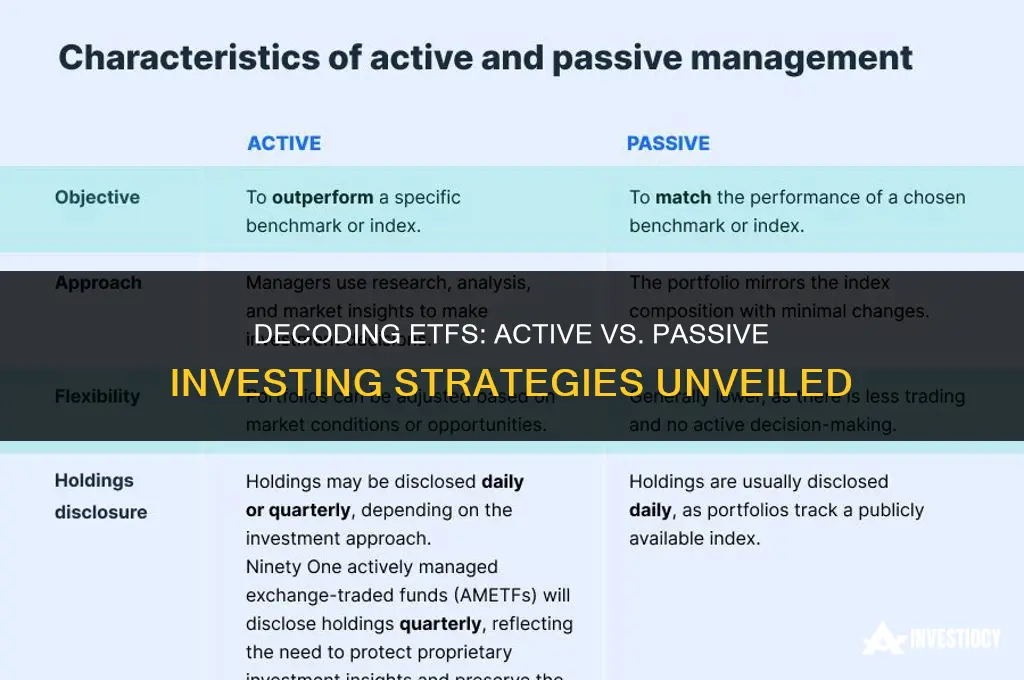
Exchange-traded funds (ETFs) are a popular investment vehicle that can be structured to follow either an active or passive approach. Understanding the difference between these two strategies is crucial for investors looking to align their portfolio with their financial goals and risk tolerance. Active ETFs are managed by professional fund managers who actively select and adjust the fund's holdings in an attempt to outperform the market or a specific benchmark. This approach often involves higher fees due to the increased management effort. On the other hand, passive ETFs aim to track a market index or sector without attempting to beat it. These funds typically have lower fees and are favored by investors who believe in the efficiency of the market. The choice between active and passive ETFs depends on an investor's preferences, investment horizon, and willingness to pay for management expertise.
Explore related products


What You'll Learn
- Definition of Active vs. Passive Investing: Understanding the fundamental differences between actively managed and passively managed investments
- How ETFs Work: Exploring the mechanics of Exchange-Traded Funds, including their structure, trading, and tracking of underlying indices?
- ETFs vs. Mutual Funds: Comparing the key features, advantages, and disadvantages of ETFs and mutual funds in the context of active and passive investing
- Index Tracking and Rebalancing: Discussing how ETFs track indices, the role of rebalancing, and the impact on investment performance and risk
- Costs and Fees Associated with ETFs: Analyzing the expense ratios, trading costs, and other fees linked to investing in ETFs compared to active funds

Definition of Active vs. Passive Investing: Understanding the fundamental differences between actively managed and passively managed investments
Active investing involves a hands-on approach where a fund manager or investor actively selects and manages the securities within a portfolio. This strategy aims to outperform the market by identifying undervalued or overvalued assets, anticipating market trends, and making timely buy and sell decisions. Active management often requires significant research, analysis, and expertise, as well as higher transaction costs due to frequent trading.
In contrast, passive investing adopts a more laissez-faire approach, where the investor or fund manager seeks to match the performance of a specific market index or sector. This is typically achieved through index funds or exchange-traded funds (ETFs), which hold a diversified portfolio of securities that mirror the composition of the underlying index. Passive investing is generally less expensive than active investing, as it involves fewer transactions and lower management fees.
One of the key differences between active and passive investing lies in the level of control and decision-making involved. Active investors have the flexibility to adjust their portfolio in response to market changes and economic indicators, while passive investors rely on the performance of the overall market or sector. This distinction also impacts the risk profile of each strategy, with active investing potentially offering higher returns but also carrying greater risk due to the possibility of poor investment decisions.
Another important consideration is the time horizon and investment goals of the individual. Active investing may be more suitable for those with a shorter time frame or specific financial objectives, as it allows for more targeted investment strategies. On the other hand, passive investing is often favored by long-term investors who are content with steady, market-average returns and are less concerned with short-term fluctuations.
Ultimately, the choice between active and passive investing depends on a variety of factors, including the investor's risk tolerance, investment goals, time horizon, and level of expertise. Both strategies have their advantages and disadvantages, and many investors opt for a combination of both approaches to achieve a balanced and diversified portfolio.
Strategic ETF Investments: Diversifying Your Portfolio for Optimal Returns
You may want to see also
Explore related products


How ETFs Work: Exploring the mechanics of Exchange-Traded Funds, including their structure, trading, and tracking of underlying indices
Exchange-Traded Funds (ETFs) operate on a unique structure that allows them to track the performance of an underlying index, such as the S&P 500, while being traded on stock exchanges like individual stocks. This dual nature of ETFs is what makes them a versatile investment vehicle. The structure of an ETF involves a trust that holds a collection of assets, which are then divided into shares that are sold to investors. These shares represent an ownership interest in the underlying assets and are designed to track the performance of a specific market index or sector.
The trading of ETFs is similar to that of individual stocks, with investors buying and selling shares throughout the trading day. However, unlike individual stocks, ETFs are not subject to the same level of volatility, as their value is tied to the overall performance of the underlying index. This makes ETFs a popular choice for investors looking to diversify their portfolios and reduce risk.
One of the key features of ETFs is their ability to track underlying indices with a high degree of accuracy. This is achieved through a process called "indexing," where the ETF's portfolio is constructed to mirror the composition of the underlying index. This involves regularly rebalancing the ETF's holdings to ensure that they remain aligned with the index.
ETFs can be actively or passively managed, with the majority being passively managed. Passively managed ETFs simply track the underlying index without any attempt to outperform it, while actively managed ETFs employ investment strategies to try and beat the index's performance. The choice between actively and passively managed ETFs depends on the investor's goals and risk tolerance.
In conclusion, ETFs are a unique investment vehicle that combines the benefits of both stocks and mutual funds. Their structure, trading, and tracking of underlying indices make them a versatile and efficient way to invest in the stock market. Whether an investor chooses an actively or passively managed ETF, understanding how these funds work is essential for making informed investment decisions.
Diversify Your Portfolio: The Benefits of Investing in ETFs
You may want to see also
Explore related products


ETFs vs. Mutual Funds: Comparing the key features, advantages, and disadvantages of ETFs and mutual funds in the context of active and passive investing
ETFs and mutual funds are two popular investment vehicles that offer different approaches to investing. ETFs, or Exchange-Traded Funds, are baskets of securities that trade on an exchange like stocks. They can track various indices, sectors, or asset classes, and are known for their flexibility and cost-effectiveness. Mutual funds, on the other hand, are professionally managed investment portfolios that pool money from multiple investors to invest in a diversified range of securities. They are typically bought and sold directly from the fund company and can be actively or passively managed.
One key difference between ETFs and mutual funds lies in their management style. ETFs are generally passively managed, meaning they aim to replicate the performance of a specific index or benchmark. This passive approach often results in lower fees and expenses compared to actively managed funds. Mutual funds, however, can be either actively or passively managed. Actively managed funds have a fund manager who makes investment decisions with the goal of outperforming the market, while passively managed funds simply track an index.
Another important distinction is the way ETFs and mutual funds are traded. ETFs trade on an exchange throughout the day, allowing investors to buy and sell shares at market prices. This provides greater liquidity and flexibility compared to mutual funds, which are typically bought and sold at the end of the trading day at the fund's net asset value (NAV). This difference in trading can impact the investor's ability to react quickly to market changes and may affect the overall investment experience.
In terms of advantages, ETFs often appeal to investors looking for a cost-effective and flexible way to invest in a diversified portfolio. They can be easily traded, allowing for quick adjustments to an investment strategy. Mutual funds, on the other hand, may be more suitable for investors who prefer professional management and are willing to pay higher fees for the potential of outperforming the market. They can also offer a wider range of investment options, including specialized funds that focus on specific sectors or asset classes.
When considering the disadvantages, ETFs may not be as suitable for investors who require regular income from their investments, as they typically do not distribute dividends as frequently as mutual funds. Additionally, ETFs can be more complex to understand and trade, especially for novice investors. Mutual funds, while offering professional management, can come with higher fees and expenses, which can eat into investment returns over time. They may also be less flexible in terms of trading, as investors are limited to buying and selling at the fund's NAV.
In conclusion, ETFs and mutual funds offer different approaches to investing, each with its own set of advantages and disadvantages. ETFs are generally more cost-effective and flexible, making them a popular choice for passive investors. Mutual funds, on the other hand, offer professional management and a wider range of investment options, which may appeal to investors looking for active management and the potential for higher returns. Ultimately, the choice between ETFs and mutual funds will depend on an investor's individual goals, risk tolerance, and investment preferences.
Smart Start: A Beginner's Guide to ETF Investing
You may want to see also
Explore related products




Index Tracking and Rebalancing: Discussing how ETFs track indices, the role of rebalancing, and the impact on investment performance and risk
ETFs, or Exchange-Traded Funds, are investment funds that hold a collection of assets such as stocks, bonds, or commodities. They are designed to track the performance of a specific market index, such as the S&P 500 or the Dow Jones Industrial Average. This tracking is done through a process called index replication, where the ETF manager selects a portfolio of securities that closely matches the composition of the target index. The goal is to provide investors with a way to gain broad market exposure with a single investment.
Rebalancing is a critical component of index tracking. It involves periodically adjusting the portfolio to ensure that it remains aligned with the target index. This is necessary because the weights of individual securities within an index can change over time due to factors such as stock price movements, dividend payments, and index reconstitutions. Without rebalancing, an ETF's portfolio could drift away from the index it is supposed to track, potentially leading to suboptimal performance.
The frequency and method of rebalancing can vary depending on the ETF provider and the specific index being tracked. Some ETFs rebalance daily, while others may do so quarterly or annually. The rebalancing process can be done in-house by the ETF provider or outsourced to a third-party firm. Regardless of the approach, the goal is to minimize tracking error, which is the difference between the ETF's performance and that of the target index.
Rebalancing can have a significant impact on an ETF's investment performance and risk profile. By maintaining a portfolio that closely matches the target index, rebalancing helps to ensure that the ETF provides the intended level of market exposure. This can be particularly important for investors who are using ETFs to implement a specific investment strategy, such as asset allocation or sector rotation. Additionally, rebalancing can help to manage risk by preventing the portfolio from becoming overly concentrated in certain securities or sectors.
However, rebalancing is not without its costs. Each time an ETF rebalances, it may incur transaction costs such as brokerage commissions and bid-ask spreads. These costs can eat into the fund's returns over time. Furthermore, frequent rebalancing can lead to higher turnover, which may result in increased capital gains taxes for taxable accounts. ETF providers must therefore strike a balance between the need to maintain index alignment and the desire to minimize costs and tax implications.
In conclusion, index tracking and rebalancing are essential components of ETF management. They enable ETFs to provide investors with a way to gain broad market exposure with a single investment, while also managing risk and controlling costs. By understanding how these processes work, investors can make more informed decisions about how to use ETFs in their portfolios.
Exploring ETF Investments: Are They Insured?
You may want to see also
Explore related products




Costs and Fees Associated with ETFs: Analyzing the expense ratios, trading costs, and other fees linked to investing in ETFs compared to active funds
ETFs, or Exchange-Traded Funds, are known for their cost-efficiency compared to actively managed funds. One of the primary costs associated with ETFs is the expense ratio, which is the annual fee charged by the fund manager to cover operating expenses. This fee is typically lower for ETFs because they are passively managed, meaning they track an index rather than requiring active stock selection and management. For example, the average expense ratio for an S&P 500 ETF is around 0.10%, while actively managed funds can have expense ratios upwards of 1.00%.
In addition to expense ratios, ETFs also incur trading costs. These costs can include brokerage commissions and bid-ask spreads. Brokerage commissions are fees charged by the broker for executing trades, and they can vary depending on the brokerage firm and the frequency of trading. Bid-ask spreads are the differences between the prices at which buyers are willing to purchase shares (bid) and the prices at which sellers are willing to sell shares (ask). ETFs typically have lower bid-ask spreads than actively managed funds due to their higher liquidity and trading volume.
Other fees associated with ETFs may include creation and redemption fees, which are charged when new shares are created or existing shares are redeemed. These fees are usually absorbed by the ETF provider and do not directly impact investors. Additionally, ETFs may incur securities lending fees, which are generated when the ETF lends out its underlying securities to short sellers. These fees can provide an additional source of income for the ETF and help offset other operating expenses.
When comparing the costs and fees of ETFs to those of actively managed funds, it is important to consider the overall impact on investment returns. Lower expense ratios and trading costs can lead to higher net returns for investors over the long term. However, it is also important to note that actively managed funds may provide additional benefits, such as professional investment management and the potential for higher returns in certain market conditions.
In conclusion, ETFs are generally more cost-effective than actively managed funds due to their lower expense ratios and trading costs. This cost efficiency can make ETFs an attractive option for investors looking to minimize fees and maximize returns over the long term. However, investors should also consider the potential benefits of actively managed funds when making their investment decisions.
Exploring the Future: A Guide to Investing in AI ETFs
You may want to see also
Frequently asked questions
The main difference lies in their management style. Active ETFs are managed by fund managers who actively select and adjust the portfolio's holdings to achieve specific investment goals. In contrast, passive ETFs track a predefined index or benchmark, with the portfolio's composition being automatically determined by the index's rules.
Active ETFs generally have higher expense ratios compared to passive ETFs. This is because active management requires more resources, including research, analysis, and trading costs, which are passed on to investors in the form of higher fees.
Passive ETFs are often considered more suitable for long-term investors due to their lower costs and the historical tendency of broad market indices to outperform actively managed funds over extended periods. However, individual investor goals and risk tolerance should always be taken into account.
Yes, active ETFs can potentially outperform passive ETFs, especially in specific market conditions or sectors where active management can add value through strategic selection and timing. However, consistently outperforming the market is challenging, and active ETFs may underperform their passive counterparts in some cases.