Faith Morrow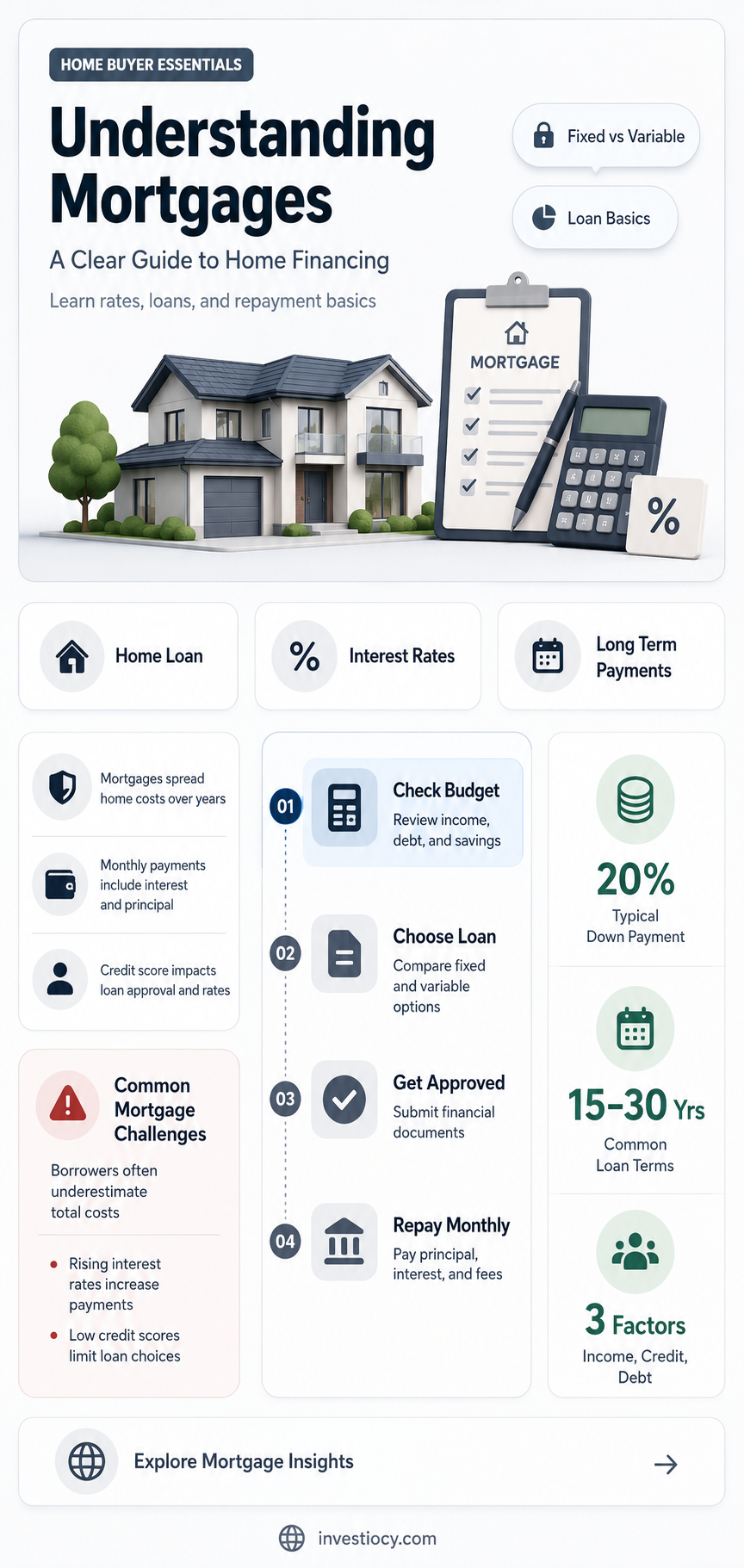
A mortgage is a type of loan designed to help individuals and families purchase a home. It works by allowing borrowers to secure a loan from a lender, using the property they intend to buy as collateral. The lender provides the funds needed to purchase the home, and the borrower agrees to repay the loan over a set period, typically 15 to 30 years. Mortgages come in various types, such as fixed-rate, adjustable-rate, and government-backed loans, each with its own set of terms and conditions. Understanding how mortgages work is crucial for potential homebuyers, as it can help them make informed decisions about their financing options and ensure they can comfortably afford their monthly payments.
Explore related products


What You'll Learn
- Types of Mortgages: Fixed-rate, adjustable-rate, FHA, VA, conventional, and jumbo loans
- Mortgage Application: Credit checks, income verification, debt-to-income ratio, and pre-approval process
- Down Payments: Minimum requirements, sources of funds, and impact on interest rates
- Closing Costs: Origination fees, appraisal fees, title insurance, and other expenses
- Repayment Terms: Amortization schedules, monthly payments, and strategies for paying off early

Types of Mortgages: Fixed-rate, adjustable-rate, FHA, VA, conventional, and jumbo loans
Understanding the different types of mortgages available is crucial for homebuyers as it directly impacts their financial planning and long-term obligations. Fixed-rate mortgages offer a stable interest rate throughout the loan term, providing predictable monthly payments. This type of mortgage is ideal for those who plan to stay in their home for an extended period and prefer consistent financial planning. On the other hand, adjustable-rate mortgages (ARMs) have interest rates that fluctuate based on market conditions, which can lead to varying monthly payments. ARMs are often chosen by borrowers who expect to move or refinance within a few years, or those who are comfortable with the potential for payment increases.
Federal Housing Administration (FHA) loans are designed to make homeownership more accessible, particularly for first-time buyers and those with lower credit scores. These loans require a lower down payment and offer more lenient credit requirements compared to conventional loans. However, they do come with mortgage insurance premiums, which can increase the overall cost of the loan. Veterans Affairs (VA) loans are available to eligible veterans and offer significant benefits, including no down payment requirement and lower interest rates. These loans are backed by the VA, which reduces the risk for lenders and allows for more favorable terms for borrowers.
Conventional loans are not insured or guaranteed by the government and typically require a higher down payment and better credit scores than FHA or VA loans. They are popular among borrowers with strong financial profiles who can afford the upfront costs. Jumbo loans are mortgages for larger loan amounts, often exceeding the conforming loan limits set by Fannie Mae and Freddie Mac. These loans are typically used for luxury homes or in high-cost housing markets and often come with higher interest rates and stricter underwriting requirements.
When choosing a mortgage, it's essential to consider factors such as your financial situation, how long you plan to stay in the home, and your risk tolerance. Each type of mortgage has its own set of advantages and disadvantages, and the right choice will depend on your individual circumstances and goals.
How Lenders Verify Your Primary Residence: A Comprehensive Guide
You may want to see also
Explore related products



Mortgage Application: Credit checks, income verification, debt-to-income ratio, and pre-approval process
Lenders scrutinize your credit history to assess your reliability in repaying debts. A higher credit score generally qualifies you for better interest rates and terms. Income verification is equally crucial; lenders need to ensure you have a stable and sufficient income to cover your mortgage payments. This involves reviewing pay stubs, tax returns, and sometimes bank statements.
The debt-to-income ratio (DTI) is a key metric in mortgage underwriting. It compares your total monthly debt payments to your gross monthly income. A lower DTI indicates you have more income available to cover your mortgage, making you a less risky borrower. Most lenders prefer a DTI of 36% or less, though some may allow higher ratios with compensating factors.
Pre-approval is a critical step in the mortgage process. It involves a thorough review of your financial situation, including credit checks and income verification. Getting pre-approved gives you an idea of how much house you can afford and shows sellers you're a serious buyer. It also locks in your interest rate for a set period, protecting you from rate increases while you shop for a home.
To navigate the mortgage application process smoothly, it's essential to be prepared. Gather all necessary documents, such as pay stubs, tax returns, and bank statements, beforehand. Check your credit report for errors and work on improving your score if needed. Pay down existing debts to lower your DTI and consider refinancing other loans to get better terms. By taking these steps, you can increase your chances of getting approved for a mortgage and securing your dream home.
Navigating Inflation: How Mortgages Adapt and Impact Homeownership
You may want to see also
Explore related products


Down Payments: Minimum requirements, sources of funds, and impact on interest rates
Lenders typically require a minimum down payment of 3% to 20% of the home's purchase price, depending on the type of mortgage and the borrower's creditworthiness. For example, FHA loans often require as little as 3.5% down, while conventional loans may require 5% to 20%. The source of the down payment funds can also impact the mortgage process. Borrowers may use savings, investments, or even gifts from family members to cover the down payment. However, some sources of funds, such as cash advances or loans from friends, may raise red flags with lenders and require additional documentation or explanation.
The amount of the down payment can significantly impact the interest rate offered by the lender. Generally, a larger down payment can lead to a lower interest rate, as it reduces the lender's risk. For instance, a borrower putting down 20% may qualify for a lower rate than someone putting down only 5%. Additionally, a larger down payment can help borrowers avoid private mortgage insurance (PMI), which can add to the overall cost of the loan.
When considering the impact of a down payment on interest rates, it's essential to weigh the benefits of a lower rate against the opportunity cost of tying up a large sum of money in the home. Borrowers should also consider their long-term financial goals and whether a larger down payment aligns with their overall financial strategy. In some cases, it may be more beneficial to put down a smaller amount and invest the remaining funds elsewhere, especially if the borrower expects to move within a few years or has other high-interest debt to pay off.
In conclusion, understanding the minimum requirements, sources of funds, and impact on interest rates is crucial for borrowers navigating the mortgage process. By carefully considering these factors, borrowers can make informed decisions that align with their financial goals and help them secure the best possible mortgage terms.
Decoding Primary Residence: How Mortgages Influence Your Main Home
You may want to see also
Explore related products


Closing Costs: Origination fees, appraisal fees, title insurance, and other expenses
Closing costs are a critical aspect of the mortgage process that borrowers must understand to avoid unexpected financial burdens. These costs, which can range from 2% to 5% of the loan amount, include various fees and expenses associated with securing a mortgage. Origination fees, charged by the lender for processing the loan application, are a significant component of closing costs. These fees can vary widely among lenders, making it essential for borrowers to shop around and compare rates.
Appraisal fees are another common closing cost, typically ranging from $300 to $500. These fees cover the cost of a professional appraisal to determine the property's value, ensuring that the lender is not over-extending itself by providing a loan that exceeds the property's worth. Title insurance is also a crucial part of closing costs, protecting the lender and borrower from potential title defects that could arise after the property purchase. The cost of title insurance varies by location and property value but can be a significant expense.
In addition to these primary closing costs, borrowers may also encounter other expenses, such as credit report fees, flood certification fees, and courier fees. These miscellaneous costs can add up quickly, so it's essential for borrowers to review their Loan Estimate carefully and ask their lender about any fees they don't understand. By being informed about closing costs and taking steps to minimize them, borrowers can save money and ensure a smoother mortgage process.
From Main Street to Wall Street: The Mortgage Journey Explained
You may want to see also
Explore related products


Repayment Terms: Amortization schedules, monthly payments, and strategies for paying off early
Understanding your mortgage repayment terms is crucial to managing your home loan effectively. An amortization schedule, which is a table showing each periodic payment on a mortgage, can help you visualize how your payments are allocated between principal and interest over time. Typically, in the early years of a mortgage, a larger portion of your monthly payment goes towards interest, with the amount applied to the principal increasing gradually.
Monthly payments are calculated based on the loan amount, interest rate, and loan term. For instance, a $200,000 mortgage with a 4% interest rate over 30 years would result in a monthly payment of approximately $955. This calculation assumes a fixed-rate mortgage, where the interest rate remains constant throughout the loan term. Adjustable-rate mortgages (ARMs) have payments that can fluctuate based on market interest rates.
Strategies for paying off your mortgage early can save you thousands of dollars in interest. One common approach is to make extra payments towards the principal. Even small additional amounts, such as $50 or $100 per month, can significantly reduce the loan term. Another strategy is to make bi-weekly payments instead of monthly ones, which can result in an extra payment being made each year without much change to your cash flow.
Refinancing to a shorter loan term, such as from a 30-year to a 15-year mortgage, is another option for paying off your mortgage faster. This strategy can lower your interest rate and reduce the overall loan term, but it typically requires higher monthly payments. It’s important to consider your financial situation and long-term goals when deciding on a refinancing strategy.
In summary, understanding your amortization schedule, managing your monthly payments, and exploring strategies for early repayment are key components of effectively handling your mortgage. By taking a proactive approach to your repayment terms, you can save money and achieve financial stability sooner.
Frequently asked questions
A mortgage is a loan from a bank or financial institution that allows you to purchase a home. You borrow a certain amount of money and agree to pay it back over a set period, typically 15 or 30 years, with interest.
A mortgage payment typically includes principal (the amount borrowed), interest (the cost of borrowing), taxes, and insurance (property and sometimes mortgage insurance).
A fixed-rate mortgage has an interest rate that remains the same throughout the loan term, while an adjustable-rate mortgage (ARM) has an interest rate that can change periodically based on market conditions.
Mortgage insurance is a policy that protects the lender in case the borrower defaults on the loan. It is typically paid by the borrower as part of the monthly mortgage payment, especially if the down payment is less than 20% of the home's purchase price.
To qualify for a mortgage, you need to meet certain criteria, including having a stable income, a good credit score, and enough savings for a down payment and closing costs. Lenders will also consider your debt-to-income ratio and the property's value.




![NMLS Study Guide 2026-2027 - 5 Full-Length Practice Tests, SAFE MLO Exam Prep Secrets Book for the Mortgage Loan Originator Exam: [4th Edition]](https://m.media-amazon.com/images/I/717iHac5CwL._AC_UL320_.jpg)