Inaya Mclaughlin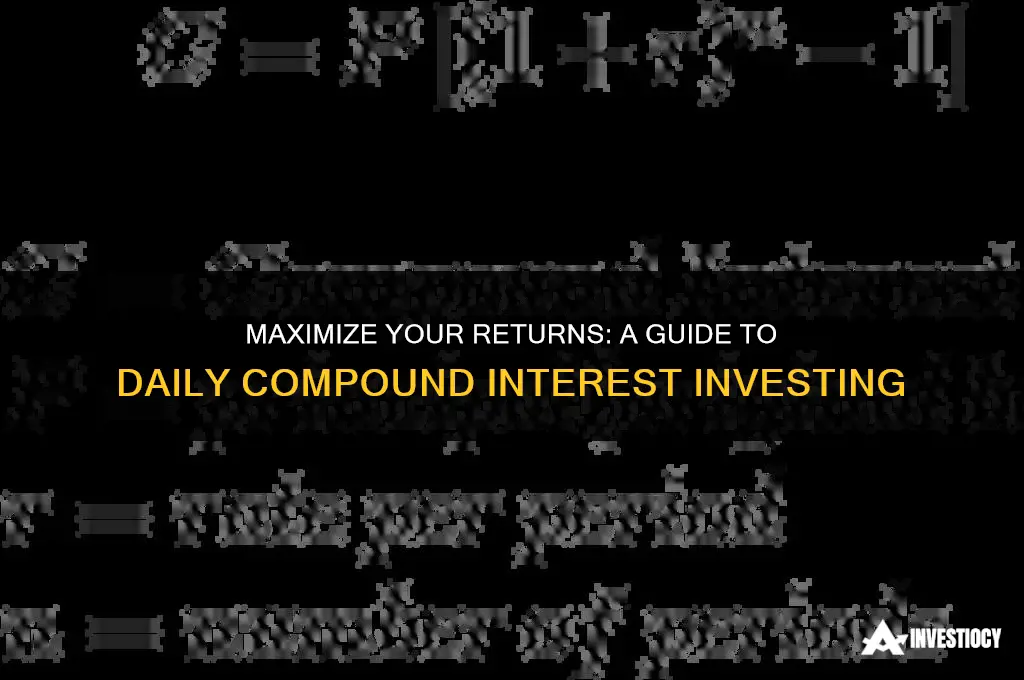
Investing in daily compound interest can be a powerful strategy for growing your wealth over time. By earning interest on both your principal investment and any accumulated interest, your returns can snowball, leading to significant growth. To get started, you'll need to understand the basics of compound interest, including how it's calculated and the factors that influence your earnings. Then, you can explore various investment options that offer daily compounding, such as high-yield savings accounts, certificates of deposit (CDs), and certain types of bonds or dividend-paying stocks. It's important to consider the risks and fees associated with each option, as well as your own financial goals and time horizon. With the right approach, daily compound interest can help you achieve your financial objectives more quickly and efficiently.
Explore related products



What You'll Learn
- Understanding Daily Compound Interest: Learn how daily compounding works and its impact on investment growth
- Choosing the Right Investment: Identify high-yield savings accounts, certificates of deposit, or bonds that offer daily compounding
- Calculating Potential Earnings: Use online calculators or formulas to estimate earnings based on principal, rate, and time
- Strategies for Maximizing Returns: Explore laddering CDs, reinvesting dividends, and maintaining a long-term perspective to boost returns
- Risks and Considerations: Be aware of inflation, interest rate fluctuations, and penalties for early withdrawals when investing

Understanding Daily Compound Interest: Learn how daily compounding works and its impact on investment growth
Daily compound interest is a powerful force in the world of finance, capable of significantly boosting investment growth over time. Unlike simple interest, which is calculated only on the initial principal, compound interest accrues on both the principal and any accumulated interest. This compounding effect can lead to exponential growth, making it a key concept for investors to grasp.
To understand daily compound interest, consider the following example: Suppose you invest $1,000 in a savings account with an annual interest rate of 5%. If the interest is compounded daily, the account balance at the end of one year would be approximately $1,051.26. This may not seem like a substantial increase, but over longer periods, the effect becomes more pronounced. For instance, if you leave the money in the account for 20 years, the balance would grow to around $2,653.30, more than doubling the original investment.
The formula for calculating daily compound interest is:
\[ A = P \left(1 + \frac{r}{n}\right)^{nt} \]
Where:
- \( A \) is the amount of money accumulated after n compounding periods.
- \( P \) is the principal amount (the initial amount of money).
- \( r \) is the annual interest rate (decimal).
- \( n \) is the number of times that interest is compounded per year.
- \( t \) is the time the money is invested for in years.
In the case of daily compounding, \( n \) would be 365. This formula allows you to calculate the future value of an investment with daily compound interest.
One of the most significant impacts of daily compound interest on investment growth is its ability to accelerate wealth accumulation. By reinvesting the interest earned each day, investors can harness the power of exponential growth. This is particularly beneficial for long-term investments, such as retirement funds, where the compounding effect can turn modest contributions into substantial sums over time.
However, it's also important to note that daily compound interest can work against investors if they are not careful. For example, if you have a high-interest credit card with daily compounding, the balance can quickly spiral out of control if not paid off regularly. Understanding how daily compound interest works can help you make informed decisions about both saving and borrowing.
In conclusion, daily compound interest is a fundamental concept in finance that can have a profound impact on investment growth. By understanding how it works and applying it wisely, investors can maximize their returns and achieve their financial goals more effectively.
Smart Investment Strategies for Rising Interest Rate Environments
You may want to see also
Explore related products


Choosing the Right Investment: Identify high-yield savings accounts, certificates of deposit, or bonds that offer daily compounding
To maximize the benefits of daily compound interest, it's crucial to select the right investment vehicle. High-yield savings accounts, certificates of deposit (CDs), and bonds are popular options, each with its own advantages and considerations.
High-yield savings accounts offer a low-risk way to earn daily compound interest. These accounts typically have higher interest rates than traditional savings accounts and allow for easy access to your funds. However, it's important to compare the annual percentage yield (APY) and fees among different institutions to ensure you're getting the best deal. Some high-yield savings accounts may have minimum balance requirements or withdrawal limits, so be sure to read the fine print.
Certificates of deposit (CDs) provide a fixed interest rate for a specific term, ranging from a few months to several years. CDs often offer higher interest rates than savings accounts, but they require you to commit your funds for the entire term. If you withdraw your money early, you may face penalties. CDs can be a good option if you have a specific savings goal and are willing to tie up your funds for a set period.
Bonds are debt securities issued by governments or corporations to raise capital. They offer a fixed interest rate and a set maturity date. Bonds can provide a steady stream of income through coupon payments, and the principal amount is typically returned at maturity. However, bonds carry credit risk, meaning there's a chance the issuer may default on their obligations. It's important to assess the creditworthiness of the issuer and the bond's rating before investing.
When choosing the right investment, consider your financial goals, risk tolerance, and time horizon. If you're looking for a low-risk option with easy access to your funds, a high-yield savings account may be the best choice. If you're willing to commit your funds for a longer period and are seeking a higher interest rate, a CD or bond may be more suitable. Remember to diversify your investments and consult with a financial advisor if you're unsure about the best option for your individual circumstances.
Unlocking Financial Growth: Compound Interest Investment Options Explained
You may want to see also
Explore related products


Calculating Potential Earnings: Use online calculators or formulas to estimate earnings based on principal, rate, and time
To calculate potential earnings with daily compound interest, you can leverage various online tools and formulas. One of the most straightforward methods involves using an online compound interest calculator. These calculators typically require three key inputs: the principal amount (your initial investment), the annual interest rate (expressed as a decimal), and the time period in years. By plugging in these values, the calculator will compute the future value of your investment, taking into account the compounding effect on a daily basis.
For those who prefer a more hands-on approach or wish to understand the underlying mechanics, the formula for compound interest can be used. The general formula is:
\[ A = P \left(1 + \frac{r}{n}\right)^{nt} \]
Where:
- \( A \) is the amount of money accumulated after n compounding periods.
- \( P \) is the principal amount (the initial amount of money).
- \( r \) is the annual interest rate (decimal).
- \( n \) is the number of times that interest is compounded per year.
- \( t \) is the time the money is invested for in years.
In the context of daily compound interest, \( n \) would be 365, as interest is compounded once per day.
Let's break down the process with an example. Suppose you invest $1,000 at an annual interest rate of 5%. After one year, with daily compounding, your investment would grow to:
\[ A = 1000 \left(1 + \frac{0.05}{365}\right)^{365 \times 1} \approx 1051.27 \]
This means you would earn approximately $51.27 in interest over the course of the year.
It's important to note that while daily compound interest can significantly boost your earnings over time, the actual impact may vary depending on the specific terms of your investment. Factors such as fees, taxes, and the stability of the financial institution can all influence your net returns. Therefore, it's crucial to conduct thorough research and consider all aspects before making an investment decision.
Understanding Investment Interest: A Beginner's Guide to Financial Growth
You may want to see also
Explore related products


Strategies for Maximizing Returns: Explore laddering CDs, reinvesting dividends, and maintaining a long-term perspective to boost returns
Laddering CDs is a strategic approach to investing that involves purchasing certificates of deposit with varying maturity dates. This method allows investors to take advantage of higher interest rates offered by longer-term CDs while maintaining liquidity through shorter-term options. By staggering the maturities, investors can ensure a steady stream of income and reinvestment opportunities, maximizing their returns over time.
Reinvesting dividends is another powerful strategy for boosting returns. When companies distribute dividends, investors have the option to reinvest those funds back into the company, purchasing additional shares. This not only increases the investor's stake in the company but also allows them to benefit from the compounding effect of dividends paid on the newly acquired shares. Over time, this can lead to significant growth in the investment portfolio.
Maintaining a long-term perspective is crucial for maximizing returns in the context of daily compound interest. Short-term fluctuations in the market can be misleading, and reacting to them can result in poor investment decisions. By focusing on the long-term trends and fundamentals of the investment, investors can ride out market volatility and benefit from the compounding effect of daily interest. This requires patience, discipline, and a deep understanding of the investment's underlying value.
To implement these strategies effectively, investors should consider their risk tolerance, investment goals, and time horizon. Laddering CDs may be more suitable for those seeking a balance between liquidity and higher returns, while reinvesting dividends can be a powerful tool for long-term growth. Maintaining a long-term perspective is essential for both strategies, as it allows investors to capitalize on the compounding effect of daily interest and dividends.
In conclusion, by exploring laddering CDs, reinvesting dividends, and maintaining a long-term perspective, investors can develop a comprehensive strategy for maximizing their returns in the context of daily compound interest. These tactics, when combined with a thorough understanding of the investment landscape and a disciplined approach, can lead to significant growth in the investment portfolio over time.
Unlocking Returns: A Guide to Investing in Argentina's Interest Rates
You may want to see also
Explore related products



Risks and Considerations: Be aware of inflation, interest rate fluctuations, and penalties for early withdrawals when investing
Inflation poses a significant risk to investors relying on daily compound interest, as it can erode the purchasing power of their returns over time. For instance, if an investment yields a daily compound interest rate of 5%, but the inflation rate is 3%, the real return is only 2%. This underscores the importance of considering inflation-adjusted returns when evaluating investment opportunities. Investors should also be mindful of the potential for interest rate fluctuations, which can impact the overall performance of their investments. A sudden increase in interest rates could lead to a decrease in bond prices, affecting the value of fixed-income investments. Conversely, a drop in interest rates might reduce the returns on savings accounts and other interest-bearing investments.
Penalties for early withdrawals are another critical consideration for investors. Many investment vehicles, such as certificates of deposit (CDs) and certain types of retirement accounts, impose fees or penalties for withdrawing funds before a specified maturity date. These penalties can significantly reduce the overall returns on an investment, making it essential for investors to understand the terms and conditions associated with their investments. For example, a CD with a one-year term might impose a penalty of three months' interest for early withdrawal, which could negate a substantial portion of the interest earned.
To mitigate these risks, investors should adopt a diversified investment strategy that takes into account their risk tolerance, investment horizon, and financial goals. This might involve allocating a portion of their portfolio to inflation-protected securities, such as Treasury Inflation-Protected Securities (TIPS), which are designed to keep pace with inflation. Additionally, investors should consider laddering their investments across different maturities to minimize the impact of interest rate fluctuations and reduce the need for early withdrawals. By carefully weighing the risks and considerations associated with daily compound interest investments, investors can make more informed decisions and potentially enhance their long-term financial outcomes.
Unlocking Tax Benefits: The Deductibility of Investment Interest Expense
You may want to see also
Frequently asked questions
Daily compound interest is the interest earned on an investment each day, which is then added to the principal amount. This results in the interest being calculated on a larger amount each day, leading to exponential growth over time.
Daily compounding calculates interest on the investment every day, while annual compounding calculates interest once a year. Daily compounding leads to faster growth because the interest is reinvested more frequently, resulting in a higher overall return.
Investments that offer daily compound interest include high-yield savings accounts, money market accounts, and some types of bonds and mutual funds. It's important to check with the financial institution or investment advisor to confirm if an investment offers daily compounding.
To maximize the benefits of daily compound interest, it's important to start investing as early as possible, maintain a consistent investment amount, and avoid withdrawing funds frequently. Reinvesting dividends and interest can also help accelerate growth.
While daily compound interest can lead to significant growth, it's important to be aware of potential risks such as market volatility, inflation, and changes in interest rates. It's crucial to diversify investments and consult with a financial advisor to mitigate these risks.