Inaya Mclaughlin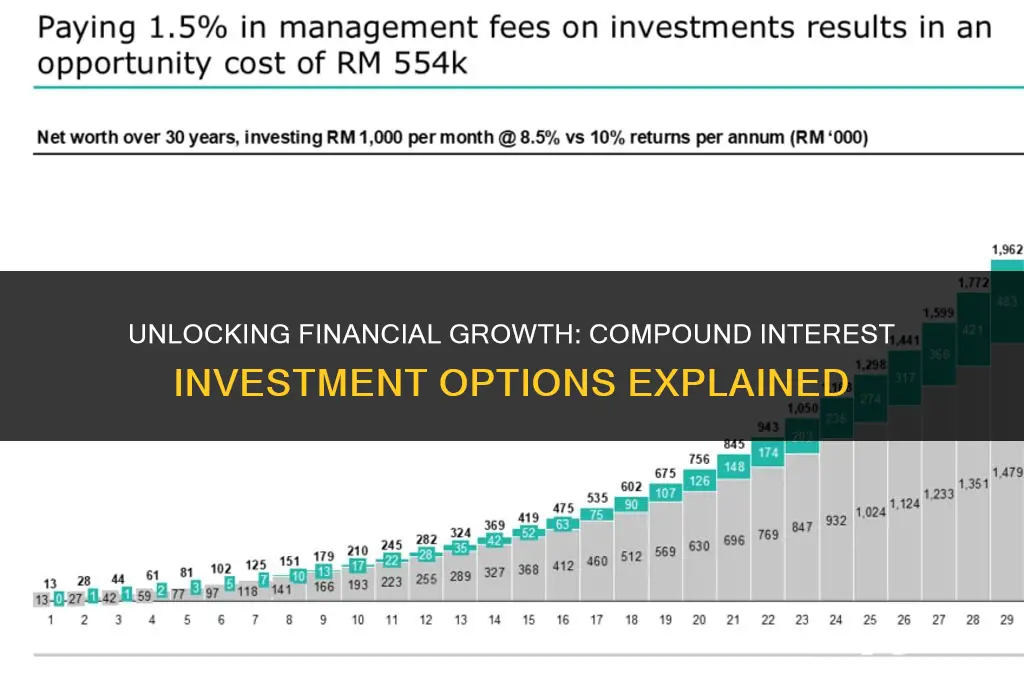
Compound interest is a powerful financial concept where the interest earned on an investment is reinvested, leading to exponential growth over time. When exploring investment options, it's crucial to identify those that offer compound interest to maximize returns. In this context, various investment vehicles such as savings accounts, certificates of deposit (CDs), bonds, and stocks can potentially provide compound interest. However, the key lies in understanding how each option compounds interest and the associated risks and returns. For instance, high-yield savings accounts and CDs typically offer compound interest, but with lower returns compared to stocks or mutual funds, which can provide higher returns but come with greater risk. Therefore, identifying the right investment option with compound interest requires careful consideration of one's financial goals, risk tolerance, and investment horizon.
Explore related products



What You'll Learn
- Understanding Compound Interest: Explanation of how compound interest works and its benefits
- Types of Investments: Overview of investment options that offer compound interest, such as stocks, bonds, and mutual funds
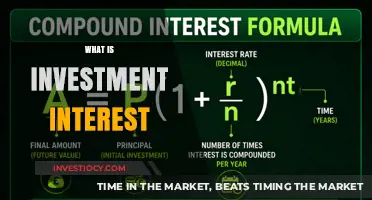
- Calculating Returns: Guidance on how to calculate compound interest returns using the formula A = P(1 + r/n)^(nt)
- Reinvestment Strategies: Discussion on the importance of reinvesting dividends and capital gains to maximize compound interest
- Long-Term vs. Short-Term: Comparison of compound interest effects over long-term versus short-term investment periods

Understanding Compound Interest: Explanation of how compound interest works and its benefits
Compound interest is a powerful financial concept that can significantly impact your savings and investments over time. It occurs when the interest earned on an investment is reinvested, allowing it to earn even more interest. This process creates a snowball effect, where your money grows exponentially rather than linearly.
To understand how compound interest works, let's consider an example. Suppose you invest $1,000 in a savings account with an annual interest rate of 5%. At the end of the first year, you would earn $50 in interest, bringing your total balance to $1,050. In the second year, you would earn interest not only on your initial investment but also on the $50 earned in the first year. This means you would earn $52.50 in interest in the second year ($1,050 x 5%), bringing your total balance to $1,102.50. As you can see, the interest earned in the second year is greater than the interest earned in the first year, even though the annual interest rate remained the same.
The benefits of compound interest are numerous. First, it allows your money to grow faster over time, which can help you achieve your financial goals more quickly. Second, it can help you build wealth even with relatively small initial investments. Third, compound interest can provide a hedge against inflation, as your money grows at a rate that is typically higher than the rate of inflation.
To take advantage of compound interest, it's important to start investing early and to reinvest your earnings. This means that you should avoid withdrawing your interest earnings and instead allow them to remain in your investment account. Additionally, you should consider investing in accounts that offer compound interest, such as savings accounts, certificates of deposit (CDs), and retirement accounts like 401(k)s and IRAs.
In conclusion, understanding compound interest is crucial for making informed investment decisions. By reinvesting your earnings and taking advantage of the snowball effect, you can watch your money grow exponentially over time, helping you achieve your financial goals and build long-term wealth.
Smart Investment Strategies for Rising Interest Rate Environments
You may want to see also
Explore related products


Types of Investments: Overview of investment options that offer compound interest, such as stocks, bonds, and mutual funds
Stocks are a popular investment option that offer the potential for compound interest. When you invest in stocks, you're essentially buying a small piece of ownership in a company. As the company grows and generates profits, the value of your stock can increase, and you may also receive dividends, which are distributions of the company's earnings. Reinvesting these dividends can lead to compound interest, as you earn returns on both your initial investment and the reinvested dividends.
Bonds are another investment option that can provide compound interest. Bonds are essentially loans that you make to a company or government entity. In exchange for your loan, you receive regular interest payments, which can be reinvested to earn additional returns. Bonds are generally considered to be less risky than stocks, but they also tend to offer lower returns.
Mutual funds are a type of investment that pools money from multiple investors to invest in a diversified portfolio of stocks, bonds, or other securities. Mutual funds can offer the potential for compound interest, as the returns from the underlying investments are reinvested back into the fund. This can lead to exponential growth over time, as the fund's value increases based on both the initial investment and the reinvested returns.
When considering investment options that offer compound interest, it's important to think about your risk tolerance, investment goals, and time horizon. Stocks tend to be more volatile and risky, but they also offer the potential for higher returns. Bonds are generally less risky, but they offer lower returns. Mutual funds can provide a balance between risk and return, but it's important to choose a fund that aligns with your investment objectives.
To maximize the benefits of compound interest, it's crucial to start investing early and to reinvest your returns consistently. Even small, regular investments can grow significantly over time, thanks to the power of compounding. Additionally, it's important to diversify your portfolio to minimize risk and to take advantage of different investment opportunities.
In conclusion, stocks, bonds, and mutual funds are all investment options that can offer compound interest. Each option has its own unique characteristics, risks, and potential returns. By understanding the differences between these investment options and by developing a well-diversified portfolio, you can harness the power of compound interest to grow your wealth over time.
Unlocking Financial Growth: The Power of Compound Interest in Investment
You may want to see also
Explore related products


Calculating Returns: Guidance on how to calculate compound interest returns using the formula A = P(1 + r/n)^(nt)
To calculate compound interest returns, you can use the formula A = P(1 + r/n)^(nt). This formula is essential for determining the future value of an investment that earns compound interest. Let's break down each component of the formula to understand how it works.
- A represents the amount of money accumulated after n compounding periods.
- P is the principal amount, which is the initial amount of money invested.
- R is the annual interest rate (decimal form), which is the rate at which the investment grows each year.
- N is the number of times that interest is compounded per year.
- T is the time the money is invested for, in years.
For example, let's say you invest $1,000 (P) at an annual interest rate of 5% (r = 0.05) for 3 years (t = 3). The interest is compounded quarterly (n = 4). Using the formula, you can calculate the future value of your investment:
A = 1000(1 + 0.05/4)^(4*3)
A = 1000(1.0125)^12
A ≈ $1,196.27
This means that after 3 years, your investment would grow to approximately $1,196.27.
When evaluating investment options, it's crucial to consider the compounding effect, as it can significantly impact the growth of your investment over time. Compound interest can help your investment grow faster, as the interest earned in previous periods is reinvested and earns additional interest. This can lead to a snowball effect, where your investment grows exponentially over time.
In conclusion, understanding how to calculate compound interest returns using the formula A = P(1 + r/n)^(nt) is essential for making informed investment decisions. By considering the compounding effect, you can better evaluate investment options and choose the one that best aligns with your financial goals.
Navigating Investments: Strategies for a Falling Interest Rate Environment
You may want to see also
Explore related products


Reinvestment Strategies: Discussion on the importance of reinvesting dividends and capital gains to maximize compound interest
Reinvesting dividends and capital gains is a cornerstone strategy for maximizing compound interest in investment portfolios. Compound interest occurs when the interest earned on an investment is reinvested to buy more of the same investment, thereby generating additional interest on the accumulated amount. Over time, this can lead to exponential growth in the investment's value.
One of the most effective ways to harness the power of compound interest is through the reinvestment of dividends. When an investor owns dividend-paying stocks, they receive regular distributions of the company's profits. By reinvesting these dividends back into the stock, the investor can purchase more shares, which in turn can generate more dividends. This creates a virtuous cycle of growth, as the increased number of shares leads to higher dividend income, which can then be reinvested to buy even more shares.
Similarly, reinvesting capital gains can also boost compound interest. Capital gains are the profits realized when an investment is sold for more than its original purchase price. By reinvesting these gains back into the market, investors can compound their returns over time. For example, if an investor sells a stock for a $1,000 gain and reinvests that money into another stock that appreciates by 10%, they will have earned an additional $100 in capital gains. If this process is repeated, the investor can significantly increase their overall returns.
However, it's important to note that reinvestment strategies are not without risks. Market volatility can lead to fluctuations in the value of investments, and there is always the possibility of losing money. Additionally, reinvesting dividends and capital gains can increase an investor's exposure to a particular asset class, which may not be appropriate for all risk tolerances.
To mitigate these risks, investors should carefully consider their investment goals, risk tolerance, and time horizon before implementing a reinvestment strategy. Diversification across different asset classes and regular portfolio rebalancing can also help to manage risk and ensure that the reinvestment strategy remains aligned with the investor's overall financial objectives.
In conclusion, reinvesting dividends and capital gains is a powerful tool for maximizing compound interest and growing investment portfolios over time. By understanding the mechanics of compound interest and implementing a thoughtful reinvestment strategy, investors can potentially achieve significant long-term returns.
Unlocking Wealth: The Power of Compound Interest in Investing
You may want to see also
Explore related products

Long-Term vs. Short-Term: Comparison of compound interest effects over long-term versus short-term investment periods
Compound interest is a powerful force in finance, and understanding its effects over different investment periods is crucial for making informed decisions. When comparing long-term versus short-term investments, the impact of compound interest becomes particularly pronounced.
In the short term, compound interest may not seem significant. For instance, if you invest $1,000 at an annual interest rate of 5% for one year, you'll earn $50 in interest, resulting in a total of $1,050. However, over a longer period, such as 10 years, the effects of compound interest are dramatic. Using the same $1,000 investment at a 5% annual rate, you would earn approximately $628.89 in interest, bringing your total to $1,628.89. This substantial difference illustrates the exponential growth potential of compound interest over time.
One key advantage of long-term investments is the ability to ride out market fluctuations. Short-term investments are more susceptible to market volatility, which can lead to losses if you need to withdraw your funds during a downturn. In contrast, long-term investments allow you to weather these storms and potentially benefit from market recoveries.
Another important consideration is the impact of taxes on your returns. Short-term capital gains are typically taxed at a higher rate than long-term gains, which can significantly reduce your net returns. By investing for the long term, you can minimize the tax burden on your earnings, allowing your investments to grow more efficiently.
Ultimately, the choice between long-term and short-term investments depends on your financial goals, risk tolerance, and time horizon. If you're saving for retirement or a major purchase, long-term investments may be more appropriate. However, if you need quick access to your funds or are looking to capitalize on short-term market opportunities, short-term investments might be a better fit. Regardless of your choice, understanding the effects of compound interest is essential for maximizing your investment returns.
Unlocking Returns: A Guide to Investing in Argentina's Interest Rates
You may want to see also
Frequently asked questions
Compound interest is the interest calculated on the initial principal, which also includes all the accumulated interest from previous periods. It's like earning interest on top of interest, which can significantly increase the growth of your investment over time.
Many investment options offer compound interest, including savings accounts, certificates of deposit (CDs), bonds, mutual funds, exchange-traded funds (ETFs), and stocks. However, the frequency and rate of compounding can vary between different investments.
Compound interest can have a powerful effect on the growth of an investment. By reinvesting the interest earned, you can accelerate the growth of your principal amount. Over time, this can lead to a substantial increase in the value of your investment, especially if you maintain a consistent investment strategy.
The amount of compound interest earned is influenced by several factors, including the principal amount, the interest rate, the frequency of compounding, and the time horizon of the investment. Higher principal amounts, higher interest rates, more frequent compounding, and longer investment periods generally result in greater compound interest earnings.