Lester Freeman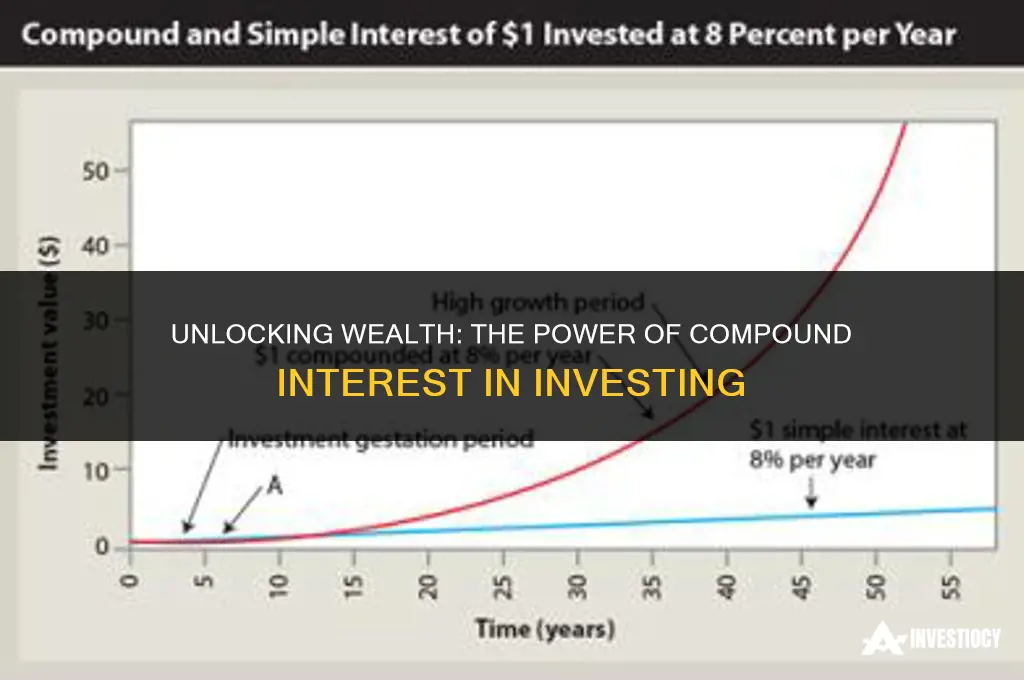
Investing using compound interest is a powerful strategy that can significantly grow your wealth over time. Compound interest occurs when the interest earned on an investment is reinvested, allowing it to earn even more interest. This creates a snowball effect, where your returns can increase exponentially as time goes on. To take advantage of compound interest, it's important to start investing early and consistently, even with small amounts. By doing so, you can harness the power of time and compounding to build substantial wealth. In this guide, we'll explore the key principles of investing with compound interest and provide practical tips to help you get started on your journey to financial growth.
Explore related products


What You'll Learn
- Understanding Compound Interest: Learn how interest accrues on both principal and accumulated interest over time
- Choosing the Right Investment: Select investments that offer compound interest, such as savings accounts, bonds, or mutual funds
- Reinvesting Dividends: Automatically reinvest dividends to maximize the compounding effect and grow your investment faster
- Setting Investment Goals: Define clear, achievable goals to guide your investment strategy and measure progress
- Monitoring and Adjusting: Regularly review your investments, adjusting as necessary to stay on track and optimize returns

Understanding Compound Interest: Learn how interest accrues on both principal and accumulated interest over time
Compound interest is a powerful force in the world of finance, allowing investors to grow their wealth exponentially over time. Unlike simple interest, which is calculated only on the initial principal amount, compound interest accrues on both the principal and any accumulated interest. This means that as time goes on, the interest earned in previous periods becomes the foundation for even more interest in the future, creating a snowball effect that can significantly boost investment returns.
To illustrate this concept, consider the following example: Suppose you invest $1,000 in a savings account that offers an annual interest rate of 5%, compounded quarterly. After one year, you would earn $50 in interest, bringing your total balance to $1,050. In the second year, you would earn interest not only on the original $1,000 but also on the $50 in accumulated interest from the first year. This would result in an interest payment of $52.50 for the second year, bringing your total balance to $1,102.50. As you can see, the interest earned in the second year is greater than in the first year, even though the annual interest rate remained the same.
The key to harnessing the power of compound interest is to start investing early and to reinvest any dividends or interest payments back into the investment. This allows the snowball effect to gain momentum and can lead to substantial growth in your investment portfolio over time. For example, if you had invested $1,000 in a stock market index fund with an average annual return of 8% when you were 25 years old and continued to invest $100 per month, you would have accumulated over $1 million by the time you reached age 65, assuming no withdrawals and consistent returns.
However, it's important to note that compound interest can also work against you if you're not careful. For instance, if you have high-interest debt, such as credit card debt, the compound interest can cause the amount you owe to grow rapidly, making it difficult to pay off. Therefore, it's crucial to manage debt responsibly and prioritize paying off high-interest obligations before investing.
In conclusion, understanding compound interest is essential for anyone looking to grow their wealth over time. By reinvesting earnings and starting early, investors can take advantage of this powerful financial force to achieve their long-term financial goals. However, it's also important to be mindful of the potential downsides of compound interest, such as the rapid growth of debt, and to manage finances responsibly.
Understanding Investment Interest Expense: A Guide for Savvy Investors
You may want to see also
Explore related products





Choosing the Right Investment: Select investments that offer compound interest, such as savings accounts, bonds, or mutual funds
To maximize the benefits of compound interest, it's crucial to select the right type of investment. Savings accounts are a popular choice due to their low risk and high liquidity. They are ideal for short-term goals or emergency funds, as you can access your money quickly without incurring significant penalties. However, they typically offer lower interest rates compared to other investment options.
Bonds, on the other hand, provide a higher potential return while still maintaining a relatively low risk profile. They are debt securities issued by governments or corporations, and when you invest in a bond, you are essentially lending money to the issuer. Bonds are suitable for investors with a medium-term horizon and those seeking regular income through interest payments.
Mutual funds offer the highest potential returns among the three options, but they also come with higher risks. These funds pool money from multiple investors to purchase a diversified portfolio of stocks, bonds, or other securities. Mutual funds are managed by professional fund managers, which can be an advantage for investors who lack the time or expertise to manage their own portfolios. However, they often require a longer investment horizon and can be more volatile than savings accounts or bonds.
When choosing an investment, consider your financial goals, risk tolerance, and investment horizon. If you're saving for a short-term goal or need quick access to your funds, a savings account may be the best choice. For medium-term goals and a slightly higher return, bonds could be a suitable option. If you're looking for long-term growth and are comfortable with higher risks, mutual funds may be the way to go.
Remember, diversification is key to a successful investment strategy. Consider spreading your investments across different asset classes to minimize risk and maximize returns. Additionally, be mindful of fees and expenses associated with each investment option, as they can significantly impact your overall returns over time.
In conclusion, selecting the right investment that offers compound interest is essential for achieving your financial goals. By understanding the characteristics and risks of savings accounts, bonds, and mutual funds, you can make an informed decision that aligns with your investment objectives and risk tolerance.
Unlocking Tax Benefits: The Deductibility of Investment Interest Expense
You may want to see also
Explore related products


Reinvesting Dividends: Automatically reinvest dividends to maximize the compounding effect and grow your investment faster
To maximize the compounding effect and accelerate the growth of your investment, it's crucial to reinvest dividends automatically. This strategy allows you to take advantage of the interest earned on both the principal amount and the accumulated dividends, leading to exponential growth over time.
One effective approach is to set up a dividend reinvestment plan (DRIP) with your brokerage firm. A DRIP enables you to automatically reinvest dividends into additional shares of the same stock or mutual fund, without incurring transaction fees. This not only saves you money on commissions but also ensures that your dividends are put to work immediately, earning more interest and generating additional dividends.
For instance, let's consider an investment of $10,000 in a stock with a 3% annual dividend yield. If you reinvest the dividends annually, after 10 years, your investment would grow to approximately $13,439. However, if you had set up a DRIP and reinvested the dividends quarterly, your investment would reach around $14,162 over the same period. This difference may seem small, but it can add up significantly over longer investment horizons.
When setting up a DRIP, it's essential to monitor the performance of your investments and adjust your strategy as needed. For example, if a stock's dividend yield decreases or its price becomes overvalued, you may want to consider switching to a different investment with more favorable conditions. Additionally, be aware of any fees associated with DRIPs, as some brokerage firms may charge a small fee for this service.
In conclusion, reinvesting dividends automatically through a DRIP can be a powerful tool for maximizing the compounding effect and growing your investment faster. By putting your dividends to work immediately and avoiding transaction fees, you can take advantage of the exponential growth potential of compound interest and achieve your financial goals more quickly.
Smart Investment Strategies for Rising Interest Rate Environments
You may want to see also
Explore related products



Setting Investment Goals: Define clear, achievable goals to guide your investment strategy and measure progress
Setting investment goals is a crucial step in harnessing the power of compound interest. Without clear objectives, it’s challenging to create a focused investment strategy or measure progress accurately. To begin, consider what you want to achieve through investing. Are you saving for retirement, a down payment on a house, or perhaps funding your child’s education? Each goal will have a different time horizon and risk tolerance, which will influence your investment choices.
Once you’ve identified your goals, it’s essential to make them SMART: Specific, Measurable, Achievable, Relevant, and Time-bound. For instance, instead of a vague goal like “save for retirement,” aim for a specific target such as “accumulate $1 million in my retirement account by age 65.” This clarity will help you stay motivated and on track.
Next, prioritize your goals. If you have multiple objectives, allocate your resources accordingly. Consider using a goal-setting framework like the Eisenhower Matrix to categorize your goals based on their urgency and importance. This will ensure that you’re focusing on the most critical objectives first.
Regularly reviewing and adjusting your goals is also vital. As your financial situation changes, your investment strategy may need to adapt. For example, if you receive a significant bonus or inheritance, you might want to reallocate some funds to accelerate your progress towards a particular goal. Conversely, if you experience a financial setback, you may need to adjust your timeline or contribution amounts.
Finally, remember that setting investment goals is not a one-time task. It’s an ongoing process that requires regular monitoring and evaluation. By staying committed to your objectives and adjusting your strategy as needed, you can effectively leverage compound interest to achieve your financial aspirations.
Unlocking Financial Growth: The Power of Compound Interest in Investment
You may want to see also
Explore related products






Monitoring and Adjusting: Regularly review your investments, adjusting as necessary to stay on track and optimize returns
Regularly reviewing and adjusting your investments is crucial to harnessing the power of compound interest effectively. This proactive approach ensures that your financial goals remain on track and that your returns are optimized over time. Monitoring your investments allows you to identify any underperforming assets, adjust your portfolio to maintain the desired risk level, and capitalize on new opportunities that may arise in the market.
To stay on track, it's essential to set clear financial goals and regularly assess your progress toward achieving them. This involves reviewing your investment performance, rebalancing your portfolio as needed, and making adjustments to your asset allocation. By doing so, you can ensure that your investments align with your risk tolerance and financial objectives, while also taking advantage of the compounding effect.
One effective strategy for monitoring and adjusting your investments is to conduct regular portfolio reviews. These reviews should include an analysis of your investment performance, a comparison with your benchmark or target returns, and an evaluation of your risk exposure. Based on this assessment, you can make informed decisions about whether to rebalance your portfolio, adjust your asset allocation, or explore new investment opportunities.
Another important aspect of monitoring and adjusting your investments is staying informed about market trends and economic conditions. This involves keeping up-to-date with financial news, market analysis, and economic indicators that may impact your investments. By staying informed, you can anticipate potential market shifts and make timely adjustments to your portfolio to mitigate risks and capitalize on opportunities.
In addition to regular portfolio reviews and staying informed, it's also important to consider the impact of fees and taxes on your investment returns. High fees can erode your returns over time, while taxes can significantly impact your net gains. By monitoring and adjusting your investments with an eye toward minimizing fees and optimizing tax efficiency, you can maximize your overall returns and achieve your financial goals more effectively.
In conclusion, monitoring and adjusting your investments is a critical component of successful investing with compound interest. By regularly reviewing your portfolio, staying informed about market trends, and making informed adjustments, you can optimize your returns, manage risk, and achieve your financial objectives.
Understanding Investment Interest: A Beginner's Guide to Financial Growth
You may want to see also
Frequently asked questions
Compound interest is the interest earned on both the principal amount and the accumulated interest of a deposit or loan. It's calculated by adding the interest to the principal, then earning interest on the new total. This process repeats over time, causing the amount to grow exponentially.
To take advantage of compound interest when investing, start by putting your money into an account or investment that earns a high rate of return. Then, leave the money in the account for as long as possible to allow the interest to compound. The earlier you start investing and the more frequently the interest compounds, the more your money will grow over time.
Some common investment options that utilize compound interest include savings accounts, certificates of deposit (CDs), bonds, and stocks. Each of these options has its own level of risk and potential for growth, but they all allow your money to earn interest and compound over time.