Faith Morrow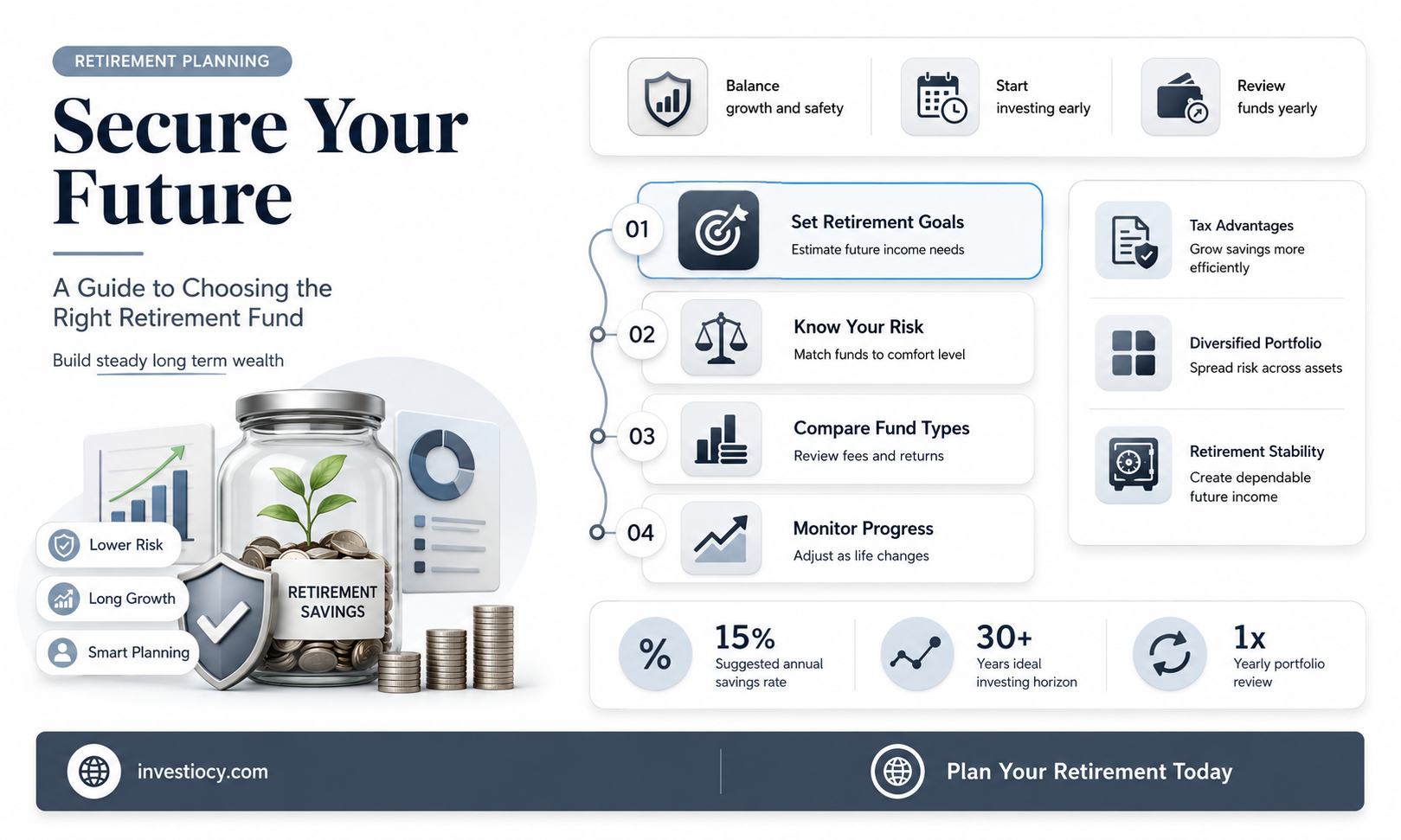
When considering retirement funds, it's essential to understand the different options available and how they align with your financial goals and risk tolerance. Retirement funds typically include 401(k)s, IRAs, Roth IRAs, and annuities, each with its own set of benefits and drawbacks. A 401(k) is a popular choice due to its employer matching contributions, while IRAs offer more flexibility in investment choices. Roth IRAs are funded with after-tax dollars, providing tax-free growth and withdrawals in retirement. Annuities can offer a guaranteed income stream but often come with higher fees and less liquidity. It's crucial to evaluate your current financial situation, projected retirement needs, and investment horizon to determine the most suitable retirement fund for your future.
| Characteristics | Values |
|---|---|
| Fund Type | There are several types of retirement funds including 401(k), IRA, Roth IRA, SEP IRA, and Solo 401(k). Each has its own contribution limits, tax advantages, and withdrawal rules. |
| Contribution Limits | For 2023, the contribution limit for a 401(k) is $22,500, while for an IRA it's $6,500. Roth IRAs have the same limit as traditional IRAs. SEP IRAs allow contributions up to 25% of your net earnings, up to $66,000 in 2023. Solo 401(k)s have a contribution limit of $22,500, plus an additional $6,500 catch-up contribution if you're 50 or older. |
| Tax Advantages | Contributions to traditional 401(k)s and IRAs are tax-deductible, reducing your taxable income for the year. Roth IRAs are funded with after-tax dollars, but qualified withdrawals are tax-free. SEP IRAs offer tax deductions for contributions, similar to traditional IRAs. Solo 401(k)s also offer tax-deductible contributions. |
| Withdrawal Rules | For 401(k)s and traditional IRAs, withdrawals are generally allowed starting at age 59½, with a 10% penalty for early withdrawals. Roth IRAs allow tax-free withdrawals of contributions at any time, and tax-free withdrawals of earnings after age 59½ if the account has been open for at least 5 years. SEP IRAs have similar withdrawal rules to traditional IRAs. Solo 401(k)s also follow the same withdrawal rules as traditional 401(k)s. |
| Investment Options | 401(k)s typically offer a range of investment options, including stocks, bonds, mutual funds, and ETFs. IRAs and Roth IRAs offer a wide range of investments, including individual stocks, bonds, mutual funds, ETFs, and CDs. SEP IRAs and Solo 401(k)s also offer diverse investment options. |
| Fees | Fees can vary widely among different retirement funds. 401(k)s often have administrative fees, investment fees, and possibly surrender charges. IRAs may have setup fees, annual fees, and investment fees. Roth IRAs and SEP IRAs typically have similar fees to traditional IRAs. Solo 401(k)s may have higher fees due to their complexity. |
| Employer Matching | Many employers offer matching contributions to 401(k) plans, typically up to a certain percentage of your salary. This is essentially free money that can significantly boost your retirement savings. IRAs, Roth IRAs, SEP IRAs, and Solo 401(k)s do not offer employer matching. |
| Portability | 401(k)s are generally not portable; if you leave your job, you may need to roll over your 401(k) into an IRA or another 401(k). IRAs, Roth IRAs, SEP IRAs, and Solo 401(k)s are more portable, allowing you to move your funds between different financial institutions or investment options. |
| Required Minimum Distributions (RMDs) | Traditional 401(k)s and IRAs require you to take RMDs starting at age 73 (as of 2023). Roth IRAs do not require RMDs during the account owner's lifetime. SEP IRAs and Solo 401(k)s have RMD requirements similar to traditional IRAs. |
| Estate Planning | Retirement funds can be an important part of your estate planning strategy. Beneficiaries can be named for all types of retirement accounts, allowing you to designate who will inherit your funds after your death. |
| Risk Tolerance | Your risk tolerance and investment goals should guide your choice of retirement fund. If you're more risk-averse, you may prefer a fund with more conservative investment options. If you're willing to take on more risk for potentially higher returns, you may prefer a fund with a broader range of investment options. |
| Time Horizon | Your time horizon until retirement should also influence your choice of fund. If you have many years until retirement, you may prefer a fund with more aggressive investment options. If you're closer to retirement, you may prefer a fund with more conservative options to protect your savings. |
Explore related products


What You'll Learn
- Types of Retirement Accounts: Explore 401(k), IRA, Roth IRA, and other account options
- Investment Options: Consider stocks, bonds, mutual funds, ETFs, and real estate
- Risk Tolerance: Assess your comfort with market fluctuations and potential losses
- Fees and Expenses: Understand management fees, transaction costs, and other expenses
- Tax Implications: Learn about tax-deferred growth, withdrawals, and potential penalties

Types of Retirement Accounts: Explore 401(k), IRA, Roth IRA, and other account options
Navigating the landscape of retirement accounts can be complex, but understanding the distinct features of each type is crucial for making informed investment decisions. A 401(k) plan, often provided by employers, allows workers to save and invest a piece of their paycheck before taxes are taken out. This can significantly reduce taxable income and provide a substantial nest egg over time. However, the funds are typically tied up until retirement, and early withdrawals can incur hefty penalties.
Individual Retirement Accounts (IRAs) offer another avenue for retirement savings. Traditional IRAs allow contributions to be made with pre-tax dollars, similar to a 401(k), but they are not tied to employment. This flexibility makes IRAs a popular choice for those who are self-employed or wish to supplement their employer-sponsored retirement plan. Roth IRAs, on the other hand, are funded with after-tax dollars, which means the money grows tax-free and qualified withdrawals in retirement are tax-free as well. This can be a significant advantage for those who expect to be in a higher tax bracket in retirement.
Other retirement account options include annuities, which provide a steady income stream in retirement, and health savings accounts (HSAs), which are designed to cover medical expenses but can also serve as a retirement savings tool. When deciding which retirement fund to invest in, it's important to consider factors such as contribution limits, tax implications, investment options, and withdrawal rules. Consulting with a financial advisor can help tailor a retirement plan to individual needs and goals.
Unlocking Impact: Private Equity's New Frontier in Sustainable Investments
You may want to see also
Explore related products


Investment Options: Consider stocks, bonds, mutual funds, ETFs, and real estate
When evaluating investment options for your retirement fund, it's crucial to understand the unique characteristics and potential benefits of each asset class. Stocks, for instance, offer the potential for high returns but come with higher risk due to market volatility. Bonds, on the other hand, provide a more stable income stream but typically yield lower returns. Mutual funds and ETFs allow for diversification across various asset classes, reducing risk while still offering growth potential. Real estate investments can provide a tangible asset with rental income and long-term appreciation, but they also require more active management and can be illiquid.
To make informed decisions, consider your risk tolerance, investment horizon, and financial goals. If you're younger and have a longer time to retire, you may want to allocate a larger portion of your portfolio to stocks for growth potential. As you approach retirement age, shifting towards bonds and other fixed-income investments can help preserve your capital. Mutual funds and ETFs can be a good choice for those who want to diversify their investments without having to select individual stocks or bonds. Real estate can be a solid addition to a retirement portfolio, especially for those who are comfortable with property management and have a long-term outlook.
It's also important to consider the tax implications of your investment choices. Stocks and mutual funds held in taxable accounts can generate capital gains taxes, while bonds may be subject to income tax. ETFs can be more tax-efficient than mutual funds due to their structure. Real estate investments can offer tax benefits through depreciation and other deductions, but they also come with their own set of tax complexities.
When building your retirement portfolio, it's essential to diversify across different asset classes to manage risk and maximize returns. Consider working with a financial advisor to create a personalized investment strategy that aligns with your specific needs and goals. Regularly reviewing and rebalancing your portfolio can help ensure that your investments remain aligned with your changing circumstances and market conditions.
In summary, choosing the right investment options for your retirement fund requires careful consideration of your risk tolerance, investment horizon, financial goals, and tax implications. By diversifying across stocks, bonds, mutual funds, ETFs, and real estate, and seeking professional advice when needed, you can create a well-rounded portfolio that helps you achieve a secure and comfortable retirement.
Exploring Dimensional Fund Investing: A Comprehensive Product Overview
You may want to see also
Explore related products


Risk Tolerance: Assess your comfort with market fluctuations and potential losses
Understanding your risk tolerance is crucial when selecting a retirement fund, as it directly impacts your ability to weather market storms and achieve your long-term financial goals. Risk tolerance refers to your emotional and psychological ability to withstand fluctuations in the market and potential losses in your investment portfolio. It's a deeply personal aspect of investing, influenced by factors such as your age, financial situation, investment experience, and overall attitude towards risk.
To assess your risk tolerance, consider how you would react to a significant drop in the stock market. Would you be able to stay the course and continue investing, or would you be tempted to pull your money out to avoid further losses? Your answer to this question can help you determine whether you are a high-risk, moderate-risk, or low-risk investor. High-risk investors are typically younger, have a longer investment horizon, and are more comfortable with market volatility. They are willing to take on more risk in pursuit of higher returns. Moderate-risk investors, on the other hand, are more cautious and prefer a balanced approach that combines both stocks and bonds. Low-risk investors are generally older, have a shorter investment horizon, and prioritize capital preservation over growth. They tend to favor investments with lower volatility, such as bonds and cash equivalents.
Once you have assessed your risk tolerance, you can begin to explore different retirement fund options that align with your risk profile. For high-risk investors, a portfolio heavily weighted in stocks may be appropriate, as it offers the potential for higher returns over the long term. However, this approach also comes with greater volatility and the risk of significant losses. Moderate-risk investors may benefit from a diversified portfolio that includes a mix of stocks, bonds, and other asset classes. This approach can help to mitigate risk while still providing the opportunity for growth. Low-risk investors, on the other hand, may want to focus on investments with lower volatility, such as high-quality bonds, money market funds, or certificates of deposit (CDs). While these investments may offer lower returns, they can provide greater stability and peace of mind.
It's important to note that your risk tolerance is not set in stone and can evolve over time as your financial situation and goals change. As you approach retirement, you may find that your risk tolerance decreases, and you become more focused on preserving your capital. Conversely, if you experience a windfall or come into a large sum of money, you may feel more comfortable taking on additional risk. Regularly reassessing your risk tolerance and adjusting your investment strategy accordingly can help you stay on track and achieve your retirement goals.
In conclusion, understanding your risk tolerance is a critical component of selecting the right retirement fund for your needs. By taking the time to assess your comfort with market fluctuations and potential losses, you can make informed investment decisions that align with your long-term financial goals and help you navigate the complexities of the retirement planning process.
Smart Investing: Mutual Funds and Your Savings Allocation
You may want to see also
Explore related products


Fees and Expenses: Understand management fees, transaction costs, and other expenses
Understanding the fee structure of retirement funds is crucial for making informed investment decisions. Management fees, transaction costs, and other expenses can significantly impact the overall performance of your retirement savings. Here's a breakdown of what you need to know:
Management fees are charged by the investment company to cover the costs of managing the fund. These fees can vary widely depending on the type of fund and the investment strategy employed. For example, actively managed funds typically have higher management fees than passively managed index funds. It's important to note that management fees are usually deducted from the fund's assets, which means they can compound over time and eat into your returns.
Transaction costs are fees charged when you buy or sell shares in a fund. These costs can include commissions, bid-ask spreads, and other trading expenses. While transaction costs may seem small, they can add up over time, especially if you're frequently buying and selling shares. Some funds also impose a surrender charge for selling shares within a certain time frame, which can further increase your costs.
Other expenses associated with retirement funds include administrative fees, custody fees, and audit fees. These fees are typically charged to cover the costs of maintaining the fund's records, holding its assets, and ensuring compliance with regulatory requirements. While these fees are generally lower than management and transaction costs, they can still impact your overall returns.
To minimize the impact of fees and expenses on your retirement savings, it's important to choose funds with low cost structures. This may involve opting for passively managed index funds or exchange-traded funds (ETFs), which typically have lower management fees than actively managed funds. Additionally, consider funds with no transaction fees or low minimum investment requirements to reduce your overall costs.
When evaluating retirement funds, it's also important to consider the potential tax implications of fees and expenses. Some funds may be more tax-efficient than others, depending on their investment strategy and the types of assets they hold. For example, funds that invest in tax-exempt municipal bonds may be more tax-efficient than funds that invest in taxable corporate bonds.
In conclusion, understanding the fee structure of retirement funds is essential for making informed investment decisions. By carefully considering management fees, transaction costs, and other expenses, you can choose funds that will help you maximize your returns and minimize your costs over the long term.
Strategic Bond Fund Investment: Finding Your Ideal Allocation Percentage
You may want to see also
Explore related products


Tax Implications: Learn about tax-deferred growth, withdrawals, and potential penalties
Understanding the tax implications of your retirement fund is crucial for maximizing your savings and minimizing potential penalties. Tax-deferred growth allows your investments to grow without being taxed until you withdraw the funds, which can significantly increase your retirement savings over time. However, it's important to note that tax-deferred does not mean tax-free. When you withdraw the funds, they will be taxed at your current income tax rate.
Withdrawals from tax-deferred retirement accounts, such as 401(k)s and IRAs, are generally taxed as ordinary income. This means that the funds will be taxed at your marginal tax rate, which could be higher than the rate you were taxed at when you contributed the funds. Additionally, if you withdraw funds before age 59 1/2, you may be subject to a 10% early withdrawal penalty, on top of the income tax.
To avoid potential penalties and maximize your tax benefits, it's important to understand the rules and regulations surrounding tax-deferred retirement accounts. For example, you may be able to avoid the early withdrawal penalty if you use the funds for certain qualified expenses, such as medical bills or education costs. Additionally, you may be able to reduce your taxable income by contributing to a tax-deferred retirement account, which can lower your overall tax liability.
When considering which retirement fund to invest in, it's important to weigh the tax implications against other factors, such as investment options, fees, and contribution limits. For example, a Roth IRA offers tax-free growth and withdrawals, but has income limits for contributions. On the other hand, a traditional IRA offers tax-deferred growth, but has required minimum distributions starting at age 72, which can increase your taxable income.
In conclusion, understanding the tax implications of your retirement fund is essential for making informed investment decisions. By carefully considering the tax benefits and potential penalties of different retirement accounts, you can maximize your savings and minimize your tax liability, ultimately leading to a more secure financial future.
Smart Investing: Index Funds' Optimal Allocation in Your Portfolio
You may want to see also
Frequently asked questions
There are several types of retirement funds, including 401(k)s, IRAs (Individual Retirement Accounts), Roth IRAs, and annuities. Each has its own benefits and drawbacks, such as contribution limits, tax advantages, and withdrawal rules.
Choosing the right retirement fund depends on factors like your income, age, risk tolerance, and retirement goals. Consider consulting with a financial advisor to determine which fund aligns best with your financial situation and objectives.
When comparing retirement funds, consider factors such as fees and expenses, investment options, contribution limits, tax implications, and withdrawal penalties. Additionally, evaluate the fund's performance history and the level of control you have over your investments.